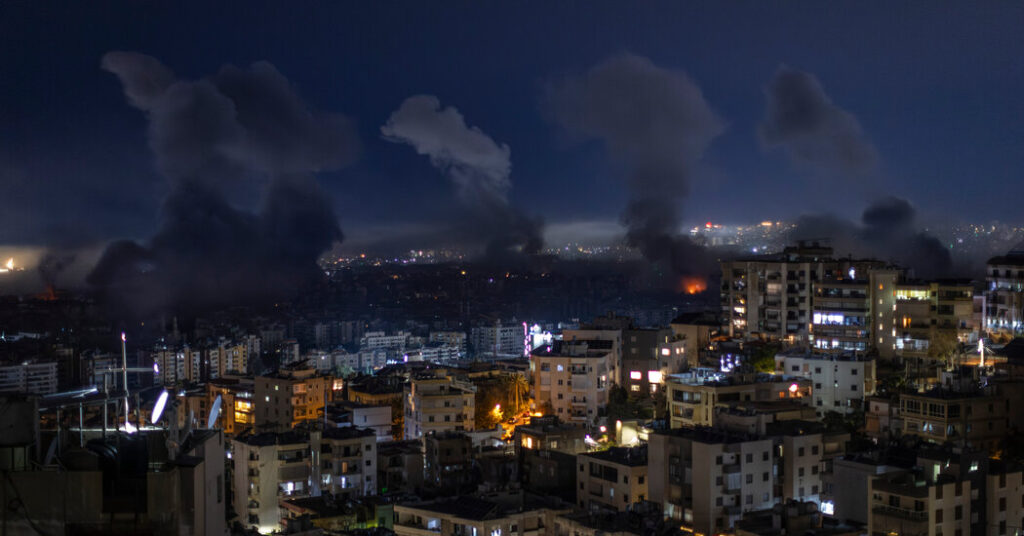
Across Beirut, the Lebanese capital, the signs and sounds of the war are everywhere.
There’s the deep thrum of warplanes and drones buzzing constantly overhead. The dull thuds of explosions rocking the densely packed southern edge of Beirut, where Hezbollah holds sway. The families who have found refuge on the city’s sidewalks, parking lots and beaches, after being ordered to leave their homes by Israel on the southern outskirts of Beirut.
And now, with airstrikes expanding beyond the limits of those southern suburbs, there is the growing suspicion that even the once-safest corners of the city may no longer be off-limits in the rapidly escalating war between Hezbollah and Israel.
That fear was crystallized on Thursday afternoon, when the Israeli military issued an evacuation order for central Beirut, the first such warning since the war began for an area within the city limits. Then, the Israeli military said it had begun carrying out a new wave of strikes in Beirut, targeting infrastructure belonging to Hezbollah.
The strike on central Beirut sent a thick plume of dust and smoke rising above the skyline of what is normally a quaint residential area filled with high-end bars and restaurants. It was the latest sign that the conflict was expanding.
Earlier on Thursday, Israeli airstrikes hit several cars along the seaside corniche in Beirut’s Ramlet al-Baida neighborhood, covering the sidewalk in bloodied sand and setting off panic in the neighborhood. The strike killed at least eight people and injured dozens more, most of them displaced people, according to hospital officials.
It was the second strike within the city limits in four days, after airstrikes on Monday struck the four-star Ramada Plaza Hotel farther down the seafront in central Beirut. Both strikes came without warning and stoked fears that, with the Israeli military determined to eliminate Hezbollah members wherever they are, nowhere was safe.
Hezbollah, an Iran-backed militant group, has been striking parts of Israel in solidarity with Hamas, another Iran proxy that led a deadly assault on southern Israel in October 2023.
“I don’t feel like there is a safe place for us to go anymore,” said Hussain Mansour, 32, standing by the site of the strikes in Ramlet al-Baida. “Where? Where should we go?”
Mr. Mansour fled his village, Majdal Salem, in southern Lebanon, last week after Israel issued sweeping evacuation orders for much of the south. He erected a makeshift tent on the sidewalk by the beach alongside hundreds of others who had been similarly displaced with the outbreak of the latest war.
Mr. Mansour sat awake much of Wednesday night with the roar of warplanes and the hum of drones overhead seemingly louder than before, he said. He worried that the noise was a sign of a coming barrage of airstrikes in the Dahiya, the densely packed southern outskirts of Beirut. Then, around 1:30 a.m., the strikes came.
After the first airstrike happened, displaced people went into chaos. Chaos seized his stretch of sidewalk, with other families who had sought refuge there grabbing whatever they had brought with them — blankets, tarps, plastic bags of clothes — and scrambled to leave the area.
“No one knew which road to take or where to flee to,” Mr. Mansour said. “If this could happen here, then we didn’t know where it would be safe.”
Mr. Mansour and his wife rushed into their car with their 9-year-old and 6-year-old sons, but were immediately stuck in traffic as the road packed with people trying to flee. Then, another Israeli airstrike hit the corniche, shaking their car. His wife and sons screamed.
Nour al-Lahhman, 40, was sitting in the grass on a nearby hillside when the Israeli airstrikes hit. “It felt like the world exploded,” she said.
Her legs began shaking, but she could not move, she said, too paralyzed with fear. After watching ambulances arrive and people try to flee on the street below for an hour, she moved into the makeshift tent she and her husband had erected a week earlier by draping thick gray blankets over tree branches and chairs.
Inside, her two sons, Omar, 5, and Yousef, 4, were still sleeping — the sound of airstrikes no longer enough of a shock to wake them up, she said. She tucked each one beneath her arm, hugged them close and told herself that, if they died in another strike, at least they would die together.
“All we want is to live in peace,” she said.
The hillside had emptied by late Thursday morning, with most people who had sought shelter there afraid to return. Gray circles of ash dotted the hillside, where displaced families had built fires to keep warm the night before.
On the street, the Lebanese authorities were cleaning up the aftermath of the strikes. The military had cordoned off the area to remove unexploded ordinance on the beach. Municipal workers swept bloodstained sand off the sidewalk along the waterfront. Police officers hauled away cars destroyed in the strikes. Bits of plastic from the vehicles’ bumpers and headlights sprawled across the beach nearby between empty water bottles and cigarette buds.
The growing reach of Israeli strikes has stoked fear and suspicion among the communities where the displaced had sought shelter. Most of the nearly 800,000 people who have been displaced are Shiite Muslims, many of them having sought refuge in areas dominated by other faiths and sects.
Now, much like the previous escalation of conflict between Hezbollah and Israel in 2024, there are growing fears that Israel seems determined to eliminate Hezbollah members wherever they are — and that they could be among the crowds of displaced.
That growing suspicion has prompted hotels to demand passports or identification cards for anyone visiting their guests in case Iranian diplomats or Hezbollah officials are among them. Apartment buildings across the city have done the same.
“We have to know the identity of every person coming into the building; we can’t have strangers here,” said Alaa Yasin, 51, a concierge at an upscale apartment building across the road from where the airstrike hit in Ramlet al-Baida.
“What if they try to assassinate someone who comes here?”
Euan Ward contributed reporting.
Christina Goldbaum is The Times’s bureau chief in Beirut, leading coverage of Lebanon and Syria.
The post ‘The World Exploded.’ Strikes Haunt Displaced Families in Lebanon. appeared first on New York Times.