PITTSBURGH — Newly elected Pittsburgh Mayor Corey O’Connor strolled into Big Jim’s — a dimly lit shot-and-a-beer bar that doubles as a neighborhood restaurant in an area called “the Run,” an Appalachian term for localities adjacent to a stream, places often driven over but not usually seen by the general public. This one, in the lower Greenfield neighborhood where O’Connor’s father — the late Pittsburgh Mayor Bob O’Connor — lived, is no different. Commuters leaving work in the city zoom home overhead on Interstate 376.
Large portions, good food and no-nonsense service have helped Big Jim’s stay popular. It opened in 1977, the year steel mills began their epic collapse.
Today, Pittsburgh faces a different kind of economic collapse. The last two Democratic mayors, Bill Peduto and Ed Gainey, neglected the basics and invested in projects with more flash such as Peduto’s pursuit of Amazon’s HQ2 and Gainey’s appearances at political rallies on national issues mayors have no jurisdiction over.
While the city appeared to flourish, the rot ate deep — exemplified most dramatically when on Jan. 28, 2022, the Fern Hollow Bridge collapsed, taking multiple vehicles and a bus with it. It was a miracle no one was killed. Lapses in bridge maintenance and oversight by the city were partly to blame.
Pittsburgh’s infrastructure had been neglected as well. The downtown corporate tax base eroded dramatically. Vacant storefronts, homeless camps and drug deals were a common sight.
“In all my years of living in and visiting Pittsburgh, I have never seen the Downtown look so bad. Empty, dirty, and unsafe,” wrote media consultant Larry Ceisler in an August 2023 letter to the editor of a local newspaper. “Personally, I experienced an attempted homicide in the lobby of my hotel on Forbes Avenue and was accosted twice walking to my office in Gateway Center.”
Pittsburgh’s decline is one reason O’Connor, a Democrat, was elected.
“The past six years in the city have been rough in back-to-back administrations, and no one felt the malaise more than the residents,” said Joe Sabino Mistick, a Duquesne law professor and longtime Democrat who has worked for several Pittsburgh mayors. “You can’t skip the delivery of basic services and that’s what’s happened lately with the past two mayors.”
O’Connor, who has a bachelor’s degree in education from Duquesne University, worked in former congressman Mike Doyle’s office. He later won his father’s former City Council seat, before becoming the Allegheny County controller.
O’Connor’s mayoral election is the latest in an apparent retreat of Pittsburgh Democrats from their progressive fringe. Matt Dugan, who was funded by George Soros, lost a heated Allegheny County district attorney race in 2023. In the same election, former Democratic Socialist Sara Innamorato narrowly won the Allegheny County executive race. Centrist Democrats usually win this position in a landslide. Innamorato immediately focused on the realpolitik of governing.
The move toward center-left with a campaign focused less on social justice tropes and more on fiscal issues shows why O’Connor won, said Mistick. “And it might be a lesson for the national party,” he added.
Nationally, Democrats continue to embrace progressives in many cities and counties. But in Pittsburgh, corporations and establishment institutions — often the targets of progressives — have stepped in to save the city from itself, repairing decay caused by a focus on social issues rather than the basics of local government: budgets, bridges and building essential services that undergird a resilient local economy.
On the day of my interview at Big Jim’s with O’Connor, the 41-year-old had been mayor for two weeks and already faced a crisis: A storm dumped over a foot of snow onto the city’s steep hills and narrow streets — and the mayor discovered nearly 40 percent of government plows were not working. City Controller Rachael Heisler issued a warning in November 2025 that years of underinvestment resulted in 58 percent of vehicles in the Public Works Streets division exceeding their planned life cycle.
Days of subzero temperatures followed, and if homeowners hadn’t immediately dug themselves out of their parking spots, they were trapped because the snow mounds created by plows that did work quickly turned to ice. The downtown business district was paralyzed for a week.
Suddenly, O’Connor was in the news accepting a $10 million donation from a powerhouse — the University of Pittsburgh Medical Center (UPMC) — to purchase ambulances, freeing him up in his budget to buy snowplows. It seemed the new mayor had a magic touch — he’ll need it.
On April 23, the nation’s eyes will be on Pittsburgh as it hosts the NFL draft, expected to draw between 500,000 and 700,000 people. It would make it the largest visitor event in the city’s history.
The new mayor has an opportunity to showcase Pittsburgh’s charm, grit, hospitality and affordability, which consistently have put it on the list of top cities in America to live.
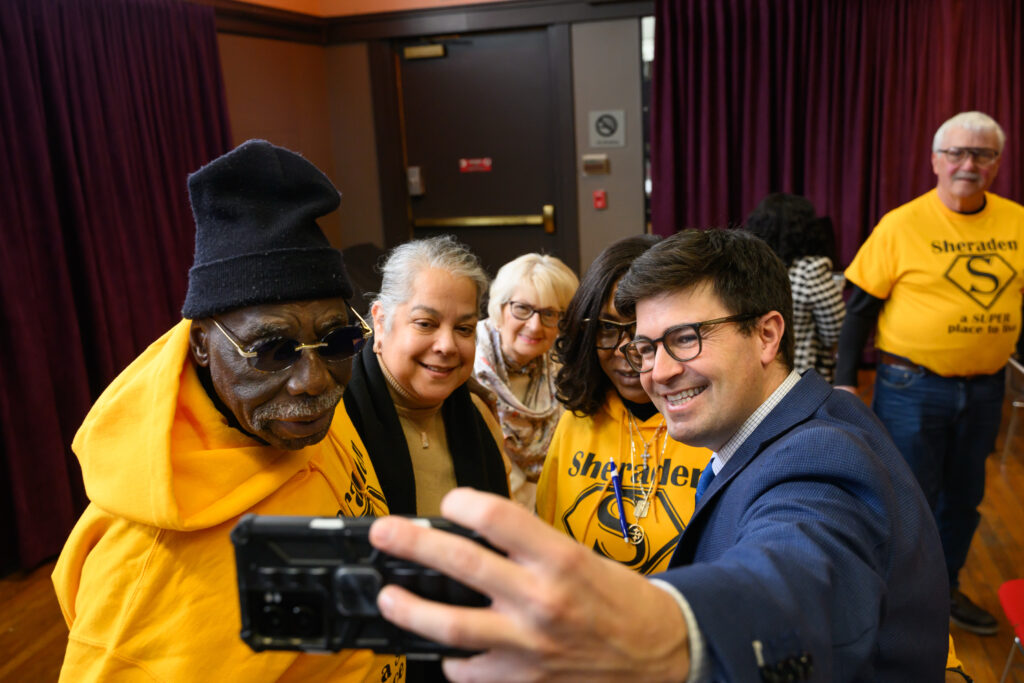
Despite the hurdles he faces, O’Connor is cheerful, always nodding his head and smiling, whether he is on local TV news or out in the community. At Big Jim’s, handshakes, backslaps and hugs greeted him as he made his way to a table in the back. Well-wishers such as Mitzi and Merle Levin, husband and wife, either found their way to the table to tell O’Connor they were rooting for him or shouted it out across the bar. Mitzi offered her help and her business card. “Call me any time for advice,” she said.
The optimism surrounding O’Connor does not surprise Mistick, who has known every mayor going back to the legendary David L. Lawrence, who partnered with business leaders and philanthropists for years to clean up the dirt and soot of the then-industrial hub.
Both of O’Connor’s predecessors focused more on ideology than governing, both struggling with their far-left flank. Democrats have long outnumbered Republicans in Pittsburgh but only in the last 10 years has the electorate banked hard to the left, elevating Democratic Socialists, sending progressive firebrand Summer Lee to Congress, making it the most progressive area in Pennsylvania.
Peduto, toward the end of his second term as mayor, seemed paralyzed by pressure from the newly powerful left; Gainey, in his only term, surrounded himself with the social justice set. Both were often absent from the public eye as the city began its first steep decline in decades.
Mistick said mayors who deliver basic municipal services are shown grace by constituents to pursue broader policy goals. But if you don’t deliver the basics, Mistick said, “Then people resent the fact that you’ve sort of blown past their needs and you focused on your particular needs as a government leader rather than theirs.”
O’Connor has wisely made a splash by picking up trash with public works employees and getting the region ready for the NFL draft. A walk through the downtown core is still bleak but less so than a year ago. The homelessness problem is less dominant; the same is true for drug activity.
O’Connor wants to entice businesses to occupy vacant storefronts during draft week. “We are offering art studios, or a pop-up brewery or restaurant to fill those spaces. It is like a pop-up incubator,” he said.
O’Connor said he calls 10 to 20 companies a week to thank them for investing in the city, to lure them to open here or to encourage them to go from 20 employees to 200. The area is experiencing an artificial intelligence boom, the result of start-up incubators emerging from universities, a strong working class labor force to build and maintain data centers, and easy access to energy to power them.
Chief executives of the biggest local organizations — Highmark Health, PNC Financial Services, U.S. Steel, UPMC and the Pittsburgh Steelers — have told me they are cautiously optimistic that O’Connor can be the new blood Pittsburgh needs to manage this transition.
By the turn of the 20th century, Pittsburgh was the center of significant industrial wealth and growth thanks to manufacturing, steel and oil. But in the late 1960s fissures in the steel industry surfaced. The city’s population decreased from about 677,000 in 1950 to 308,000 in 2024.
In the late 1980s, as the industrial center suffered, politicians partnered with CEOs, foundations, nonprofits and universities to guide Pittsburgh from high unemployment and rudderless leadership to diversifying its economy with a focus on colleges and health care.
It took a few decades, but by 2014 the University of Pittsburgh and Carnegie Mellon University began drawing researchers, tech start-ups and young professionals. The energy workforce was just getting started. UPMC became the state’s largest private employer with a workforce of about 45,000 in Pittsburgh.
The economic impact of covid-19 restrictions and the subsequent protests after the death of George Floyd seemingly changed the landscape of the city’s core overnight. Downtown’s office vacancy rate hit 19.6 percent in 2024. It was 7.8 percent in 2015. Meanwhile, vagrancy and homelessness escalated.
Gov. Josh Shapiro (D) said he developed an affection for Pittsburgh the more he began visiting when he was the state attorney general in 2017. After he was sworn in as governor in 2023, city leaders asked him for a few million dollars in grant money, but their proposal needed work.
“I grew kind of frustrated and said, ‘No, we’re not going to do a few million dollars in a grant. We need to put together a fund of hundreds of millions of dollars to really reinvest in the Golden Triangle and give a rebirth to downtown Pittsburgh,’” he said.
Shapiro, corporate leaders and union officials met regularly and eventually used state money as leverage to raise private capital to create a fund of nearly $600 million.
David Holmberg, chief executive of Highmark Health, said many meetings happened over eggs and pancakes at Kelly-O’s Diner in the Strip District neighborhood.
“The end result became a blueprint for a revitalization plan and infusion of $600 million in state and local funding, along with private investing,” Holmberg said of the announcement that came in October 2024.
The plan focuses on beautifying popular downtown areas such as Market Square and Point State Park, and developing a four-acre stretch of 8th Street in the Cultural District. Additionally, the goal is to spur initiatives to address public safety, business recruitment, drug addiction and mental illness, Shapiro said.
The announcement came on the heels of the NFL selecting Pittsburgh for the draft. Steelers president and majority owner Art Rooney II pitched the idea for the draft to PNC Financial Services chief executive William Demchak, who gave the first donation and then marshaled the business community to do the same. The draft soon had local leaders working together on how to reverse the city’s fortunes.
By October 2024, the worst kept secret in Pittsburgh was that O’Connor was going to challenge Gainey. By December 2024 it became official, and by May 2025 he won the primary against Gainey and effectively became the mayor-elect.
In January, O’Connor was struggling with a municipality in financial trouble caused by declining tax revenue and depleted federal covid-19 relief funds. It was evident that government basics had long been ignored when O’Connor learned about the lack of functioning snowplows.
UPMC had long been in a tug of war with Gainey over his demands that the health care giant allow the Service Employees International Union to unionize there. Nevertheless, UPMC handed O’Connor that $10 million check. UPMC chief executive Leslie Davis said the organization saw the urgent need to replace aging vehicles and equipment.
Sitting in a suite at Acrisure Stadium overlooking the field, 36-year-old Dan Rooney — the son of Art Rooney II — is even younger than the mayor.
Dan Rooney, who serves as vice president of business development and strategy for the team, has a humility and outsize personality reminiscent of his great-grandfather. Art Rooney, known as “The Chief,” owned the franchise and named the team “The Steelers” to reflect the area’s steel-producing legacy.
“We’re just really excited about the impact [the draft is] going to have on this community,” Dan Rooney said. “It means the world to the Steelers and everyone that has collaborated around the event to get us this far.”
How Pittsburgh manages after the draft will depend on the work of civic leaders and how the mayor balances activists focused on national progressive politics and residents who just want their hometown to be safe, clean and prosperous.
I asked O’Connor about the remarkable turnaround of U.S. Steel, whose headquarters will be a centerpiece of the skyline in television coverage during the NFL draft, and for the first time in 50 years, commentators won’t refer to it as a dying company.
O’Connor insisted instead that Pittsburgh is not a steel town anymore despite the hundreds of white-collar jobs in the city and the thousands of union jobs in three mills just outside the municipality’s limits.
“You will have 50 million eyes on Pittsburgh and our job is to sell what Pittsburgh is now, not what it was 30, 40 years ago. So it’s robotics … new entrepreneurs … like build that up, while respecting the history of the past,” he said.
“But it shouldn’t be a cut to 20 steel mills along the river anymore. That’s not Pittsburgh.”
Mike Mikus, a Democratic strategist based in western Pennsylvania, said one of O’Connor’s strengths is that he wants input from all perspectives, a great trait for somebody who serves in an executive role — but in the end, you can’t make everybody happy.
“And that is his biggest challenge,” Mikus said. “Sometimes for a city to grow, you have to do things unpopular with the base but for the greater good of the region.”
The post Pittsburgh is pivoting. It could be a lesson for Democrats. appeared first on Washington Post.