Wind. Light. Stone. Timber. Time.
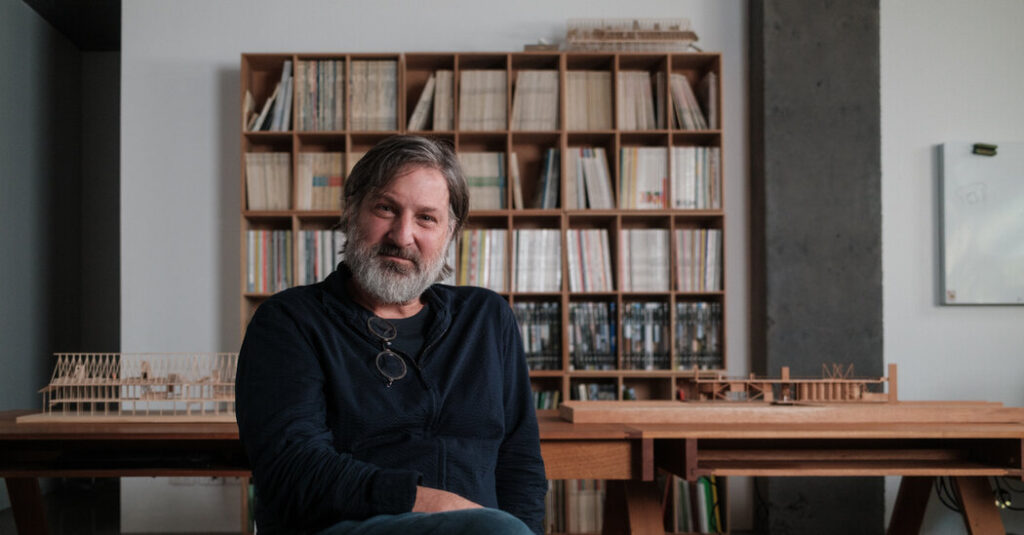
These are some of the essential elements that infuse the work of Smiljan Radic of Santiago, Chile, the winner of this year’s Pritzker Prize, architecture’s highest honor.
Not imposing or commanding, his projects are instead understated and quiet, content to serve their purpose — be it a bus stop, winery or sculptor’s studio.
While he gained some international attention with his 2014 Serpentine Pavilion — the prestigious annual commission for a structure on the gallery’s front lawn in London — Radic, 60, has otherwise been mostly working under the radar on modest projects in Chile.
“Through a body of work positioned at the crossroads of uncertainty, material experimentation and cultural memory, Smiljan Radic favors fragility over any unwarranted claim to certainty,” the jury’s citation said. “His buildings appear temporary, unstable or deliberately unfinished — almost on the point of disappearance — yet they provide a structured, optimistic and quietly joyful shelter, embracing vulnerability as an intrinsic condition of lived experience.”
The announcement of the laureate had been delayed by revelations about the connection between Tom Pritzker, the director of the foundation that awards the prize, and Jeffrey Epstein, the disgraced financier.
Pritzker last month resigned from his role as executive chairman of the Hyatt Hotels Corporation, saying that he had “exercised terrible judgment in maintaining contact with” Epstein, a convicted sex offender who in 2019 committed suicide, and his longtime companion Ghislaine Maxwell.
The Epstein files released in January showed that Pritzker and Epstein frequently corresponded about meals and appointments after Epstein’s plea deal on sex crimes charges in 2008.
While he remains director and vice president of the Pritzker Foundation, which administers the prize, “there will be space between Tom and matters related to the prize including ceremonial activities,” said Eunice Kim, a spokeswoman for the prize, which includes a bronze medallion and $100,000.
In an email, Radic described the honor as “a great surprise.”
“In a way, it creates a strange feeling,” he said, “because this kind of recognition makes you look back at what you have built over time from a different perspective.”
Radic’s structures are not marked by any consistent aesthetic signature, but share a humble sense of harmony, an unadorned elegance.
“It is difficult for me to talk about my own buildings — it always feels as if I am over-interpreting them,” he said. “But if there is something that runs through all of them, it is that — despite the diversity of budgets, scales, programs and materials — they all try to reach a certain austerity.”
“By that I mean stripping the work of excess,” he added, “reducing it to its bones.”
The delicacy and restraint of Radic’s buildings is evident in his Teatro Regional del Biobío (2018) on the banks of the Biobío River in Concepción, which envelops concrete in a semi-translucent skin that has been likened to a paper lantern.
It is there in his Vik Millahue Winery (2013), which features a transparent, fabric roof stretched like an expansive white wing, as well as a sloping plaza of running water. Or his bus stop in Krumbach, Austria (2013) — a simple glass box with a concrete ceiling and an attached bird house.
Radic’s mylar bubble for the 2023 Chilean Architecture and Urbanism Biennial allowed him “to test at an urban scale the possibility of an ephemeral and fragile space,” he said.
Working with basic materials, the architect’s projects seem to grow out of their natural surroundings. His Restaurant Mestizo (2006) occupies a corner of Bicentenario Park in Santiago, with a roof of stones from a quarry in Cajón del Maipo and interior views of the Andes.
For his Serpentine Pavilion, Radic balanced a light-filtering fiberglass shell on hulking, rough-hewed stones, providing a partially enclosed refuge to shelter visitors while connecting them to the surrounding Kensington Gardens.
Radic said he was particularly interested “in projects that have shifted the way I understand my own work” and that he takes each one on its own terms, responding to the possibilities and working within the limits.
“My work develops case by case,” he said, adding that his approach is shaped by “one’s own prejudices and obsessions — your own roots.”
The architect’s creations often conjure the extraterrestrial, like exotic objects that have plunked down from outer space — firmly rooted in the earth, yet ethereal enough to float away.
His “House for the Poem of the Right Angle” (2013) in the Vilches woods — named after a Le Corbusier lithograph — is an otherworldly jumble of jutting skylights, sensual curves and sharp right angles.
His projects also carry an environmentally conscious message by repurposing buildings. For the performing arts center NAVE in Santiago (2015), Radic nestled a black box theater into a fire- and earthquake-damaged neoclassical building — and topped it off with a whimsical circus tent.
“I consciously developed for the first time the idea of collage,” the architect said, describing the rooftop tent as “a found object that ultimately gives meaning to the whole building.”
Born in Santiago in 1965, Radic spent much of his childhood drawing and went on to study architecture at Pontificia Universidad Católica de Chile, graduating in 1989. “Architecture seemed rather boring to me,” Radic said, adding that he considered switching to law.
He later studied history and aesthetics on a scholarship at the Institute of Architecture of Venice (now Iuav University of Venice) “because I had learned almost nothing about those subjects in Chile during the dictatorship,” Radic said.
“It was in the Venice of the early 1990s,” he added, “where my real interest in architecture truly began.”
While at the Pontificia, he met Marcela Correa, a sculptor who would later become his client and his wife. They designed her first house in the Andes Mountains in 1997 and went on to collaborate on many projects.
“Especially important” was their charcoal burner’s hut in 1999, Radic said, a mound of clay and straw that riffs on the ancestral adobe structure. “Although it may seem like a minor work,” he said, “it marked the beginning of a basic experimentation with construction systems and humble materials.”
They also created “The Boy Hidden in a Fish,” an installation for the entrance of the Venice Architecture Biennale in 2010: a solid granite shell with a cedar wood box inside just big enough for one person.
Radic founded his own practice in 1995 and in 2017 established the Fragile Architecture Foundation, a platform for public dialogue and an archive.
His home studio, Pequeño Edificio Burgués (2023), offers views of the city and closeness to the elements through single-pane glass walls lined by chain-link curtains. A subterranean level is hushed by earthen berm walls and a lush rooftop garden is meant to feel neglected and untamed.
“We’ve planted three fig trees that will be trained with supports to grow in spirals, a spiral we’ll never see, like the centuries-old figs of Formentera,” the architect’s eponymous firm says in a publication, referring to an island in the Mediterranean Sea. “A couple of elegant loquat trees and pink sugar grapes on the trellis. We also planted rue, sky-blue garlic flowers to scare away pigeons, and hairy spearmint for summer juices.”
“The garden should convey a certain domestic air, like that of a country tenant,” it said.
Robin Pogrebin, who has been a reporter for The Times for 30 years, covers arts and culture.
The post A Chilean Master of Modest Design Wins Architecture’s Top Prize appeared first on New York Times.