Subscribe here: Apple Podcasts | Spotify | YouTube | Overcast | Pocket Casts
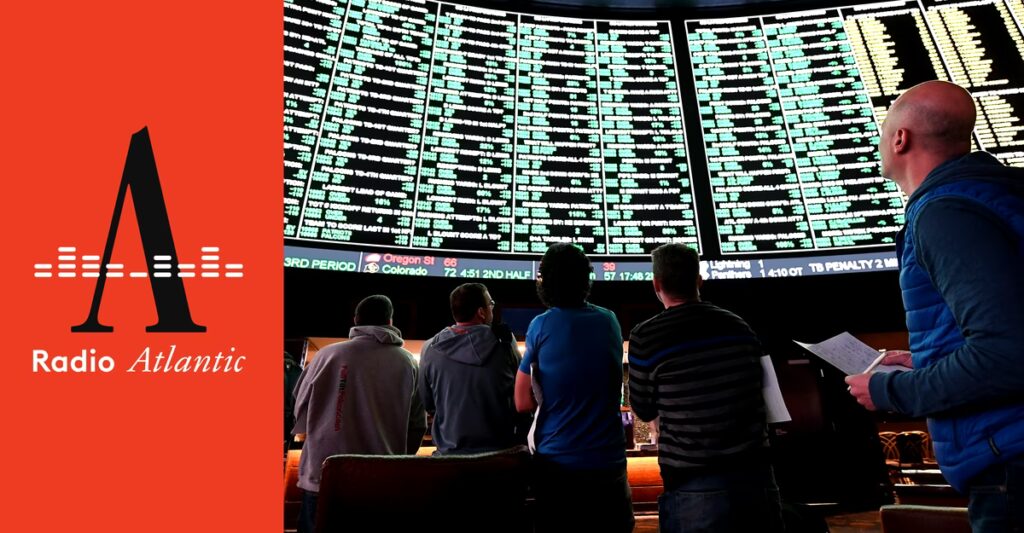
From Plato to Charles Barkley, great minds have warned about the destructive power of gambling. The way societies have usually managed the vice is to cordon it off. It’s legal, but contained to disreputable places, such as red-light districts, riverboats, and Nevada. This was true in much of the United States until 2018, when a Supreme Court ruling opened the door to legalized sports betting nationwide. If you’ve watched a game on TV in the past few years, or listened to a sports podcast, or checked a score on your phone, you have no doubt absorbed, via ads, this practically overnight cultural transformation: Sports betting is everywhere, and now accessible from your couch. Last year, Americans spent $160 billion on it.
The easy availability means that people who otherwise might not have been tempted have gotten sucked in. Unlikely people—such as a Mormon father of four and Atlantic staff writer—are betting on sports these days. In the case of McKay Coppins, it was supposed to be just for research.
In an act of genius or cruelty, this magazine gave Coppins $10,000 to try a season of sports betting. The idea was to provide him with an amount sufficient enough to make the stakes feel real. The result was a painful lesson on hubris, temptation, and how to ruin Christmas. In this episode of Radio Atlantic, Coppins discusses the rise of sports betting, the questionable morals of prediction markets, and what he learned about himself in his season of sanctioned vice.
The following is a transcript of the episode:
Hanna Rosin: Last year, when Atlantic staff writer McKay Coppins wanted to do a story about sports gambling, he and his editor started out with the usual angles.
McKay Coppins: We ticked through all the obvious approaches, right? You should talk to people who struggle with gambling addiction. You should talk to the executives at the big online sportsbooks.
Rosin: And then one of them had another idea.
Coppins: I can’t remember if it was my editor or me who first said, Well, maybe you should try it a little bit.
[Music]
Coppins: Part of it is that, because I was a sports fan—if you are a sports fan, if you watch sports in the year 2026, you are just constantly bombarded with gambling advertising.
Kevin Hart (in DraftKings commercial 1): DraftKings, now, I know it’s the Super Bowl and all, but everyone gets a free bet?
Speaker (in DraftKings commercial 2): Lay it all on tonight’s game or kiss it goodbye.
Speaker 1 (in FanDuel commercial): FanDuel’s free Pick ’Em game gives you more ways to win this fantasy season.
Speaker 2 (in FanDuel commercial): Agreed.
Coppins: Every game you watch, it’s just an onslaught of ads for online sportsbooks.
Narrator (in DraftKings commercial 1): Head to the DraftKings Sportsbook app to claim your free bet now.
Coppins: If you listen to sports podcasts, like I do, all the sponsors are FanDuel, DraftKings.
Bill Simmons: The Bill Simmons Podcast, brought to you by FanDuel Sportsbook. We are also brought to you—
Coppins: And almost through, like, cultural osmosis, I started to pick up some of the kind of sports-betting language. I started to hear about point spreads and money lines so much that I was like, Man, what is the deal with this?
Man 1: —one on one, so—
Man 2: Now yours will be the opposite. You are +3.5 now.
Man 1: ’Cause that’s not the odds; that is the spread.
Man 2: No, that’s not the odds. That’s what a—
Coppins: I just had this feeling that gambling was becoming so culturally ubiquitous that it couldn’t help but change our culture, right? It was definitely changing sports and sports media. But it felt like it was having a bigger effect on the country than that, and so I wanted to look into it.
Rosin: I’m Hanna Rosin. This is Radio Atlantic. Sports betting is everywhere, despite basically only becoming legal in most of the U.S. in the past eight years.
And it just keeps growing.
Coppins: Just to give you a sense—in 2017, Americans legally wagered $4.9 billion on sports. Last year, that number was $160 billion.
Rosin: McKay was about to add to that pile by experimenting with sports gambling himself.
There was just one problem: McKay is Mormon, so gambling is against his religion.
Coppins: And they were like, Well, what if we came up with this work-around? (Laughs.)
Rosin: (Laughs.) So you asked Jesus.
Coppins: So I went and presented it to God. Well, no, actually, I asked my bishop, which is a pretty strange experience.
Rosin: His bishop gave a tentative yes—but only because of a technical work-around that he and his editor came up with: McKay would not be staking his own money. For the entire run of the upcoming NFL season, McKay would be staking the magazine’s money.
The Atlantic gave one of its staff writers $10,000 to gamble with.
Coppins: And I will say, I did not ask for $10,000.
Rosin: And if, by the end of the season, he came out ahead, he could split the winnings 50–50.
Coppins: I went into it thinking, My eyes are wide open. I’m already skeptical of the sports-betting industry. I have never had any interest in gambling whatsoever. (Laughs.) This will be kind of a fun gimmick for the story. But that’s about it, right?
My wife, also, when I told her I was gonna do this, had sort of the same feeling, like, Oh, well, that’ll make the story funny.
[Music]
Coppins: And I thought maybe it would be, like, one section of the story because it wouldn’t really amount to much, but it would be a fun little detail.
Rosin: I feel like this is where we cue the cliff-hanger music, whatever that cliff-hanger music is. (Laughs.)
Coppins: (Laughs.) Now for a break. Let’s—
Rosin: Yes. (Laughs.) Now for a break.
Coppins: We’ll tell you what happened next after.
Rosin: So talk about your first few bets. How did you get going?
Coppins: Well, the very first night I set up my DraftKings account was the first game of the NFL season. It was on a Thursday night. I remember excusing myself from the family dinner table. I have four young kids.
I knew they were gonna find out eventually what I was doing, but it still felt a little bit unseemly that I was gonna start gambling, and so I didn’t want them to see me download DraftKings and ask what I was doing.
So I went into my bedroom, I downloaded DraftKings and deposited $500 into my account, and I was off. And that first night, I knew so little about sports betting that I was basically just punching in bets at random.
But I think I made a parlay bet that was kind of long odds for Saquon Barkley and Jalen Hurts to both score touchdowns. And at the end of the night, I was up 20 bucks.
And I remember the next morning, I told my wife, Hey, I won 20 bucks last night, and she got so excited. And she high-fived me, and we were immediately fantasizing about what we were gonna do with all the winnings that I would make at the end of the season. (Laughs.) We’re gonna replace the KitchenAid mixer that needs to be replaced. Maybe we could even put new shelves up in the pantry. We had all these big ideas ’cause maybe I was secretly a sports-betting savant and we didn’t know it.
[Music]
Rosin: So at some point, you realize you’re not a savant, or maybe you’re not a savant, and you get in touch with Nate Silver, which is hilarious. Just say who Nate Silver is, so—
Coppins: Well, I had this idea that I needed a gambling guru, right? I was gonna need somebody to hold my hand through the process and at least give me the kind of best practices of the sports bettor.
Nate Silver, I would describe him as America’s most famous statistics nerd, right? He started FiveThirtyEight. He was known for calling the outcomes of elections based on his proprietary polling model and, a few years ago, pivoted to gambling. (Laughs.) He cites a midlife crisis and general fatigue with politics.
And he wrote a book about gambling, a very good book. He had always been a poker player. And I basically called him up, and I was like, Hey, Nate, I don’t know what I’m doing. Do you wanna be my guide?
And he was happy to do it, although I will tell you, my very first call with him was pretty humiliating because I, beforehand, sent him all my bet slips for the first week. (Laughs.) And got on the phone with him and he kind of pulled them up as we were on the phone, and just immediately, he started to react in real time as he was looking at them.
Rosin: Ugh.
Coppins: And he just says, Okay. Oh. Oh, no. (Laughs.) And then started laughing at me, which is how I learned that it’s possible to be emasculated by Nate Silver.
Rosin: (Laughs.) Right, right, right, right, right. What was he noticing?
Coppins: Well, he said I was making a bunch of mistakes, and one of them was that I was only using DraftKings. And what he said is, the basic reality of sports betting—and I think this is important to note because I have met so many people who, when I told them I was now getting into sports gambling, they’d say, Oh, I know a guy who made millions as a sports bettor, and if you’re just really good at it, then you can make a lot of money. And I just wanna dispel that a little bit because the first thing Nate Silver told me was, It is incredibly hard to make money as a sports gambler. And to do it, you have to exploit microscopic edges, right?
He said, You should be shopping for lines, the best betting lines on any given game, across multiple books; you can’t just use DraftKings. You need a bunch of different books ’cause all the lines are a little different. You need to steer clear of parlays and prop bets.
Prop bets are, like, individual outcomes within a game. Parlays are—they have longer odds; they’ll pay out more money. But it’s only if multiple different outcomes hit, so, like, the Chiefs to win and the Chargers to cover the spread or whatever.
But what it boiled down to was you have to understand that sports betting successfully is a grind.
[Music]
Coppins: And then he told me—and this was a shocking revelation for me—well, actually, what I asked him was, I’m starting out with $10,000. What would be a good season? If I get to the end of the season, how much would I have to win for this to count as a victory? And he was almost confused by the question because he said, Oh, if you win one penny, you’re in the top 2 percent of bettors.
Rosin: Ugh, my God. (Laughs.)
Coppins: He was like, Even I—who, in my lifetime, have made hundreds of thousands of dollars gambling—if I break even betting on the NFL, I’ll count that as a win.
It was kind of this revelatory moment where it was like, Oh, everybody loses money gambling. You can’t really win. And I knew that intellectually, right: The house always wins. This is the one thing everybody knows about gambling. But what’s kind of amazing in retrospect is that I didn’t really believe him. I heard him, but I was like, But I could be in that 2 percent.
Rosin: Okay, so you leave this Nate Silver conversation with maybe what we can both agree is false confidence. (Laughs.)
Coppins: (Laughs.)
Rosin: And you start to go deeper in. What did you start to notice about yourself? What happens?
Coppins: Well, I started out following his rules that he gave me, right? Basically, what he said is, If you wanna be a good sports bettor, at the beginning of every week, sit down in a quiet place. Look over the lines. Do some research on—
Rosin: What’s the lines?
Coppins: The betting lines, so: The Chiefs are favored to beat the Bills by two points, right? Basically, for every game, a bunch of different sportsbooks will have similar but not identical lines, so you look through all the lines; you decide which games you like, which lines are most enticing. You should look at injury reports. You should look at weather forecasts, other factors that might affect the outcome of the game. And then, when the games are still several days away and you’re not acting out of emotion or chasing your losses, you should make your bets in kind of a sober frame of mind. So that—
Rosin: And stick to them, calmly.
Coppins: And stick to them. Right. Unless something really dramatic changes—the quarterback gets injured at practice or whatever—you should stick to them and not alter them once the game has started. Because that’s the temptation, right? So I stuck to that. I really tried to. For the first month or two, I was doing what Nate told me.
But I was surprised by a couple things. First, I was surprised by how emotionally I reacted when games didn’t go my way, right? The very first game that I bet on, 30 seconds into the game, the best defender on the Eagles got into something with a player on the Cowboys and spit on him and got ejected from the game.
And so you have these things that are totally out of your control that you couldn’t have possibly anticipated that affect the outcome of the game, and it drives you crazy. And what surprised me was how it wouldn’t just drive me crazy, but I would start to develop irrational hatreds for certain players based on their performance losing me money.
Rosin: Okay, so you’re angry at the players. Did your family start to notice anything about you?
Coppins: So that was the other thing that changed. I was surprised by how quickly and extensively what was supposed to be, like, this dumb little gimmick kind of took over my life. (Laughs.)
Again, I didn’t want my kids to see me gambling all the time. They knew I was doing it for my story. But I was so obsessed with looking at the lines, looking at the prop bets that were available. I would often hide from them to place bets. So I would slip away from the living room and go hide in the kitchen pantry to put bets in. And I remember—
Rosin: (Laughs.) The pantry. Oh my God.
Coppins: —one time—and this is not, like, a vast pantry; it’s, like, a closet that I’m hiding in. I remember my 10-year-old son once went into the pantry ’cause I had gone to get them snacks and then just stayed there and was on DraftKings, and he found me, and he announced to the family, Dad is hiding again.
Rosin: (Laughs.)
[Music]
Coppins: My wife caught me looking at one of the betting apps at church, which I think is doubly sinful in some way. I think also one of the early advantages or benefits of sports betting, which was I was so much more interested in the games, also meant that I was watching so much sports.
[Sounds of NFL games]
Coppins: My Sunday afternoons were completely consumed by watching, like, five NFL games at a time.
[Sounds of NFL games]
Coppins: I would stay up super late watching the end of West Coast games. And then after that, I would spend another hour scrolling on FanDuel to see future bets. And that meant that I was then sleeping in later, which meant that I wasn’t as present in the morning routine of getting the kids ready for school. And I remember, I knew I was in trouble sometime in October, when my wife, who is pretty patient and supportive, said something like, I can’t wait for this gambling experiment to be over.
We kind of got into a little argument because she noted that I had been staying up super late watching these games that I was gambling on and I wasn’t as available as I usually was helping with the kids. And she was like, Look, if you’re staying up late working, I understand and I get it. And I very stupidly was like, This is for work! (Laughs.)
Rosin: I knew you were gonna say that. (Laughs.)
Coppins: I walked right into it, and she just rolled her eyes. She was like, You don’t have to watch every game that you gamble on—you have no control over the outcome, which is the kind of thing that is obviously true and also so outrageous to a gambler because, of course, you’re gonna watch the games that you gamble on, like, How dare you!
Rosin: In a moment, things get even worse.
Coppins: I was waking up in the middle of the night because I would have these nightmares that I had blown through the $10,000 and was now gambling with our own money and didn’t even realize it. (Laughs.)
Rosin: That’s after the break.
[Break]
Rosin: This is all funny, but I do wonder if there was ever a point when you felt like you lost yourself in some way.
Coppins: There was a stretch when I kind of went into a tailspin, and it was right around Christmas of last year.
And I think it started, actually, with another Cowboys game, Lions and Cowboys. I had bet the Cowboys to cover a 3.5-point spread; they were the underdogs. And in the fourth quarter, it looked like I might be able to win. Dak Prescott, the quarterback, was driving down the field, about to score a touchdown, it looked like. And then there was this controversial offensive-pass-interference call that was made that ended the drive, and I ended up losing a bunch of money.
And this game ended, and I couldn’t believe it. I couldn’t believe that I had been burned by a bad call by a random referee. And it was like something snapped for me. And I think because, up to that point, I had tried to be pretty diligent, right? I was doing all the things Nate Silver said—I was monastically studying the lines; I was staying away from the suckers’ bets, the parlays and the prop bets—and I should have won that bet. But because of this bad, bad call—it just drove me insane, and I became determined.
At certain points, I had actually been up for the season. Around Thanksgiving, I was up a couple hundred bucks. But at this point, after losing that game—I lost, I think, $500, and I just went ballistic. And I was like, I am gonna win back everything that I lost. I’m sick of this. And this is a term that I learned in the course of my reporting and then experienced: I was on tilt.
[Music]
Coppins: On tilt describes kind of the emotional, frenzied state that a gambler gets into when they start making really unwise decisions. And for the next two weeks, basically, I was on tilt.
It was a strange experience ’cause it was Christmas season. I have young kids. We’re doing all these festive family things. We’re going ice skating. And every outing was an opportunity to gamble more.
My toddler fell asleep in the minivan, and I was like, You guys go skate. I’ll stay here with the toddler ’til he wakes up.
Rosin: (Laughs.)
Coppins: And I’m putting together six-game parlays on my phone. (Laughs.)
I remember collapsing onto the couch and starting to do the mental math, and I realized that I had lost $2,500 in 13 days.
Rosin: Whoa.
Coppins: For basically any gambler, that’s a bad two-week stretch, but what was concerning to me was that at no point in those two weeks did I think that I was doing anything wrong.
Rosin: Let’s move on to the bigger picture: Sports betting used to be illegal. How did that change?
Coppins: Well, it was always illegal, with some caveats, right? There were always parts of the country where it was either explicitly legal or people kind of looked the other way.
From the very beginning of American history, the Puritans understood that gambling was a dangerous vice. They outlawed it in Plymouth. Pennsylvania had laws on the books about it. It was kind of always consigned to riverboats or red-light districts or places that were kind of considered unsavory. There was this kind of idea that if people had to gamble, they would need to go to unsavory places to do it.
In 2012, Chris Christie, governor of New Jersey, wanted to help the flagging economy of Atlantic City and had this idea that he would make Atlantic City one of those places where sports betting was legal.
Governor Chris Christie: And that’s why I’m pleased to announce today that our administration is formally submitting our sports-gambling regulations this week. (Applause.)
Coppins: He passed a bill legalizing sports betting in Atlantic City, which then prompted the sports leagues to sue. And this case ended up winding through federal court, eventually landed at the Supreme Court—
Chief Justice John Roberts: In case number 16-476, Murphy v. NCAA, and the consolidated case, Justice [Samuel] Alito has the opinion of the court.
Coppins: —which, in 2018, decided to overturn the federal ban on sports betting, opening the door for states to legalize it in their respective territories.
Rosin: What a history. Because looking back now, we think, that idea of betting containment, like, We’ll only have it in Atlantic City. We’ll only have it in Las Vegas, that seems so old-fashioned and wholesome now as an idea.
Coppins: It does, but it was the consensus view, like, as of eight years ago. I want people to understand that this new Wild West era of sports betting that we’re in is only a few years old. It’s kind of insane how quickly we, as a country, as a society, decided to unlearn the lessons that every civilization before us had learned, which is that gambling is civilizationally ruinous and soul-rotting and incredibly dangerous and should be kept at bay.
Now, look, in a liberal-democratic society, you have to make a certain amount of tolerance for vice, right? And it makes sense to me to have a few places, kind of containment zones, where the vice is tolerated.
But it is literally just in 2018 and after that, all of a sudden, the leagues realized there is an enormous amount of money to make in doing this. The states suddenly realized, Oh, we could get a bunch of tax revenue if we legalize it and tax it. And the sportsbooks, which almost overnight became these kind of economic juggernauts, started throwing money around to very rapidly expand sports betting across the country.
I’ve lost count—it’s 38, 40 states, something like that, that have legalized it. I would be surprised if, by the end of the decade, unless something dramatic changes, every state hasn’t legalized it.
Rosin: Okay, so sports betting is one thing. We can see how it’s gotten outta control. It makes a certain kind of sense. Sports is a game.
I think where you really start to want to do an anthropology of shifts in American culture is when it goes beyond sports betting, ’cause you can bet on anything these days. So do you see those two things as connected? ’Cause you did do some of that in this experiment as well.
Coppins: I did, and I do think they’re connected. I think that, in some ways, the predictive markets, like Polymarket and Kalshi, are kind of the logical end point of the sports-betting explosion, right? And now they’re introduced to the idea, Well, you don’t know that much about sports? You can also bet on the Oscars. You can also bet on what the temperature in Los Angeles will be tomorrow. You can also bet on when Taylor Swift’s wedding to Travis Kelce will take place.
After first kind of conditioning the American population to get more comfortable with gambling on their phones, we’re now introducing them to the idea of gambling on every facet of American life. It doesn’t have to just be sports.
[Music]
Coppins: I actually first took interest in the predictive markets after the Venezuela operation. This became kind of a famous story, but after U.S. troops went into Venezuela to capture the president, [Nicolás] Maduro, it was revealed that this guy on Polymarket bet a huge amount of money on the idea that Maduro would be removed from power by a certain date.
News reporter (from CBS Detroit): —bet $32,000 that the Venezuelan president would be out of power by January 31.
Coppins: And clearly, this was somebody who had inside knowledge, and he or she made a killing on it.
News reporter (from CBS Detroit): And that user cashed out, making more than $400,000.
Man: These markets are—
Coppins: And once I started talking to people who work at these platforms, I found out that insider trading is actually kind of part of the whole experience. It’s a feature of the platforms, not a bug.
Proponents of these predictive markets will argue that the more insiders use their platforms to cash in on their inside knowledge, the more useful the markets become as predictors of future events.
Rosin: That’s circular. Why is that a defense of it?
Coppins: Because their argument is that the predictive market’s social utility is that they are more useful than polls or surveys or predictions by experts or pundits, right?
Rosin: I see. So it’s an actual freer flow of information. It’s a more accurate source of future information.
Coppins: That’s right. Well, and they go—
Rosin: That’s interesting.
Coppins: —they go even further than that, though. The CEO and founder of Kalshi has said that, basically, the goal is to move the digital public square away from social media, where AI slop and rage bait are kind of the coin of the realm, into predictive markets, where you are incentivized to invest based on what you genuinely believe or have inside knowledge about.
A more grandiose summary of his vision—he said, “The long-term vision is to financialize everything and create a tradable asset out of any difference [in] opinion.”
Rosin: Okay. That’s where he—
Coppins: (Laughs.) That’s where he loses you?
Rosin: (Laughs.) That’s where he loses me, because accuracy, actually, is a value. I actually understand that argument.
Did you follow the controversy over Kalshi and Iran, that whether or not people did or didn’t bet on Ayatollah [Ali] Khamenei, I think the way they put it was, would be “out”?
Coppins: Yes.
Rosin: And some bettors took that to mean dead, like would be assassinated. And then Kalshi kind of was very morally righteous about that, like, Oh, we would never bet on something like somebody’s death. We don’t do that.
Coppins: But by the way, these markets also provide bets on whether Gaza will experience a famine, how many people will be deported from the U.S. in a given year, whether a nuclear bomb will be set off somewhere in the world, so I would just be a little skeptical of high-and-mighty defenses from these markets.
Rosin: Your list just now actually sent a chill because that way of collapsing everything into an abstract non-reality, how did we get there? Is this just a symptom of a culture where nothing’s really real? We never know if anyone’s joking or not joking, so the natural next step is: Why take anything seriously? Just lean into it and turn it into a betting game.
’Cause it’s one thing to say, Okay. The gates were open. Everyone started sports betting. But they were meeting a moment.
Coppins: Yes, for sure.
Rosin: The culture was very ready for this moment where everything can be bet on. Why?
Coppins: Yeah, there’s a chicken-and-egg thing going on here. I do think it’s not a coincidence that America is being turned into a giant casino at a time when a former casino operator is in the Oval Office. And I don’t know if that’s a symptom or a driver of that cultural change, but it is the fact, by the way, we should say, that these predictive markets were facing a lot of government scrutiny during the last administration. There were investigations by the Justice Department, by the Commodity Futures Trading Commission. Both of those investigations were quietly shut down when [President Donald] Trump returned to office.
But I think this gets at something bigger that you’re gesturing at, which is it does feel like America was primed to start to see every aspect of American life, whether it’s politics or war or culture or art, as kind of a table game.
And there is something very American about it.
[Music]
Coppins: The idea that we would all start to play these games that reduce to the abstract very real things and turn them into moneymaking ventures, almost like digital video games that can put a distance between us and what’s really happening, and also feed that very kind of American optimism that somehow I can come out ahead.
Rosin: Right, right.
Coppins: While, meanwhile, the systems rewards insiders, crushes and demoralizes regular people, and ultimately, the house always does win.
Rosin: Okay. So how much money in total did you lose? (Laughs.)
Coppins: (Laughs.) I lost $9,891.
Rosin: What happens to the last hundred?
Coppins: I return it to the Atlantic, with a thank-you note, I guess. (Laughs.)
Rosin: Wow. Okay, okay.
Coppins: I actually literally just sent an email to our accountant saying, Please deduct this from my paycheck. (Laughs.)
Rosin: (Laughs.) Tell the truth: You think you’ll never gamble again.
Coppins: Well, the morning after the Super Bowl, I signed something called a self-exclusion form, which is designed for problem gamblers who want to cut themselves off. So I pulled up the Virginia self-exclusion form and filled it out, which means that the online sportsbooks, at least, are legally prohibited from taking my action.
Now, I will say, the caveat is it was a five-year ban. (Laughs.)
Rosin: (Laughs.) So ask you again in five years.
Coppins: There is a lifetime ban, but you have to go to a physical location to do that, and I didn’t do it, so check in with me again in five years.
Rosin: So if I, right here, say, I will bet you $5 on Best Picture at the Oscars, do you just say no? (Laughs.)
Coppins: (Laughs.) What bet are you making? Gimme the odds.
[Music]
Rosin: Thanks again to Atlantic staff writer McKay Coppins. Make sure to check out the story. It’s called “Sucker: My Year as a Degenerate Gambler.” Also, we should say that prediction markets like Polymarket and Kalshi do technically prohibit manipulation and insider trading.
This episode of Radio Atlantic was produced by Jinae West. It was edited by Kevin Townsend. Rob Smierciak engineered and provided original music. Michelle Ciarrocca fact-checked. Claudine Ebeid is the executive producer of Atlantic audio, and Andrea Valdez is our managing editor.
Listeners, if you enjoy the show, you can support our work and the work of all Atlantic journalists when you subscribe to The Atlantic at TheAtlantic.com/Listener.
I’m Hanna Rosin. Thank you for listening.
The post ‘If You Win One Penny, You’re in the Top 2 Percent of Bettors’ appeared first on The Atlantic.