When last year’s wildfires forced Colleen Atwood to evacuate her home in Pacific Palisades, the Oscar-winning costume designer grabbed a few photographs, gathered her pets and left. She didn’t spend much time deciding what to take. She couldn’t imagine that her house on Aderno Way, where she’d lived for more than 30 years, would burn.
“I had to do a runner,” Atwood jokes, describing her hurried exit on a recent morning phone call from Australia, where she’s been working on Tom Hanks’ World War II drama “Greyhound 2.” “I didn’t really believe it was real.”
What she didn’t grab were her Academy Awards she had earned over the course of her career. One of the four Oscars — her first, for the 2002 musical “Chicago” — was safely on display at the Academy Museum of Motion Pictures. But the other three, for “Memoirs of a Geisha” (2005), “Alice in Wonderland” (2010) and “Fantastic Beasts and Where to Find Them” (2016), had been sitting on a bookshelf in a work area just off the dining room.
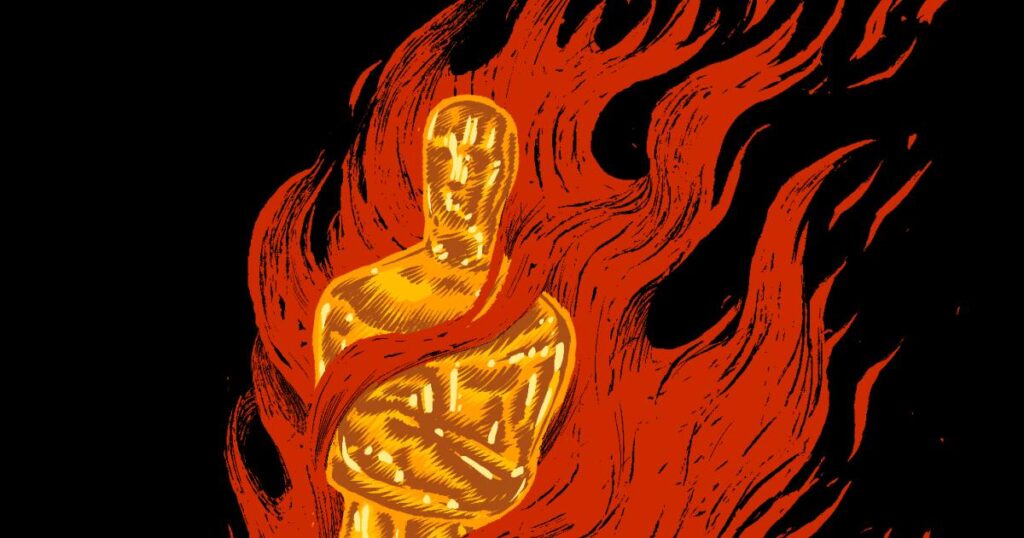
When Atwood was finally allowed back onto the property, almost nothing remained. She and an assistant picked through the rubble, searching for anything that might have survived the devastating fires that destroyed more than 6,800 structures in the Palisades, Topanga and Malibu. Her three BAFTAs and two Emmys were gone, along with her Disney Legend award. Two of the Oscars had melted entirely, but one of the statuettes had endured — just barely.
The gold-plated figure she’d won for “Fantastic Beasts” was warped and blackened by heat, its surface blistered and twisted like something pulled from a furnace. Atwood gave the damaged trophy a nickname: “my crispy critter.”
For nearly a century, the Oscar statuette has been Hollywood’s most enduring symbol of success, a gold-plated knight gripping a crusader’s sword, designed to look as permanent as the honor it represents. But like everything else, the object itself is not immune to catastrophe. Fires, thefts and the occasional accident have destroyed or scattered a small number of the statuettes handed out each year by the Academy of Motion Picture Arts and Sciences.
When that happens, the question becomes: What, exactly, happens to an Oscar when it disappears or is damaged beyond recognition?
In the days after the fires, a dramatic image of a charred Oscar lying in the rubble circulated widely on social media, with some posts claiming it showed Robert Redford’s statuette destroyed in the disaster. Isabella Rossellini shared it with her million-plus Instagram followers, calling it “heartbreaking.” The image turned out to be an AI-generated fake.
For Atwood, though, the loss of her Oscars was all too real — and she was not alone.
Production designer Rick Carter, a two-time Oscar winner known for his work with directors such as Steven Spielberg, Robert Zemeckis and James Cameron, had been in Paris when a friend called to warn him that the blaze was moving toward his Palisades neighborhood. By the time he returned, his house and nearly everything inside it were gone, including the Oscars he had won for 2009’s “Avatar” and 2012’s “Lincoln.”
“When we went back, we didn’t find any trace of them,” Carter said by phone earlier this month as he prepared to board a plane at LAX for another trip to Paris, where he travels regularly. “Everything was destroyed. All my artwork was gone. There was nothing. It was so painful.”
Carter’s statuettes had been displayed on a mantel. They represented the two very different sides of his work as a production designer: the fantastical world-building of “Avatar” and the grounded historical realism of “Lincoln.”
“I have two kids — I have two arms, two eyes,” he says. “It just fit that somehow I’d been lucky enough to get these two Oscars.”
Like Atwood, Carter initially wasn’t sure what would happen next. The academy tightly controls the statuettes. Each bears a unique serial number and since 1950, winners have been prohibited from selling them on the open market without first offering them back to the organization for one dollar. Carter didn’t know whether the lost trophies could be re-created. “I thought, ‘Well, I wonder if they actually replace these things,’ ” he says.
The academy rarely discusses publicly what happens when one of its statuettes — more than 3,000 of them are now out in the world — is lost or destroyed. When contacted for this story, the organization said it would repair or replace Oscars belonging to living winners in cases of severe damage or catastrophic loss, though it declined to detail how those requests are handled or how often they occur.
Even before last year’s wildfires, at least one previous Oscar winner lost an Academy Award in a blaze. In 1983, Gene Kelly’s Beverly Hills home was destroyed after a Christmas tree ignited in the middle of the night. Kelly escaped with minor burns after his son, who was downstairs, rushed to help rescue the actor from his bedroom, but the fire consumed much of the actor’s memorabilia, including the honorary Oscar he’d received in 1952.
Despite their aura of permanence, Oscar statuettes have occasionally vanished over the years. Vivien Leigh’s Oscar for “A Streetcar Named Desire” was stolen during a break-in in the 1950s. Margaret O’Brien’s miniature “juvenile” Oscar for “Meet Me in St. Louis” was taken by a housekeeper who offered to polish it but never returned. Olympia Dukakis’ statuette for “Moonstruck” was stolen by a thief who brazenly tried to sell it back to her, while Whoopi Goldberg’s Oscar for “Ghost” briefly disappeared after she mailed it to the academy to be replated and polished, only for it to be recovered days later, mysteriously, by a security guard who found it in a trash bin at Ontario International Airport, 35 miles east of L.A.
And Jared Leto once revealed that his 2014 Oscar for “Dallas Buyers Club” disappeared during a move and remained missing for six years before resurfacing in 2024 — a story that somehow feels very Jared Leto.
While the design of the Oscar has stayed largely unchanged since the award’s inception, the materials used to make the trophies have evolved over time. The first statuettes, introduced at the inaugural ceremony in 1929, were gold-plated solid bronze. Within a few years the academy switched to a lighter tin-based alloy known as Britannia metal, plated in layers of copper, nickel silver and gold. This alloy softens and deforms at relatively low temperatures — around 500 F — well below the intensity of a typical house fire.
During World War II, when metal was scarce, the trophies were made of painted plaster for three years, with winners later invited to exchange them for metal versions.
In 2016, the academy returned to bronze as the statuette’s core material. Today’s Oscars are cast in molten bronze at a fine-art foundry in upstate New York, polished to a mirror finish and electroplated in 24-karat gold, a process that takes several months to produce each year’s batch. Bronze typically melts at temperatures approaching 1,800 F, slightly above the range reached in intense structure fires. The academy also maintains a long-standing relationship with its former manufacturer, Chicago-based R.S. Owens & Co., which services and restores older statuettes that have lost their luster.
“My most recent Oscar was made by the foundry they’re using now,” Atwood says. “I think that’s why it survived.”
In the months after the L.A. fires, the academy eventually stepped in.
Carter, a five-time Oscar nominee, says the organization contacted him not long after his house burned and arranged to create replacement statuettes. A few months after the fires, he went to the academy and received them from its chief executive, Bill Kramer — a moment he hadn’t expected to find as emotional as he did. The replacement Oscars are now at a family cabin in Carmel while he waits for his Palisades house to be rebuilt.
“I didn’t quite recognize until they were gone how much I had valued what they meant on kind of a talisman level,” Carter says. “When they were suddenly there again, I realized how much that mattered. The older I get, the more they mean. They’re imbued with what you put into them — whatever vision was attached to them that meant something to you and other people. It’s intangible but, you know, it’s a gold statue and it’s heavy.”
Atwood also received replacement Oscars after sending the academy a photo of her scorched “crispy critter” and informing them that two others had been completely lost. (She’s also keeping the original as a memento of the fires.) Atwood says the experience made her newly aware of how much the awards still resonate beyond Hollywood.
“I realized how much other people value what the Oscar is,” says the 12-time Oscar nominee, currently staying with a friend in Santa Monica. “People I know who aren’t in the industry kept asking, ‘Did you get your Oscars?’ As much as everyone says it’s hard to keep people watching the Oscars, people all over the world still embrace what the Oscar stands for.”
For now, Atwood’s replacement Oscars are safely stowed away.
“They’re locked up in a storage unit,” she says with a laugh. “They’re having a nap right now.”
The post They lost their Oscars in the wildfires. What happens next? appeared first on Los Angeles Times.