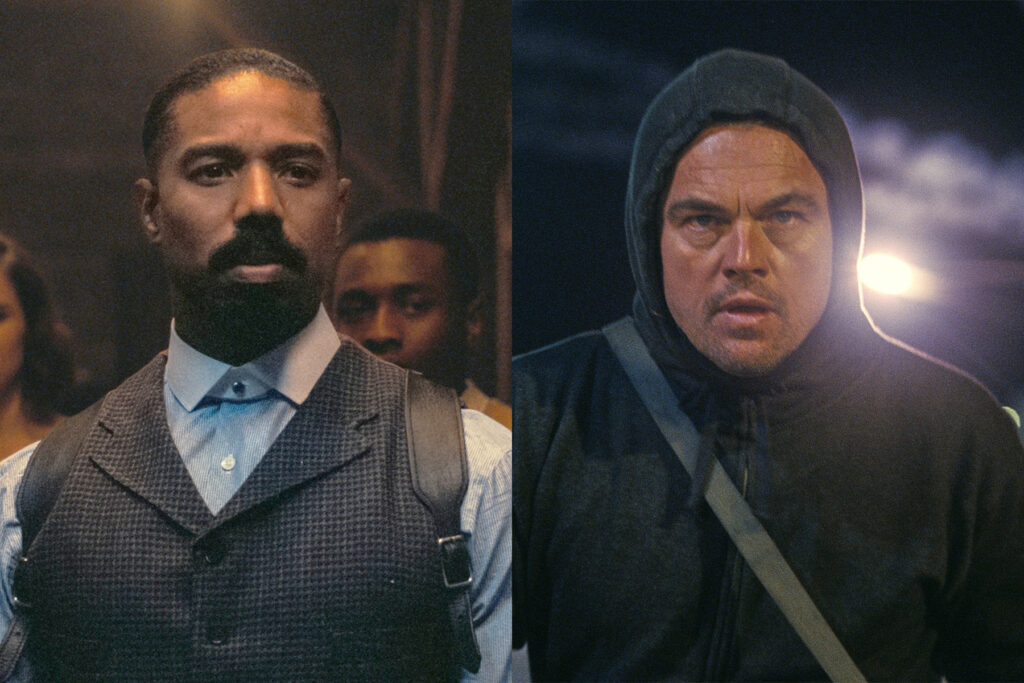
On Sunday night, sometime before midnight Eastern time (hopefully long before midnight Eastern time), either “One Battle After Another” or “Sinners” is going to win the Oscar for best picture. Eight other movies are nominated, of course, and theoretically they all have a chance. But the overwhelming odds favor those two.
Either film would be, to say the least, a nontraditional victor. “One Battle After Another” is an anti-fascist absurdist comedy featuring one of the biggest movie stars on the planet spending most of the film stumbling around stoned in a bathrobe. “Sinners” is a vampire movie (no movie about vampires has ever even been nominated for best picture before) that’s also a dark, sexy musical driven by historical rage at a century of White executives exploiting Black art. It seems remarkable that either movie exists at all, let alone that one of them is going to win best picture.
So it’s worth noting why they exist. In September 2021, frustrated with Warner Bros.’s decision to release all its films on streaming the same day they arrive in theaters (as well as how it handled his covid-era release “Tenet”), Christopher Nolan, the star filmmaker behind the signature Warner Bros. “Dark Knight” films, as well as “Interstellar,” “Inception” and “Dunkirk,” announced he was moving his next work — which turned out to be “Oppenheimer” — to Universal. Nolan said that he and fellow filmmakers “went to bed the night before thinking they were working for the greatest movie studio and woke up to find out they were working for the worst streaming service.”
Shortly afterward, when Discovery and Warner Bros. merged, Discovery CEO David Zaslav became Public Enemy No. 1 among Hollywood creatives for some questionable, anti-filmmaker decisions, like shelving completed films such as “Batgirl” and “Coyote vs. Acme,” taking tax write-offs instead; gutting Turner Classic Movies; and burying “Juror #2,” a well-regarded film that may have been the final movie of his studio’s most beloved director, Clint Eastwood. Warner Bros. — the home of Eastwood, of Michael Curtiz, of Stanley Kubrick — had become the place filmmakers reviled.
Zaslav had to change that, and fast, so, in June 2022, he brought in veteran Hollywood executives Michael De Luca and Pamela Abdy from MGM to run Warner Bros. Pictures Group and told them, essentially, to take some chances — to give respected filmmakers an opportunity to make their passion projects to restore the studio’s luster.
One shouldn’t give Zaslav too much credit here — reportedly, at multiple points he was close to firing them — but the strategy worked. Not only did the executives green-light “Battle” and “Sinners” (in addition to wowing critics, the latter is a massive financial hit), they also approved hits like “Weapons” (which may win Amy Madigan a best-supporting-actress Oscar on Sunday) and “Wuthering Heights,” as well as more surefire mainstream fare like “Superman” and “A Minecraft Movie.”
Not every movie succeeded — “Parasite” director Bong Joon Ho’s follow-up “Mickey 17” didn’t really work, and last weekend’s “The Bride!” is an outright disaster. But on the whole, the strategy was a roaring success that evoked the studio’s prior glories and served as a reminder that if you let smart directors make great movies, even in a streaming world, audiences will go out to the theater to see them.
It is possible that this revival, alas, will be brief. The recent not-yet-completed-or-approved $110 billion purchase of Warner Bros. by Paramount Skydance and its chairman David Ellison puts not just Warner Bros., but the entire studio system, in jeopardy. Not only has Ellison shown little patience for such “art-house” movies — he’s much more a big-budget tentpole guy, as evidenced by his biggest hit, “Top Gun: Maverick” — he also, of course, has his own executives. There’s widespread belief that the redundancies will lead to massive layoffs. (That’s another reason most creatives were cheering for Netflix’s bid for Warner Bros..) That De Luca/Abdy sensibility — the notion that to get people to the theater, you need to swing big — would seem to be in direct opposition to Ellison’s. You have to wonder if they are polishing their resumes. And if there are even any studios left for them to go to.
There are still existing, risk-taking Warner Bros. movies on their way, most notably the upcoming “Digger” (a dark comedy with Tom Cruise directed by “Birdman” helmer Alejandro González Iñárritu) and “The End of Oak Street” (a science fiction film starring Anne Hathaway and Ewan McGregor, written and directed by David Robert Mitchell, maker of “It Follows.”). But those may turn out to be the last vestiges of a sunsetting regime.
The love of movies, the faith in movies, that green-lighting “One Battle After Another” and “Sinners” displayed — a faith that was richly rewarded by audiences, and will be richly rewarded again on Sunday night — does not seem in evidence at Paramount. If that spirit is extinguished, it will be Warner Bros.’ loss. But it will also be all of ours.
The post The studio renaissance driving this year’s Oscars may already be ending appeared first on Washington Post.