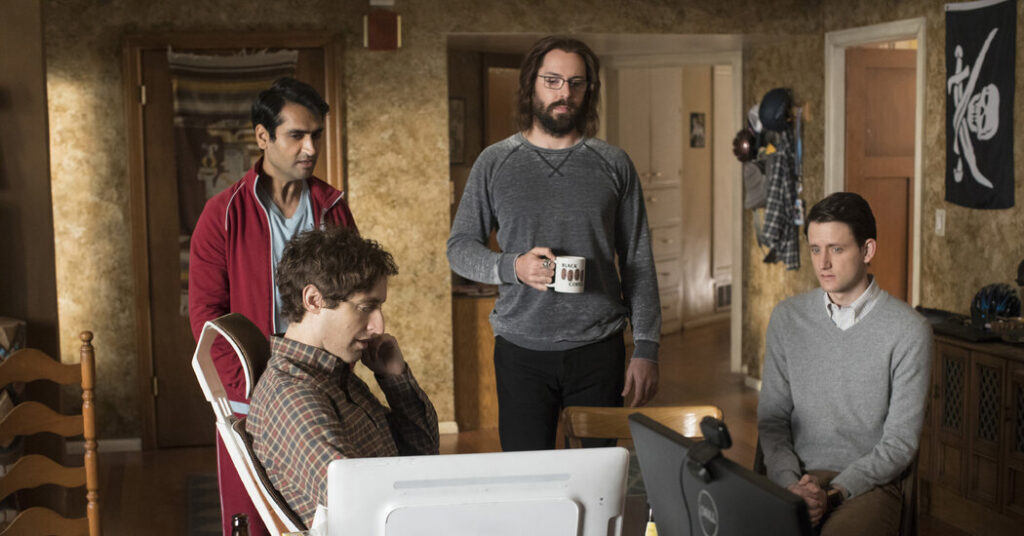
Silicon Valley’s artificial intelligence boom has created a bounty of dramas and absurdities ripe for mockery. Each new development, from A.I. agents that go awry to accusations of corporate espionage, stokes interest in reviving the industry’s classic satire: “Silicon Valley,” the HBO comedy that skewered the tech industry for six seasons, ending in 2019.
“I’m once again asking for an HBO ‘Silicon Valley’ reboot,” an A.I. researcher wrote in a typical post.
These wishes are not likely to be fulfilled. Alec Berg, an executive producer and showrunner on the series, said in an interview that “Silicon Valley,” which premiered in 2014, wouldn’t work today. Sentiment around the tech industry has morphed over the last 12 years from naïve to cautiously optimistic to skeptically pessimistic to cynical to, at times, downright hostile.
“It would feel like a period piece, because at its core, it’s optimistic, and I think we’re living in a post-optimistic world in a lot of ways,” Mr. Berg said.
That view may explain why Hollywood’s portrayal of the tech industry has turned so bleak in recent years. As the industry has grown in wealth and power, generating doomsday warnings about A.I.-induced job losses and killer robots, movies and television shows about technology companies have shifted from tales of underdogs to stories about billionaires with no accountability.
“Mountainhead,” a 2025 HBO movie about three tech billionaires and one tech hundred-millionaire spending a night in a mountain retreat, is nihilistic. A.I.-generated disinformation from one billionaire’s companies sends the world into chaos, and the titans cynically debate, razz and one-up one another from their mansion, speaking in the rapid-fire, casually cruel slang of the extremely online. Degen. Steelman. Roomcuck. Call it “Succession”-speak. The men plot ways they might use the chaos to create a new world order, with the end goal of conferring more power, status and money to themselves.
It’s entertaining, but ultimately soulless. The mercenary characters in “Mountainhead” show viewers how easy it is to do the wrong thing, in contrast to the lovable scamps on “Silicon Valley,” who were generally fighting to do the right thing — especially when it would have been easier and more profitable to compromise their morals.
In “Silicon Valley,” the audience was invited to root for an entrepreneur named Richard Hendricks (Thomas Middleditch) and his ragtag band of coders at the start-up Pied Piper as they took on Hooli, a behemoth evocative of Google or Salesforce. The series concluded with Pied Piper’s discovering that the technology it had built was powerful enough to cause enormous harm. Rather than take that risk, the team shut it down.
“Richard Hendricks was trying to build something without compromising his soul,” Mr. Berg said. The show was beloved by the tech industry. (With one notable exception: Elon Musk reportedly disliked it.)
“Silicon Valley” also found plenty of delicious hypocrisy to mock. When Gavin Belson (Matt Ross), the chief executive of Hooli, declared, “I don’t want to live in a world where someone else makes the world a better place, better than we do,” it laid bare the tech industry’s true driving force of money and ego over any high-minded mission.
But there is no hypocrisy to expose today, Mr. Berg said. He pointed to the way that tech executives had catered to President Trump, including when Tim Cook, chief executive of Apple, presented the president with a glass-and-gold plaque.
“Now, they’re not even hiding it,” he said. The “make the world a better place” ruse is over.
The desire for a new season of “Silicon Valley” has led tech workers to create a modernized version of the show’s opening credits. They’ve used A.I. to make new scenes, inserting the heads of top A.I. companies. Others have suggested creating scripts with A.I. and getting venture capital firms to buy the show’s rights. Instead, they get the brutal cynicism of “Mountainhead.”
A new show called “The Audacity,” which airs on AMC next month (after premiering at SXSW this coming weekend), splits the difference between “Silicon Valley” and “Mountainhead.” The show stars Billy Magnussen as Duncan, a frazzled chief executive under immense pressure after a failed acquisition by an Apple-like company known as Cupertino. (Its chief executive is “Big Tim.”)
Duncan behaves a bit like the men of “Mountainhead.” He crosses ethical lines while seeking help from his therapist, a board member and a company employee, all while arguing that it’s OK — even smart — for people like him to break rules. He uses “Succession”-speak, describing his ability to sell in terms of sex. He is insulted to learn he has been labeled “a dumb man’s genius.”
Last week, the show hosted an intimate viewing party at the Battery, a private club in San Francisco. Dick Costolo, former chief executive of Twitter who now runs an investment firm, noted in a Q&A that the first episode of “The Audacity” “couldn’t have a more cynical take on the Valley.”
On the other hand, he added, it was accurate. “This is actually what some of these people are actually like,” he said.
Gina Mingacci, the executive producer of “The Audacity,” said that despite the show’s dark comedy, the arc of the eight-episode season is ultimately hopeful. The show, which on Monday was picked up for a second season, attempts to capture some of the energy that made Silicon Valley a cradle of innovation by showing Duncan’s early, idealistic days as a founder.
“It’s not all like jaded tech, look where we’ve come to,” she said in an interview. “We all know where we’ve come to.”
The other way the show stays hopeful is by focusing as much on the characters’ families as it does on their ambitions. “The Audacity” includes the teenage children of three Silicon Valley families. In the first episode, one of the teenagers is ignored by workaholic parents while another is criticized by a helicopter mom. There’s a bratty suicide joke and a kleptomaniac who steals a tungsten cube (a decorative metal trinket beloved by the crypto crowd).
These children haven’t chosen to live in the world of Silicon Valley, Ms. Mingacci said. They just want to be loved by their parents. Ms. Mingacci noted that Jonathan Glatzer, the show’s creator, is often drawn to people “that aren’t on God mountain.”
The teen characters also showed that tech still has some hypocrisy left to expose. In one scene, Jamison (Ava Marie Telek), the daughter of a tech exec, expresses judgmental surprise that Orson (Everett Blunck), the son of a therapist, was allowed to have a smartphone. Jamison explains, while floating in a pool with a million-dollar view, that smartphones are twice as addictive as hard drugs. Orson points out that every parent in Silicon Valley works in tech, to which Jamison replies with a pitying smile, “Arms dealers don’t give their kids land mines.”
The tech industry will soon have yet another chance to see itself through Hollywood’s lens. “Artificial,” a movie about the largest A.I. start-up, OpenAI, is expected to be released this year. The movie is not exactly a satire, but it did cast a comedian, Ike Barinholtz, to play Mr. Musk.
Last week on “Jimmy Kimmel Live!” Mr. Barinholtz hinted that his portrayal of Mr. Musk may not be flattering. “I’m such a fan of the guy,” he said sarcastically. “It’s not the rockets that crash, or the cars that have bumper stickers that say, ‘I hate the man that made this car.’ I just respect his comedy. I think he’s just a deeply funny person.”
He concluded on a dark note. The portrayal, he joked, could get him “sent to the prison penal colony on the moon.”
Erin Griffith covers tech companies, start-ups and the culture of Silicon Valley from San Francisco.
The post Silicon Valley’s Image Takes a Dark Turn in Pop Culture appeared first on New York Times.