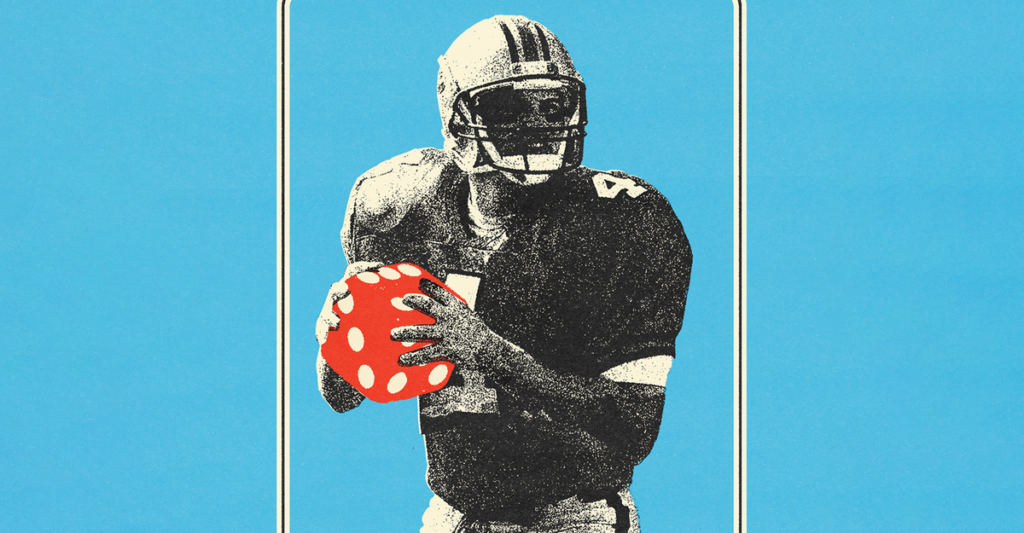
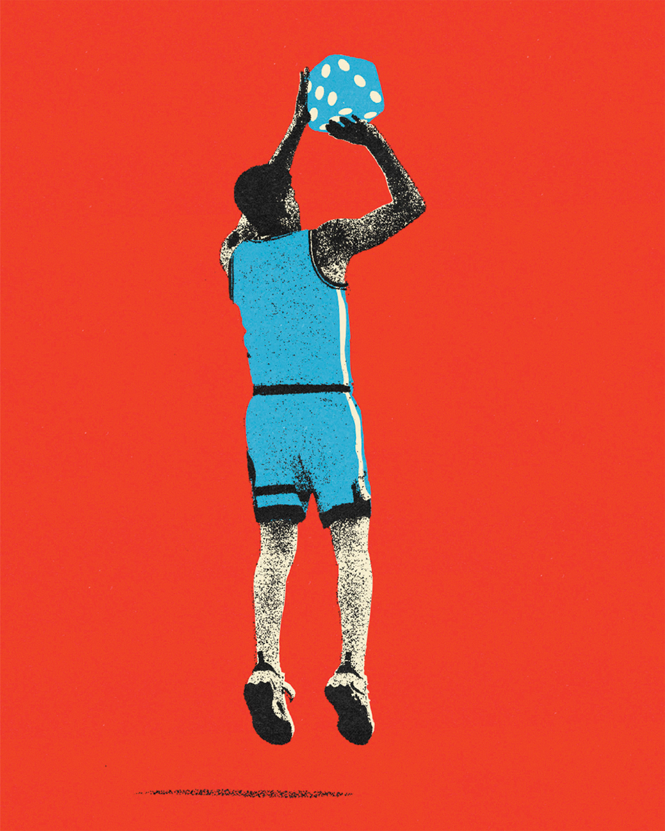
Illustrations by Tyler Comrie
On a Thursday evening in September, I excused myself from the family dinner table and slipped into my bedroom. I didn’t want my kids to see what I was about to do.
With the door locked behind me, I pulled out my phone and downloaded the DraftKings betting app. I felt a certain thrill as I typed in my debit-card information and deposited $500. The first game of the NFL season was a few minutes away. Anything seemed possible.
I am not, by temperament, a gambling man. As a suburban dad with four kids, a mortgage, and a minivan, I’m more likely to be found wrestling a toddler into a car seat than scouring moneylines or consulting betting touts. And as a practicing Mormon, I am prohibited from indulging in games of chance. Besides, I had always thought of gambling as a waste of time. This makes me an outlier among my generational peers: Since 2018, Americans have wagered more than half a trillion dollars on sports, and roughly half of men ages 18 to 49 have an active account with an online sportsbook.
When I set out to report on the sports-betting industry—its explosive growth, its sudden cultural ubiquity, and what it’s doing to America—my editors thought I should experience the phenomenon firsthand. Mindful of my religious constraints, they proposed a work-around: The Atlantic would stake me $10,000 to gamble with over the course of the upcoming NFL season. The magazine would cover any losses, and—to ensure my ongoing emotional investment—split any winnings with me, 50–50. Surely God would approve of such an arrangement, my editors reasoned, because I wouldn’t be risking my own hard-earned money.
This spiritual loophole intrigued me. But for the sake of my soul, I decided I’d better consult a higher ecclesiastical authority than The Atlantic’s masthead.
A few days later, I sat across from my bishop, explaining the experiment and watching a look of pastoral concern come over his face. After some consideration, he said (a bit tentatively, if I’m being honest), “I don’t think you’re doing anything wrong.” He grasped the difference between gambling with my own money and using my employer’s for research purposes. But he had also seen too many lives wrecked by vice to let me leave without a warning. He told me stories he’d heard about upstanding family men who had let an initially modest gambling habit ruin them, and a cautionary tale about a churchgoing lawyer who developed an unhealthy curiosity about sex work after handling a prostitution case and wound up devastating his family.
I promised the bishop that I would steer clear of slippery slopes. “This will really just be a journalistic exercise,” I assured him.
Fifteen minutes before kickoff, I scrolled through the available wagers on DraftKings in wide-eyed bewilderment. Struggling to make sense of the terminology—Profit boosts? Alternative spreads?—I punched in bets almost at random. I bet that the Eagles would beat the Cowboys by at least nine points, based on the sophisticated premise that the Eagles had won the previous Super Bowl and the Cowboys had not. I placed a bet that Eagles quarterback Jalen Hurts would throw for more than 200 yards, and wagered on something called a “same-game parlay” that would pay out if both Hurts and running back Saquon Barkley scored touchdowns.
Then, after tucking in my kids for the night, I turned on the TV in our bedroom and settled in next to my wife, Annie.
Watching the game was unexpectedly stressful. Toggling among my five different bets—monitoring their progress, weighing live “cash out” options—left me feeling harried and sweaty. Four seconds into the game, I got a taste of the capriciousness of the enterprise when the Eagles’ best defender inexplicably spit on the Cowboys’ quarterback and got himself ejected. Had the Eagles’ chances of beating the spread, and my chances at winning $75, just been expectorated away?
But the experience was also strangely mesmerizing. For 200 bucks, I had purchased an artificial rooting interest in a game I had no reason to care about. I kept watching even after a weather delay pushed it late into the night, scrolling frenetically next to my sleeping wife in search of angles to exploit with late-game bets. Most of my bets ended up losing, but the long-shot Hurts-Barkley parlay hit, and when the game ended, I calculated that I was up $20.
The next morning, I proudly shared the news with Annie, who high-fived me and immediately began to fantasize about how we would spend my winnings for the season. Could we replace our dying KitchenAid mixer? Remodel the kitchen pantry? Like so many wives before her, she had looked upon my foray into sports gambling with a bemused air of exasperation; now she was seeing a potential upside.
I laughed at her sudden enthusiasm—but I was starting to get ideas myself. I had made $20 on my very first night of gambling. Scale up the wager sizes, multiply across all 272 games in the NFL season, throw in some NBA and college football, and I stood to make—what, $10,000? $20,000? More?
I knew, of course, that I wouldn’t win every bet. But I didn’t see the harm in dreaming. As Annie and I traded home-improvement fantasies, I tried my best not to dwell on the last thing the bishop had said to me: “Be careful.”
Ever since the advent of sports, humans have found ways to lose money gambling on them. Ancient Greeks wagered on the (occasionally rigged) early Olympic Games; Romans bet on chariot races and gladiatorial contests (also sometimes rigged). When 17th‑century settlers arrived in North America, they encountered Native tribes placing high‑stakes bets on “little brother of war,” a precursor to lacrosse.
Throughout most of America’s history, gambling was heavily regulated and generally discouraged. In 1631, Puritans banned games of chance in Plymouth Colony “under pain of punishment.” In 1794, a Pennsylvania law prohibited “cockfighting, cards, dice, billiards, bowling, shuffleboard, horse racing, or any other type of gambling.”
Laws varied by state and century, but the practice always came with a healthy social stigma, one rooted in millennia of accumulated wisdom. To humanity’s great thinkers and leaders, gambling was an impediment to an ethical life (Aristotle), an invention of the devil (Saint Augustine), and a tax on the ignorant (Warren Buffett). It fostered selfishness and a something-for-nothing ethos that was poisonous to the soul. George Washington went so far as to warn that “every possible evil” could be tied to gambling: “It is the child of avarice, the brother of inequity, and the father of mischief.” As a result, gambling was largely contained to certain disreputable corners of society, such as riverboats, red‑light districts, and Nevada. For a time, it was the near‑exclusive province of leg‑breaking bookies and pin-striped criminals. Later, Native American reservations and offshore bookmakers got in on the action.
But professional sports leagues remained determined to keep gambling at a distance. High-profile scandals—the White Sox World Series fix in 1919, the Mafia-instigated point-shaving scheme at Boston College in 1978—had convinced commissioners that betting posed an existential threat to organized sports. In June 1990, officials from the major U.S. leagues testified before the Senate. Paul Tagliabue, then the NFL commissioner, captured their shared assessment: “Nothing has done more to despoil the games Americans play and watch than widespread gambling on them.”
Two years later, Congress passed the Professional and Amateur Sports Protection Act, which effectively banned most sports betting outside Nevada. It remained the law of the land for decades.
Then, in 2012, New Jersey Governor Chris Christie, hoping to boost Atlantic City’s flagging economy, signed a bill expanding sports betting to licensed locations in his state. The leagues sued New Jersey, and the case began winding its way through the federal courts. When I spoke with him recently, Christie recalled the thundering indignation that his bill provoked at the time. He was once cornered at an event by Bill Bradley, the former Knicks player turned senator, and NBA Commissioner David Stern, who both shouted at him so loudly that other attendees started to gawk. “I’m not an animal to be bet on, like a horse,” Bradley scolded Christie. “We’re going to come after you with everything we’ve got,” Stern warned.
“You know what, David?” Christie recalled telling Stern. “After I win this thing—and I’m going to win it—you’re going to thank me.”
G. K. Chesterton once wrote about two people who encounter a fence erected across a road. One of them demands that it be torn down; the wiser of the two responds that they should find out why it was put there in the first place before deciding on a course of action.
By 2018, Christie’s case had landed before the Supreme Court, which overturned the federal ban on sports betting. Justice Samuel Alito, writing for the majority, made no effort to consider the public-policy rationale that had led Congress to make the law, or the cascading consequences of overturning it. He simply ruled that the Constitution empowers states, not the federal government, to regulate gambling, and scrapped the entire legal framework that had been in place for the past quarter century. No one involved—not Alito; nor the five justices who joined him; nor the legislators in 36 states who would legalize sports betting for their constituents; nor the league commissioners, who would rush into partnerships with online sportsbooks—seemed acquainted with Chesterton’s fence.
Practically overnight, we took an ancient vice—long regarded as soul-rotting and civilizationally ruinous—put it on everyone’s phone, and made it as normal and frictionless as checking the weather. What could possibly go wrong?
Week Two
Total gambled: $376.00 Down $58.15
If I was going to do this, I decided, I would need a gambling guru—someone to talk me through the basics of sound sports betting (if such a thing existed) and teach me best practices.
The obvious choice was Nate Silver, America’s most famous statistics nerd. Silver first made a name for himself as the founder of 538, an election-forecasting website that accurately predicted the winner of all 50 states in the 2012 presidential campaign. A few years ago, Silver, citing a midlife crisis and political fatigue, discarded the pundit suits, threw on a baseball cap, and started writing more about gambling. He launched a newsletter full of sophisticated sports-betting models and wrote a book about the psychology of successful gamblers. He estimates that he has netted in the “mid–six figures” over the course of his gambling life. If anyone could turn me into a respectable bettor, I figured, it was him.
Before our first call, I sheepishly sent Silver my week-one bet slips. After that first triumphant game, things had gone downhill. Scrolling through DraftKings’ offerings, I had turned into a little kid at a carnival, emptying my parents’ wallet into any ring toss or high striker that caught my eye. I’d taken fliers on games without doing any research, and placed live bets on whatever ESPN happened to be showing when I turned on the TV. On Saturday afternoon, while casually watching a random college-football game with my brother, I bet $10 that the point total wouldn’t go over 52.5, lost, tried to make my money back with a new bet that it wouldn’t go over 61.5, and lost that one too. Of the 14 wagers I’d placed in my first week, I’d won three.
Silver pulled up my slips when we got on the phone, and began to audibly react as he scrolled:
“Okay …”
“Oh.”
“Oh no.” He started laughing.
Is it possible to be emasculated by Nate Silver? Apparently, yes.
Perhaps sensing my humiliation, he tried to soften his assessment. “Look, the nice way to put it is that you’re betting like a recreational bettor.” I took this as a withering insult.
Silver laid out some basic realities of the sports-betting economy. The books effectively charge you about 4.5 percent for every bet you place, he explained, which means it isn’t enough to win 50.1 percent of the time; you have to win 52.5 percent of your bets just to break even, and that’s before taxes. My most obvious mistake, he said, was that I was using only DraftKings. To find edges, I would need to shop for lines across at least three or four books every week.
He gave me other tips, too: Avoid “prop bets” on individual players (Josh Allen to rush for more than 50 yards) and multi-leg parlays, which pay out only if every outcome hits (the Chiefs cover the spread, the Ravens win, and the Chargers score more than 24 points). Props and parlays are how sportsbooks generate most of their profits. “They’re suckers’ bets,” Silver said, which made sense, given that I had already placed several of them.
Live betting—placing wagers in the middle of games—was also a bad idea, he told me, because it leads to gambling based on emotion more than logic. Also, televised games are broadcast on a delay, which means the sportsbooks can adjust lines before you even see what has happened on the field. You are, in effect, betting against people who live 20 seconds in the future.
To guard against emotional betting, Silver suggested a Tuesday-morning ritual: I should sit in a quiet place, study the lines for that week’s games, gather information on injury reports and weather forecasts, and then place $100 bets on the six or seven games I liked best.
Before we hung up, I asked Silver what kind of profit would make it a successful season for me.
He seemed confused by the question. “If you make one penny, that would be better than 98 percent of people over an entire season,” Silver answered, as if this were obvious.
I was taken aback. Hadn’t Silver himself made hundreds of thousands of dollars gambling? Yes, he said, but that was mostly from poker tournaments. Sports betting was a game of razor-thin margins and microscopic edges. NFL football was among the hardest sports to win money on—the lines were too sharp, the teams too evenly matched. Silver told me that, even with his quantish models and prognosticatory brilliance, he would consider it cause to celebrate if he broke even on the season.
Intellectually, I understood what he was saying. But some part of me didn’t believe him. Somehow, I was still convinced that I could beat the odds.
There is something unsettling about the suddenness with which gambling became omnipresent in American sports.
Turn on any game, on any channel, at any time of day, and you are likely to be bombarded with neon-soaked, star-studded ads for sports-betting apps: Jamie Foxx stalking a Bellagio suite, phoning Wayne Gretzky, Kevin Garnett, and Barry Sanders for betting tips. Shaquille O’Neal and Kevin Hart hyping new-customer bonuses for DraftKings. Hall of Famers who would have been selling sneakers and Wheaties a generation ago are now getting paid millions of dollars to lure 21-year-olds into online casinos.
Virtually every sports-media outlet in America, from CBS Sports to your favorite niche football podcaster, takes sponsorship money from gambling companies. ESPN now recaps the day’s games by covering which teams beat the spread; gambling talk pervades pregame studio panels. Every major TV network now seems to employ a data whiz with glasses and rolled-up sleeves who can break down the betting angles for viewers at home.
The leagues, initially so opposed to legalized sports betting, embraced it to help reverse sliding TV ratings and lure back the younger fans who were drifting away. Before long, they found themselves beholden to the industry they’d helped create. Now the NFL, the NBA, and MLB all have large equity stakes in the data companies that power the sportsbooks. They license broadcast rights directly to sportsbook-operated streaming services, and hurry to defend their partners whenever a game-fixing scandal breaks. “Gambling touches everything,” the former ESPN reporter Joon Lee recently wrote in a New York Times op-ed. “The betting apps are in charge now, and everyone knows it. The leagues are hostage to the forces they unleashed.”
In 2017, Americans legally bet $4.9 billion on sports. Last year, that number rose to at least $160 billion—and once you’re hooked, the list of sporting events you can gamble on is seemingly endless. Unsatisfied with wagering only on Sunday football games? Not to worry: How would you like to bet on an Indian cricket match, or Lithuanian Ping-Pong, or a Polish soccer game in a league whose name you can’t pronounce? In 2023, an offshore book called BetOnline briefly allowed people to gamble on the Special Olympics. The plan ran aground when athletes were apparently awarded identical medals in the same event—the Special Olympics is not, strictly speaking, about winners and losers—and bettors revolted after their payouts were delayed. A spokesperson for BetOnline acknowledged to the New York Post that grading the Special Olympics had been “more challenging than we expected.”
Now, with the rise of “prediction markets” like Kalshi and Polymarket, gambling options are no longer limited to sports. Live-betting odds have been featured on the Golden Globes telecast and CNN’s election coverage. In 2026, you can gamble on how warm it will get in Los Angeles tomorrow, and the winner of the Grammy for Best Rap Album, and how much money Avatar: Fire and Ash will gross, and the date of Taylor Swift’s wedding, and Time magazine’s Person of the Year, and the possibility of extraterrestrial life being discovered, and how many people will be deported from the United States, and the prospect of Iranian regime change, and the chances that Donald Trump declares martial law before his term ends, and whether Jesus Christ will return to Earth this year.
In remarkably short order, gambling has permeated every nook and cranny of American life. (If this strikes you as apocalyptic, the odds for the Second Coming currently stand at 23 to 1.)
Week Three
Total gambled: $1,011.00 Down $185.40
In late September, my family piled into our Honda Odyssey and drove to Greenville, North Carolina, for the Brigham Young–East Carolina football game. Like any good father, I had made a project in recent years of indoctrinating my young kids in the sports fandom of my alma mater. We rolled up to the BYU tailgate party—fancy bespoke sodas instead of beer; a canned-food drive in place of keg stands—and spent the hours before the game eating barbecue and taking pictures with Cosmo, the beloved Cougar mascot.
I had decided in advance not to bet on the game—I didn’t need any action in order to be invested in its outcome, and the stress might sour the family experience. But at the tailgate, I met a BYU administrator who told me about how prepared the team was and how the defense would be “locked in.” This was hardly insider information, but it was enough to compel me—an hour before kickoff—to put $100 on BYU to win. When I mentioned this to my 12-year-old daughter, she rolled her eyes. “That’s not very Mormon of you,” she said.
The game was a blast. BYU fans had traveled from all along the East Coast to fill a large section of the stadium. Our defense was indeed locked in, forcing two turnovers and propelling the team to an early lead. By the middle of the third quarter, East Carolina fans were leaving in droves while my kids and I belted the Cougar fight song until we were hoarse: Rise and shout, the Cougars are out!
It was one of those ecstatic family moments—a core memory in the making. And yet, as we sang, I couldn’t quite ward off an intrusive thought: I should have bet BYU to cover the spread. Much better juice.
Week Five
Total gambled: $2,206.00 Down $220.13
By October, I had settled into a rhythm with my betting. Following Silver’s advice, I had downloaded several more sportsbook apps (FanDuel, ESPN Bet) and spent time early each week searching for the most enticing games on the NFL schedule. I kept tabs on roster updates and checked various prediction models.
One of my most valuable resources was a website that aggregated the lines across all sportsbooks and tracked the micro-movements in real time. The differences were minimal, but Silver had told me that exploiting even the tiniest advantage was crucial. If I liked the Seahawks to beat the Buccaneers, one book might have them as four-point favorites, while another would have them at 3.5; one might require me to bet $110 to win an additional $100, while another needed only $106. The books are constantly adjusting their lines to keep users evenly balanced on each side of a given bet, in order to limit the risk of lopsided payouts, which would cut into their profits.
I took a certain perverse pride in my mastery of the lingo and the basic betting math. Scouring the sportsbooks each week for the best lines made me feel like a sharp. But the process could be time-consuming. One rainy evening, I found myself parked outside a big-box store in Northern Virginia where my wife had sent me on an errand, obsessively scavenging for lines on my phone and jotting down favorites in my Notes app. When I looked up, 45 minutes had passed. I would be late for dinner.
Doing all of this homework heightened my investment in the games—but it also conjured something disconcerting and primal in me.
I first noticed it during the fourth quarter of the Cardinals-Titans game that Sunday. The Cardinals had been heavy favorites, and I’d bet on them to win by a touchdown. Early in the fourth quarter, it looked like a win was in the bag. The Cardinals were already up 21–6 when running back Emari Demercado ran for what looked like a game-sealing 72-yard touchdown. But when the referees reviewed the play, they found that Demercado, who had dropped the ball after scoring, had actually let it go half a step before reaching the end zone. The touchdown was reversed, the play was ruled a fumble, and the Titans proceeded to pull off an improbable 16-point comeback to win the game. My money vaporized.
Rewatching clips of Demercado’s fumble, I was filled with an irrational hatred for this person I had never met. I hated the way he sauntered so cavalierly into the end zone. I hated the way he tossed the ball to the ground like a used dish towel in what I’m sure he thought was a cool flex. I hated the way he shrugged off reporters’ questions in the locker room afterward by repeating the same meaningless quote (“Just gotta be smarter”).
The intensity of the feeling, fleeting as it was, unnerved me.
Caroline Garcia doesn’t remember the first abusive message she received from an angry gambler who lost a bet on her, but she knows she was still a teenager.
Garcia, a French tennis player who at her peak was ranked fourth in the world, told me she got so many deranged messages over the years—so many slurs and death threats, so many fuck you s and kill yourself s—that they started to feel like background noise. She recalled the dissonance of receiving the most unhinged message imaginable and then looking at the sender’s wholesome Instagram: “His profile picture is with his kid of 1 year old, and you’re like, I don’t understand—what is the problem with you? ” I felt a twinge of shame as I realized I could empathize with that gambler’s brief spell of insanity more than I’d like to admit.
Garcia, who retired last year, was speaking with me via Zoom from Dubai, where she now lives with her husband. She told me she likes how safe the city feels. More than a decade of death threats from deranged bettors can make you appreciate high-tech security systems and heavily policed streets.
Athletes are no strangers to wrathful comments, of course. But the rise of legal, normalized betting has coincided with an increase in harassment. More than a third of men’s Division I college-basketball players say they’ve received abusive messages from gamblers, and 21 percent of gamblers themselves cop to lashing out at athletes in person or online. The trend makes sense: When a player underperforms, he’s not just letting down his teammates and fans. He’s costing gamblers money. In the adrenaline spike of a tough beat, a bettor loses perspective; the athlete becomes a subhuman extra in the gambler’s personal drama.
Tennis is among the most gambled-on sports in the world. And because it’s primarily an individual game, the frustration of losing bettors lands directly on the players themselves rather than on coaches or whole teams. Garcia, who hosts a podcast called Tennis Insider Club, said players trade tips on how to deal with the abuse. They call law enforcement and hire private security; some of them rely on AI-powered software called Threat Matrix, which monitors and assesses the credibility of menacing messages across platforms.
A few have taken to mocking the misdirected rage. After Gaël Monfils lost in the first round of the Stuttgart Open last year, he posted a “special message” on Instagram for the gamblers who were filling his DMs with racist insults. “Really? You’re still betting on me?” deadpanned Monfils, who at 38 was one of the oldest players on the tour. “You write in that I’m shit. I know I’m shit! We both know I’m shit!”
But even the most easygoing athletes realize that the desperation of a losing bettor can lead to scary places. In 2024, during a fourth-round women’s match at the U.S. Open, in New York City, the official X account for the U.S. Tennis Association received a DM: “I’m inside Louis Armstrong with a bomb that will go off at 1 pm est.” As experts worked to determine the credibility of the threat and the NYPD quietly swept the arena for explosive devices, tournament officials considered evacuating the stadium. Eventually, the message was traced to Strasburg, Pennsylvania, where a 20-year-old man had wagered a large sum on the match. When his player fell behind, he tried to disrupt the match and void his bet with a bomb threat. He now faces up to five years in prison.
Before Garcia retired, she told me, she often found herself wondering if a losing gambler’s digital threat would escalate to physical violence. She told herself it was unlikely, but the possibility was always in the back of her mind. “You just hope that he will always stay in messages, and he will never go the next step,” she said. Her eyes drifted to some unseen point off camera. “You never know.”
Week Seven
Total gambled: $3,551.00 Down $567.23
I was surprised at how quickly and extensively the experiment was bleeding into the rest of my life. I was listening to gambling podcasts in the shower and spending my Sunday afternoons watching five football games at a time—one on my phone and four on the TV’s split screen.
I routinely stayed up past midnight scrolling through the apps, my face illuminated in the dark of our bedroom by brightly colored ads for “NO SWEAT BETS” and “SAME GAME PARLAYS.” I impatiently swiped away FanDuel’s “Reality Check” pop-ups, which notified me, in what I took to be a passive-aggressive tone of disapproval, that I was spending quite a lot of time on the platform.
It was now common for my family to catch me furtively tapping in wagers. On one occasion, my 10-year-old son discovered me on my phone in the kitchen pantry, where I’d gone to get snacks for the kids, and announced, “Dad is hiding again!” On another, Annie happened to glance down the pew at church just as I was sneaking a peek at DraftKings. “You’re addicted,” she stage-whispered.
My wife was no longer having fun with this stunt of mine. Having given up on the prospect of a big payday, she was now focused on the more immediately visible consequences of my gambling—like the fact that our 7-year-old daughter knew the difference between a point spread and a moneyline, and that our 10-year-old’s first question whenever I turned on a game was “Who are we betting on?”
Once, Annie overheard me enthusiastically explaining to our kids that if the third leg of my parlay hit, I would win enough money to erase all of my losses for the season. “But gambling is bad,” she shouted from the other room, “and people who do it eventually lose all their money, right?” Her tone of voice suggested that I was bound by marital covenant to endorse this position, which I promptly did.
“I can’t wait for your gambling experiment to be over,” Annie muttered one night as we drove home from a long weekend at my parents’ house. I had been up late the night before, sweating a Texans-Seahawks game that didn’t end until about 1 a.m., and I’d slept in longer than intended, leaving Annie to wrangle the kids by herself all morning. This had become, she noted, a regular occurrence in recent weeks.
“I’m fine with you sleeping in when you’re up late working, but …” Annie began.
“This is for work,” I insisted.
She scoffed. “You don’t have to watch every game you bet on,” she said. “You have no control over the outcome.”
The irrefutability of her point reduced me to indignant sputtering.
In truth, I was beginning to wonder about what Annie had said to me at church. I had always told people that I didn’t have an addictive personality, believing that to be so. Now I had to consider a different possibility: Maybe I had simply constructed a life with strong enough guardrails that I’d never had to test the premise.
What would happen to me, I wondered, if those guardrails were removed?
I met Craig Carton at his Midtown Manhattan studio—faux brick, wood floors, klieg lights—near Madison Square Garden, about an hour before he went on air. Carton was a quintessential sports-media success story, having leveraged his bombastic New York morning show, Boomer and Carton, into a national following, as well as a book deal and a lucrative TV gig.
Now he spends a lot of his time talking to gambling addicts.
Carton hosts a weekly call-in show on WFAN called Hello, My Name Is Craig, in which he interviews recovering gambling addicts. The guests’ stories are invariably bleak. The Wall Street trader who maxed out 15 credit cards and started stealing jewelry from his parents to cover his losses. The father of two whose wife left him when she found out he hadn’t paid the mortgage for two years. The Little League umpire who got so deep in the hole that he decided he would try to win it all back in one trip to Atlantic City or else kill himself.
Carton, a bald, wiry guy with a raspy New York accent, toggles between empathy and razzing his guests—routinely interrupting a confession to bark, “Heard that one before!”
He’s hard on them because he’s been there. “I’m not a therapist,” he told me. “But I can talk to a gambler the way a nongambler can’t. You can’t bullshit me—anything you’ve done in the gambling world, I’ve done times a hundred.”
The story of Carton’s own descent into ruinous gambling addiction is typical: He started out playing low-stakes blackjack and placing modest bets on sporting events. But little by little, the habit consumed him. He began gambling so much that casinos would fly him out to Vegas on private jets and comp his meals and hotel rooms. As his bets got bigger, the losses became harder to conceal. He borrowed, refinanced, moved money around, and lied about it all, until federal agents showed up early one morning in 2017 outside his Tribeca apartment and arrested him for securities and wire fraud. Prosecutors accused him of siphoning millions from a ticket-resale business, and misleading investors, in order to pay off gambling debts. What Carton remembers most vividly from the morning agents handcuffed him to a bench outside his building was the look on his wife’s face when she saw him.
Carton went to rehab in Arizona, spent a year in prison, and, when he got out, started counseling compulsive bettors and speaking at schools about the dangers of gambling addiction. He is overbooked. Since 2018, when the sports-betting ban was overturned, internet searches for phrases like Am I addicted to gambling? have spiked by 25 percent, and calls to gambling helplines from young men have surged. Gamblers Anonymous has reported young men showing up in droves across the country, and one survey found that nearly one-third of 11-year-old boys had gambled in the past year. (The CEO of FanDuel’s parent company, Flutter Entertainment, has spoken enthusiastically about the growth potential provided by the massive, exploitable market of Americans soon to come of age.)
Experts estimate that only about 2 to 5 percent of gamblers will develop compulsive behaviors. But as Carton likes to point out, that small percentage becomes a very large number when tens of millions of Americans suddenly have casinos in their pockets.
Gambling addiction is similar to other addictive disorders, but there are key differences. It’s easier to hide, at least at first—the addict doesn’t have glazed eyes or slurred speech, and no one can smell it on him. Plus, the compounding financial pressure of the habit can quickly turn a private vice into a full-blown crisis. One in five compulsive gamblers will attempt suicide in their life, a higher rate than for any other category of addict.
Executives at the major online sportsbooks are quick to trumpet their commitment to “responsible gaming.” But that purported commitment runs up against an economic reality: As much as 90 percent of the sportsbooks’ revenue comes from less than 10 percent of their users. Their apps seem clearly designed, much like TikTok and Candy Crush, to keep users scrolling and tapping in a hypnotic stupor. If your account is nearing empty, DraftKings will offer a “reload bonus” of gambling credits to entice you to deposit more money; if you’ve gone a couple of days without making a wager, you might get a push alert from FanDuel offering a “no sweat bet,” promising to refund a loss with site credits to be used for more gambling.
When I asked Christian Genetski, the president of FanDuel, about accusations that online sportsbooks prey on problem gamblers, he dismissed the idea as “a bit of a trope.” He said his company goes out of its way to identify and slow down users who exhibit reckless or addictive behaviors. Bettors who start spending more time or money than usual on the app will receive a notification alerting them to the anomaly—hence the Reality Check alerts I had impatiently dismissed. If they disregard too many of these notifications, FanDuel will impose limits on their gambling, and may even shut down their accounts. (An executive at DraftKings told me it has a similar policy.) “We don’t want any revenue from someone that has a gambling problem,” Genetski told me, noting that the platform’s biggest spenders are not necessarily the ones with unhealthy habits. Genetski said that it’s in FanDuel’s long-term interest to keep users gambling at a sustainable rate. “If people are burning out because they are spending beyond their means, they’re not going to be customers for very long.” (“Loss smoothing” is the industry’s term of art for this tactic; gamblers call it “the slow bleed.”)
When Carton sits down with a gambling addict, his first suggestion is to fill out a “self-exclusion” form. Most states that have legalized gambling allow you to submit a document to the government that prohibits online sportsbooks from taking your action for a defined period—the gambling equivalent of Odysseus binding himself to the mast so he can withstand the temptation of the Sirens. (The strategy isn’t fail-safe: After Carton filled out his own self-exclusion form in New Jersey, he received a letter from a brick-and-mortar casino in Atlantic City. “It said something to the effect of ‘We see that you’ve self-excluded from online gaming. Feel free to come in anytime. We’d love to have you.’ ”)
Many of the young men Carton works with started out betting on football games with their dads. The dad, craving a Sunday-afternoon bonding experience, would open the account, make picks with his son, and then split the winnings—while covering the losses himself. “You’re creating these little mini-monsters in gambling who have no idea that there are times you lose, and the money is real,” Carton told me.
Listening to him talk, I became aware of the troubling parallels to my arrangement with The Atlantic. When I mentioned this to him, he chuckled ruefully. “You’re in harm’s way, that’s for sure,” he said.
I asked him, hypothetically, what warning signs a new gambler should watch for, and he rattled off a list of questions. Are you going to sleep and waking up thinking about your bets? Are you staying up late to watch West Coast games with teams whose rosters you know nothing about? Are you “chasing”—making reckless new bets to win back the money you lost? Are you placing bets on your phone in the bathroom so your family doesn’t see you gambling?
I shifted uncomfortably in my seat.
Week Eight
Total gambled: $5,321.00 Down $132.40
On October 23, the FBI announced the arrests of more than 30 people in a pair of interlocking gambling schemes. The indictments alleged a yearslong mob operation that drew on insider information to manipulate NBA games and win bets. Terry Rozier, while playing for the Charlotte Hornets, was said to have tipped off associates that he would leave a game early with a foot injury, enabling bettors to place more than $200,000 on “under” prop bets for his points, rebounds, and assists. The implicated included NBA players and a retired Hall of Fame point guard turned head coach. (They have pleaded not guilty.)
As I watched the FBI press conference on CNN, my phone pinged with messages from friends and sources who knew about my sports-betting experiment, including one from the governor of Utah: “Really relieved your name didn’t come out in that gambling ring.”
That evening, I had made plans to check out a real-life sportsbook in Washington, D.C. I invited along two friends, Steve and Ryan, who had been following my gambling rumspringa with deep amusement, and were eager to see me in action.
Neither their wives nor mine expressed interest in joining us. This had become something of a pattern since my experiment began—whenever I started talking about gambling with a couple, the woman would almost invariably tune out or recoil, while her husband leaned in attentively, eager to hear more. Neuroscientists have sought to explain this phenomenon. Men are, on average, less psychologically affected by financial loss than women, and more prone to optimism (rational or otherwise) about their financial future; this combination naturally leads to more risk-taking. There are complicated brain-chemistry factors involved that have to do with testosterone, and dopaminergic systems, and kappa-opioid receptors, all of which seem to add up to a Jim Gaffigan joke about how men are morons compared with their wives. Whatever the reason, the gender split is undeniable: Men make up about 70 percent of sports bettors in America and, according to one study, 98 percent of online sports bettors who qualify as “problem gamblers.”
Our plan was to watch the Chargers play the Vikings, along with a couple of NBA games, at the Caesars inside Capital One Arena. But the place was smaller than anticipated and depressingly empty, redolent with the smell of cleaning chemicals, secondhand smoke, and dissatisfaction with life choices. “This feels like the DMV,” Ryan said. We decided to take our business across the Anacostia River to the MGM National Harbor casino, in Maryland.
I approached the counter, eager to show off my newfound gambling prowess to my friends, and confidently told the bored-looking woman in a blazer that I wanted to “put $100 on the Thunder minus 7.5.” I whipped out my debit card, feeling particularly proud of this bit of lingo I’d picked up. “Cash only,” the woman responded, without making eye contact. Chastened, I shuffled over to an ATM that charged me a $9.75 withdrawal fee.
We settled into recliners facing a wall of massive TV screens. I had expected the sportsbook lounge to be more glamorous, more fun, than the apps I’d been using—a classic sports bar on steroids. But the communal experience I craved was curiously absent. Everyone seemed to be paying attention to different games, or rooting for different sub-outcomes within the games. I tried to bond with some guys nearby who, like me, had money on the Chargers. But they were preoccupied with a prop bet, and barely noticed when Justin Herbert completed a perfect 27-yard touchdown pass to Ladd McConkey with 45 seconds left in the first half.
Gambling had made us all care much more about the games, but it had also atomized us—taking the last and purest expression of American monoculture and turning it into a hyper-individualized, every-man-for-himself portfolio of micro-bets.
The Chargers game was a blowout, but the Oklahoma City Thunder went into double overtime against the Indiana Pacers, and I stayed late with Steve to watch the end. My 7.5-point cover looked out of reach until the final seconds of the game, when the Pacers, down six, tried to foul Thunder center Chet Holmgren. Two free throws would have won me the bet, but the referees ignored the foul, and the game ended. Shouts of indignation rang out from disparate quarters of the lounge. I buried my head in my hands while Steve cackled at my misfortune.
“Tough beat, buddy,” he said.
Seeking company in my misery, I pulled up X, where I found a stream of outraged gamblers accusing the referees of fixing the game, perhaps with the aid of the NBA commissioner.
“Clearly they had money on Indiana,” one wrote.
“Disgusted.”
“Adam Silver must resign.”
I am not usually prone to paranoid thinking. But to my surprise, I found myself wondering if these venting gamblers were right. The morning’s indictment lingered in my mind. Had the refs rigged the game? Were league officials involved? What about players? How deep did this thing go?
The NBA gambling ring exposed in October was only the beginning. In November, two MLB players pleaded not guilty after being indicted for manipulating pitches to help bettors. In January, federal prosecutors accused 39 college-basketball players across 17 Division I teams of taking bribes from gamblers to underperform. (The indictment alleges that the scheme began with rigging Chinese professional-basketball games, then spread to the NCAA.) That same month, the Ultimate Fighting Championship canceled a bout after reports of suspicious betting activity.
Taken together, the proliferating scandals have posed the most significant threat to the credibility of organized sports in the U.S. since Shoeless Joe Jackson got paid to help fix the 1919 World Series. One recent poll found that 65 percent of Americans now believe that professional athletes sometimes change their performance to influence gambling outcomes; in another poll, 70 percent of respondents agreed that sports betting “lessens the integrity of the game.”
Gambling apologists argue that the recent revelations are proof that new laws are working—offshore sportsbooks and black-market bookies never coordinated with law enforcement to flag suspicious bets the way FanDuel and DraftKings do now. The cheating isn’t new, this argument goes; it’s just getting discovered and prosecuted more frequently.
Even if that’s true—and some researchers are skeptical—fans’ teetering confidence could become an existential problem. It’s easy to start questioning the legitimacy of what you’re watching on the field or the court, especially when the leagues and the gambling-subsidized sports media both have such clear conflicts of interest. (In October, while ESPN was covering the gambling-ring indictments, producers scrubbed the screen of references to its own online sportsbook.) If trust in the integrity of the game disappears, then interest is likely to follow. Every sport risks becoming professional wrestling—an entertaining spectacle that everyone knows is bogus.
Sports leagues, of course, are not the first American institutions to suffer a crisis of authority in the 21st century. (See also: Wall Street, Congress, the military, the police, the press, etc.) But the recent decline of trust in sports is, to an extraordinary degree, self-inflicted and avoidable. By embracing gambling so completely—normalizing it, celebrating it, reaping massive profits from it—the leagues have all but ensured that many fans will see it as baked into the game itself. Even if point-shaving is rare, each new revelation reinforces the notion that the system is rigged. To watch sports in 2026 is to become, almost inevitably, a kind of conspiracy theorist.
After a late penalty in a December game between the Broncos and the Raiders turned a meaningless field goal into a bad beat for anyone who had Denver minus 8.5, the Barstool Sports founder, Dave Portnoy, filmed himself melting down on camera. “This is the most rigged game I have ever seen in my entire life,” Portnoy ranted, pacing around his living room alone, looking like a paranoid QAnon adherent. He demanded that the referees be investigated; he demanded that the Raiders’ coach, Pete Carroll, be investigated. Then he called for more decisive punishments. “Prison for Pete Carroll!” he bellowed. “Murder Pete Carroll! I want Pete Carroll murdered!”
Portnoy apologized the next day, clarifying that he’d only been calling for a “metaphorical murder.” But he didn’t back off his accusation. He had lost a quarter of a million dollars on “one of the wildest sequences” of the season, he told his audience. Somebody needed to get to the bottom of it.
Week Thirteen
Total gambled: $10,941.00 Up $156.16
A couple of days before Thanksgiving, I called Nate Silver, who was preparing to leave for a poker tournament in the Bahamas. He asked me for a gambling status report, and I informed him that I’d been following his advice—diligently shopping for lines, mostly sticking to point spreads. Three months in, I had wagered about $11,000 on 117 bets and was right about even. I didn’t think this sounded like something to brag about, but Silver set me straight. If I could sustain that kind of performance over the long term, he said, it would place me in the top 5 percent of sports bettors.
“So, a moral victory?” I joked.
“I’m serious,” he insisted. This NFL season had been a particularly “weird” one, he said—injuries galore, untested quarterbacks, and no dominant favorites steamrolling the rest of the league, among other anomalies. I had noticed that the FanDuel-sponsored sports podcasters I listened to most often—Bill Simmons, Cousin Sal, Joe House, and the rest of the Ringer crew—were all under .500 with their recommended picks for the year.
Silver didn’t want to reveal how much money he’d personally wagered on NFL games, but he said if it were 100 “units,” he was down about two-tenths of one unit. “You’re beating the lines,” he told me. He sounded almost impressed.
My family and I spent Thanksgiving in Florida, where my parents and siblings teased me relentlessly about my new gambling vocabulary. I laughed along with them, acknowledging the strangeness of the reporting project I’d embarked upon. I also shared their revulsion when we saw a dystopian FanDuel ad depicting a family gathered around a Thanksgiving table, each member staring at their phone, accompanied by the tagline “Bet together like never before.”
What I didn’t tell my family was that I was experiencing my first bout of gambling withdrawal. Upon arriving in Orlando, I had discovered that none of my regular apps worked. Florida allows online sports betting only through an app called Hard Rock Bet, whose servers are on Native land—the result of a 2021 compromise between gambling lobbyists and the Seminole Tribe.
When my brother put on the Chiefs-Cowboys game, a barn burner that came down to the final minutes, I noted with some alarm that I could barely muster any interest. The dopamine system in my brain had been hijacked; I needed money on the game to care about it.
When we got back to Virginia, I reflexively reached for my phone and opened DraftKings as soon as I woke up in the morning, a junkie reaching for his fix. Silver’s encouragement had filled me with irrational confidence. Could it be that I was actually good at gambling? Exceptional, even? A sports-betting savant who had discovered his talent only in middle age? This was not exactly what Silver had said, but I could read between the lines.
That night, the Patriots, my favorite team, were playing the Giants on Monday Night Football, and I spent all day putting together what I thought was the perfect play. The Pats had been on a good run, and the Giants were only 2–10. But New England was dealing with multiple injuries, and I thought the 7.5-point spread was a little rich. I decided to violate one of Silver’s key guidelines and bet $350 on a parlay: the Patriots to win outright, and the game’s point total to be under 50.5. I figured, given my performance, that I’d earned the right to break some rules.
Before the game, I showed the parlay to my 10-year-old son, explaining my logic as if I were a physicist explaining a particle accelerator. The temperature in Foxborough was forecast to be 29 degrees at kickoff, I told him, and teams always score less in the cold.
“You’re, like, a betting genius now,” he said. I felt, briefly, the swelling pride of a father who has impressed his son.
Paul Tonko does not cut an especially imposing figure. He has white tufts of hair that flare over his ears, and a rumpled, curmudgeonly affect that calls to mind a disapproving grandfather. But the 76-year-old congressman from New York is one of Washington’s few prominent crusaders against the sports-betting industry. It’s a lonely job.
Tonko came to the cause four years ago, when he saw that the social-media feeds of his younger aides were filled with ads for sports-betting apps. The marketing, he thought, bore a striking resemblance to the cigarette campaigns from a generation earlier—glossy, predatory, and calibrated to hook the young. As a co-chair of the Addiction, Treatment, and Recovery Caucus, Tonko says he recognized immediately that the industry needed more regulation. “They’re delivering a known addictive product,” he told me, sitting in his office overlooking the U.S. Capitol.
When he began working on a bill that would ban certain kinds of advertising for sportsbooks, he was surprised by the energy around the issue. He was urged on forcefully by parents whose sons had gambled away their tuition money, and by politicians and experts in the United Kingdom and Australia who wished that they’d cracked down on the industry earlier. Key players in the fight against Big Tobacco told him that online gambling was the next major public-health crisis, and volunteered their help.
The only place Tonko struggled to find support was in Congress. When he brought up the bill with colleagues, they would listen politely and then waffle when asked to sign on. They seemed to regard sports betting as an insignificant problem—a nice pet issue for Tonko, maybe, but not something worth spending time or political capital on.
Maybe the hurdle was generational: The average House member is about 60 years old, well outside the DraftKings target demographic. But Tonko suspects that at least some of the resistance has to do with money. In the years since the Supreme Court paved the way for state-by-state legalization, sports-betting companies have mounted a lobbying blitzkrieg in statehouses across the country.
In Kansas, industry representatives plied lawmakers with steak dinners, premium whiskey, and cigars in a private club as they pushed favorable tax legislation. In Mississippi, DraftKings courted the House speaker, bringing him and his wife to New Orleans for the Super Bowl, where they mingled with celebrities in a luxury suite over drinks and gourmet Creole food.
The lobbyists’ pitch to politicians is easy enough to understand: Tax revenue from online gambling can help fund schools and roads. In 2024, online sportsbooks generated at least $2.9 billion in taxes for state and local governments, a figure that is growing rapidly. Mindful of this, Tonko has been careful to frame his proposals in terms of basic harm reduction. “We’re not out to outlaw sports gambling,” he told me. He has proposed a new bill that would restrict how online sportsbooks can target and track customers, as well as cap certain kinds of losses, ban prop bets on college and amateur athletes, and create a national self-exclusion list so that people who want to bar themselves from betting don’t have to fill out a new form every time they cross a state line.
When I asked Tonko how confident he was of the bill’s passage, he seemed to slump into his sofa. “It’s an uphill battle,” he admitted. “The industry’s got megabucks. So I don’t kid myself.”
But he noted that his colleagues do seem to be growing more interested in the issue. As the hazards of ubiquitous gambling become harder to ignore, Tonko expects political support to grow. “Give it time,” he said; three years from now, things might be so bad that Americans will be clamoring for regulation.
This, it seemed, was his best-case scenario.
Week Fourteen
Total gambled: $11,841.00 Down $74.60
The tailspin began on a Thursday night, with a Lions-Cowboys game. I had bet on the Cowboys, who were 3.5-point underdogs, to cover the spread—and in the fourth quarter, a win looked within reach for me. Quarterback Dak Prescott was driving toward the end zone in pursuit of a touchdown that would have pulled the Cowboys within three. But with less than four minutes left and the Cowboys on the 11-yard line, a controversial offensive-pass-interference call ended the drive and my hopes for a backdoor cover. “That call is gonna be talked about,” the announcer boomed.
It was almost midnight—the Christmas tree was glowing nearby, my father-in-law was dozing on the couch, and I had just lost $500. I noticed that I was grinding my teeth.
I had endured plenty of tough beats up to that point, but the fluky nature of this particular loss made something inside me snap. Despite all of my research—my monastic study of the lines, my careful hunt for small edges, my righteous avoidance of the high-risk suckers’ bets that the apps were constantly pushing on me—I had been burned by a bad call from a random referee. I became determined to win it all back.
My first move was to bump up the size of my wagers. When I’d started out, I put no more than $100 on most games; now I was betting up to $500—impatiently swiping to deposit more money when DraftKings or FanDuel told me I was out of funds. Months of diligent recordkeeping were abandoned as the flurry of action caused me to lose track completely of how much I had bet, and on what. Uncertain of what remained of my $10,000 stake from The Atlantic, I routinely woke in the middle of the night, panicked that I was inadvertently dipping into my own savings.
On tilt—this was one of the terms I hadn’t known before my foray into betting. It describes the emotional distress that causes a gambler to make unwise decisions. Over several frenzied days in December, I disregarded every rule Silver had taught me—throwing money at random prop bets and constructing multi-leg parlays like I was a mad scientist mixing volatile compounds in a lab.
Point spreads and moneylines ran constantly through my head, mingling with the omnipresent Christmas carols to create a strange backbeat to the holiday season. Every festive family outing became an opportunity for me to gamble. While my wife and kids ice-skated, I sat in the minivan, our toddler napping in his car seat, as I put together a six-game parlay (lost $80). While my daughter practiced for a Christmas choir performance, I stayed outside the church, chewing my fingernails as I watched a Chiefs-Chargers game on my phone (lost $400).
One Sunday evening, we hosted a small Christmas party, where Steve and Ryan asked me how my gambling was going. I tried to adopt the same wry, self-aware tone that had so amused them when I began the experiment. But I was too keyed up to stay in character. Instead, as I rattled off betting lines in rapid succession, explaining my strategy to get back in the black with ever larger bets, I saw them exchange looks of concern.
“So you’re chasing,” Steve said.
I laughed, too loudly, and then slipped into the pantry to check the Seahawks-Colts score on my phone.
I had put a lot of money on the Seahawks to cover a two-touchdown spread. But while our guests filtered out in a blur of hugs and Merry Christmas es, I watched miserably as Seattle eked out a measly two-point win with a field goal in the dwindling moments, losing me $450.
When the house was empty, I collapsed onto the couch and started doing the math in my head. The flames were low in the fireplace; Bing Crosby was playing over the speakers. I had lost more than $2,500 in 13 days.
Week Eighteen
Total gambled: $20,511.00 Down $3,605.77
Four months of burying myself in gambling apps had apparently made me twitchy in ways that were perceptible to my colleagues. The editor in chief, concerned for my mental health, suggested that I log off for a bit and touch felt.
I landed in Las Vegas on a Sunday in early January and headed to the Bellagio, where I met Tom Nichols, the colleague that my editors had selected as my chaperone. Tom, a professor emeritus at the U.S. Naval War College and a blackjack obsessive (who knew?), came to Vegas several times a year, and was eager to teach me his ways.
He led me across the casino floor as I scampered behind him taking notes—the sage professor, goateed and clad in a black oxford shirt, explaining slot machines and table games to his earnest pupil. In my notebook, I wrote down, “Always tip the dealer” and “Forget roulette, that’s a Eurotrash game.”
Tom’s main piece of advice was to never gamble on the Strip. The corporate casinos had gotten too greedy, he explained: The odds were bad, the table minimums too high. Besides, the real Vegas wasn’t in places like the Bellagio.
He took me downtown to Fremont Street, where showgirls wandered past buskers beneath a canopy of LED screens. We passed a bar with a sign that read DRINK BEER THROW AXES, and a restaurant, the Heart Attack Grill, that offered free meals to anyone over 350 pounds and displayed customers’ weight in giant neon numbers. Tom let out a contented sigh. “America is already great,” he said.
Tom loves Las Vegas—the kitsch, the unsavory history—and seems almost protective of it. Too many people think of casinos as depressing, predatory places, he said, filled with dead-eyed senior citizens sucking on oxygen tanks as they pump their Social Security checks into slot machines. But what he loves about casinos is not so much the gambling per se as the sense of community it generates.
Tom’s favored casinos (the Golden Gate, El Cortez, the Plaza) were decidedly grimier than the Bellagio—the synthetic air-freshener-and-cologne scent replaced by the stench of beer-soaked carpet and secondhand smoke. But they were also surprisingly friendly places. At one blackjack table, we met two chain-smoking blond women in their 60s from Green Bay, one of whom ribbed me for refusing to hit on 16 while the other proudly recounted her second wedding, where the guests wore Packers jerseys. At another table, a young Black guy with facial tattoos was playing $100 hands and had developed a rollicking alliance with the white-haired geriatric at the other end of the table. “I see you!” he shouted in celebration whenever the old man got a blackjack. Tom, meanwhile, developed a running bit with the dealer about their “dysfunctional marriage.”
There was something quaintly American about the scene: strangers from different parts of the country, of different races and generations, chatting, drinking, joking, commiserating. Yes, everyone was slowly getting ripped off, but at least they were getting ripped off together. Compared with the solitary swiping of the sports-betting apps, the blackjack table was almost Rockwellian.
But as I followed Tom around town for three days, I began to appreciate Vegas for another reason: As a venue for vice, it is inherently self-limiting, a kind of containment zone for sordid behavior. Even for someone who didn’t partake in booze or strip clubs, it was an exhausting place to spend time in. The sensory overload wore me down after a while—the smells, the noise, the permanent neon twilight, the intentional assault on my circadian rhythm. I was never quite sure what time it was, only that I had probably stayed too long.
Las Vegas struck me as a monument to a truth that America once knew and had somehow chosen to forget: If gambling had to be legal, it should be contained to remote cities in the desert that make you feel a little bad about yourself.
Before leaving Las Vegas, I was determined to meet with Sean Perry, a professional sports bettor with nearly half a million followers on Instagram. Perry belongs to a new, influencer-age breed of “handicappers”—people who sell picks to recreational gamblers, claiming inside information or proprietary analytics models.
I had come across Perry’s Instagram profile months earlier, when my algorithm began to identify me as a degenerate gambler. Scrolling through his posts, I didn’t find much sports analysis—but I did find the fruits of his purported success: the private-jet selfies and Lamborghinis in his driveway, the yacht off the Amalfi Coast, the 21 Hermès handbags he presented to his girlfriend for their six-month anniversary. “Sports betting,” Perry likes to tell his followers, “is the highest-paying job in the world.”
I was fascinated by the fantasy that Perry was selling—and, if I’m being honest, a part of me was intrigued to learn his secrets. But interviewing him turned out to be trickier than anticipated. Perry was a moving target, constantly bouncing around the Strip from one sportsbook to another.
The first time we met was on Sunday afternoon at the Bellagio. He arrived with an entourage: his mom, his girlfriend, a leashed English bulldog named Ripple, and a muscly bodyguard named Ron. Perry was surprisingly quiet, even awkward, in person, mumbling as he introduced himself and generally avoiding eye contact. “I’m gonna record a little intro if you want to watch,” he muttered as he handed Ron his phone.
But once the camera blinked on, Perry’s face lit up. He pulled $100,000 in cash out of his Goyard backpack. “If you’ve got a house, sell the house!” he exhorted his followers. “If you’ve got a car, sell the car! I’ve got a guaranteed winner for you.” He marched up to the counter—his bodyguard still recording—and plunked down the wad of cash on the Ravens to beat the Steelers in that night’s game.
I was so mesmerized by the performance that I got in line behind him and put down $300 on the Ravens myself. (I’d never bought my wife 21 Hermès bags.)
Before I could ask him any questions, Perry—displeased with the size of the TV that was showing that afternoon’s Las Vegas Raiders game—decided to change his plans. He and his squad were headed to Allegiant Stadium, the Raiders’ home field, to watch the game in person. He promised to text me a meetup spot later, but I never heard from him. And when the Ravens ended up losing that night with a missed 44-yard field goal, I was glad that I hadn’t sold my house.
For three days, I chased Perry up and down the Strip. He would text me plans to be at one casino or another, and then flake at the last minute. One afternoon, he DMed me on Instagram: “I’ve got a major play lined up, ready to move when you are. How much do you usually bet on something big?” I didn’t see the message until it was too late—and good thing, because it turned out to be another loser when the Montana State Bobcats failed to cover the spread against the Illinois State Redbirds in the Football Championship Subdivision title game.
One reason to doubt the betting prowess of handicappers like Perry, who claims to make tens of millions a year gambling, is that the professional sportsbooks are carefully designed to prevent such success stories. When a gambler starts to win too consistently, the books will place limits on how much he can bet. A true sharp will be effectively banned by every sportsbook in the country before too long.
Once that happens, a game of cat and mouse ensues: The sharp might hire someone else to place bets on his behalf—on any given day, the Las Vegas Strip is teeming with “runners” who carry backpacks stuffed with $100 bills—but this strategy has its own risks. Betting in another person’s name violates the terms of most sportsbooks, and depending on how the transaction is executed, it could be considered fraud. To avoid detection, some sharps will “prime” their accounts—placing scattershot bets to make themselves look like reckless gambling addicts and prompt the sportsbooks to increase their limits—before moving in for the kill. Although the tactics are always evolving, one element of the sportsbook business model remains constant: to take as many bets as possible from bad gamblers, and as few as possible from good ones.
On my last day in Vegas, I finally caught up with Perry at Circa, whose sportsbook features a 1,000-seat theater, a 78-million-pixel Jumbotron, and half a dozen rooftop swimming pools from which gamblers can watch games and place bets. Circa, widely considered the largest sportsbook in the world, is the closest thing that sports betting has to Mecca.
Perry walked in alone—it was a weekday afternoon, and the place was mostly empty—but he was clearly dressed for another Instagram stunt. He wore wide-leg, diamond-studded jeans; a $350,000 Rolex; and two massive, bejeweled chains that read SPW (“Sean Perry Wins”). As soon as he saw me, he thrust a phone into my hand and asked me to get ready to film.
I followed him to the counter, where he placed a $100,000 bet on an NBA game. The ticket writer typed something into his computer, and then informed him that the book could take only $3,000 from him.
Perry, elated, told me to press record. “I just got limited by the biggest sportsbook in Vegas!” he declared. He was feigning outrage, but in fact, this was a badge of honor for a handicapper like him—proof that the sportsbooks were scared of his gambling facility. I pointed out that the man at the counter had cited a player injury as the reason bets on the game were limited, but Perry waved me off. “If you walk to that window right now and try to bet the 100K, they would 100 percent have accepted it.”
When he was done preening for the camera, we retreated to a quiet row of empty seats. I asked him how closely he resembled his social-media persona. “What do you think?” he scoffed. In real life, he told me, he didn’t wear bling or gaudy watches. “I put on a character when I’m on the internet,” he explained. “You have to—that’s how you get views. That’s how I make money.”
Did he ever worry that his followers might take him literally when he tells them to sell their house for a bet?
“They know I’m trolling,” Perry insisted.
I pressed him. “Sometimes people are degenerate,” he conceded. “They’ll go all in on a single play and lose money. The truth is, that’s not my fault.” Perry said that he employs a team of data analysts who pore over statistical models. One of his clients, he claimed, had made $8 million following his picks; another had made $13 million in four months.
No single bet is guaranteed, he told me. But if you stick with him over time, “it’s impossible to lose money.”
Week Nineteen
Total gambled: $22,386.00 Down $4,257.67
Upon my return from Vegas, the editor in chief asked for an update on my losses. I admitted that I was down about $4,000 but assured him, like an underwater debtor talking to his loan shark, that I was going to win it all back—the NFL playoffs were coming up. He reminded me that this was the magazine’s money I was playing with. “The future of The Atlantic depends on you,” he said. “Pick wisely.”
What I didn’t mention to him was that I was no longer gambling just on sports. I was now experimenting with prediction markets.
I had been aware of platforms like Polymarket and Kalshi, which allow users to “invest” in predictive outcomes and trade their “positions.” I also knew that the platforms, which are available in all 50 states, were competing for market share in sports betting with FanDuel, DraftKings, and other incumbents.
But my curiosity wasn’t piqued until U.S. forces stormed Venezuela in January. Days before the operation, an anonymous user had created a Polymarket account and started wagering tens of thousands of dollars that President Nicolás Maduro would be in U.S. custody by the end of the month. When Maduro was captured, the account holder walked away with more than $400,000 in profit.
I assumed at first that the story was an example of obscene abuse—insider trading on a deadly military raid. But once I started playing around with the markets, it became clear that insider trading was a feature, not a bug. The platforms’ founders say they’re providing a social utility, moving the entire digital public square from social-media sites, where AI slop and rage bait reign, to prediction markets, where you are incentivized to invest based on what you genuinely know or believe. “People don’t lie when money’s involved,” Tarek Mansour, a Kalshi co-founder and its CEO, told The New York Times. And although the platforms technically prohibit manipulation—and, in Kalshi’s case anyway, insider trading—proponents have acknowledged that insiders making bets based on what they know only heightens the markets’ predictive value.
But scrolling through the available bets on Kalshi, I struggled to locate the civic spirit. Would anyone truly benefit because I could wager on which words Trump would use next week (5-to-1 payout on Somalian), or which nicknames he’d deploy for his political enemies (3-to-1 for Newscum)? Was the quality of the discourse improved by our ability to gamble on drug-boat bombings in the Caribbean or whether Gaza would experience a famine? “The long-term vision is to financialize everything and create a tradable asset out of any difference in opinion,” Mansour has said.
It is perhaps not a coincidence that the casinofication of America is taking place while the Oval Office is occupied by a former casino operator. Under the Biden administration, the Justice Department and the Commodity Futures Trading Commission opened investigations into whether Kalshi and Polymarket were flouting federal regulations. But the government scrutiny ended when Trump returned to office. Polymarket hired a former Trump adviser as its first Washington lobbyist and added the president’s son Don Jr. to its board; Kalshi also brought on Don Jr., as a “strategic adviser.” The investigations were quietly closed, and the companies began to scale up rapidly.
But the great gambling experiment that we’ve embarked on is bigger than the current president. The prediction markets represent the logical end point of the sports-betting explosion: Everything in American life—politics and culture, art and war—becomes a Las Vegas table game, tantalizing in its promise of profit, rigged against regular people, destined to demoralize and crush those who play.
In 1907, a Unitarian minister, writing in The Atlantic, warned against “speculation.” “The long and costly experience of mankind bears uniform testimony against gambling,” Charles F. Dole wrote. “It is a dangerous or unsocial form of excitement; it hurts character, demoralizes industry, breeds quarrels, tempts men to self-destruction.”
[From the December 1907 issue: Charles F. Dole on the ethics of speculation]
Not every consensus of the past is worth clinging to, of course. But as a society, we are making an enormously risky bet: that we can reap the rewards of a runaway gambling industry without paying any price; that the litany of social ills long associated with this vice—addiction and impoverishment, isolation and abuse, cheating and chasing and corrosive idleness—can, this time, be kept in check; that, unlike every civilization that came before us, we can beat the house.
What are the odds that we’re right?
The Super Bowl
Total gambled: $28,206.00 Down $4,787.70
Despite my assurances to the editor in chief, the playoffs did not go well. For complicated reasons involving point spreads and, possibly, divine punishment, I somehow managed to correctly pick the winner in 10 out of 12 games through the first three rounds while still losing money.
As the losses piled up, I took solace in my beloved Patriots’ improbable postseason run. I had grown up in Massachusetts at the dawn of the Brady-Belichick dynasty; now I was sharing in the joy of New England fandom with my son, who perched next to me for every game. When quarterback Drake Maye scrambled through a blizzard for a game-clinching first down in the AFC championship—my son and I jumping up from the couch in a frenzy of high fives and enraptured whoops—it felt a little like destiny.
It also felt like an opportunity: When the line opened that night for Super Bowl LX, the Patriots were 2-to-1 underdogs against the Seattle Seahawks. I had what I thought were sound analytical reasons to believe the sportsbooks were underestimating the Patriots. But I was also seduced by the allure of a big, go-for-broke win, the chance to dig out of the hole I’d dug myself into.
If I put everything I had left on the Patriots moneyline and they won, I would end the season up about $5,000. Not life-changing money, but enough to put that new KitchenAid mixer in play.
Nate Silver did not endorse this plan. My fanatical faith in the Patriots didn’t factor into his model, and he calmly walked me through the many reasons it favored the Seahawks. “You’re gambling, McKay,” he said disapprovingly.
I spent some time perusing the Cheesecake Factory–size menu of available Super Bowl bets. It turned out you could gamble on essentially every second of the event, from the length of the national anthem (the smart money was on less than 116.5 seconds for the whole song but more than 3.5 seconds for how long the singer would hold the last note on brave) to the coin toss (it had been tails eight out of the past 12 games) to the color of the Gatorade poured on the winning coach’s head (the chalk bet was yellow/lime, but red would pay out 15 to 1).
In the end, I put $4,735 on the Patriots to win the game, and spent about $700 on a smattering of long-shot parlays and prop bets that ranged from plausible to preposterous.
The Super Bowl was a disaster. After the Patriots got shut out in the first half—which I spent shouting at the TV and anxiously shoving tortilla chips into my mouth—our guests decided they needed to “get the kids to bed.” By the time Maye threw a hope-killing fourth-quarter interception, I had retreated into my phone, watching despondently as the live odds for a Patriots comeback got longer and longer until finally the TV screen filled with confetti.
As I toggled between gambling apps, my son sullenly turned off the TV and announced that he was going to bed. He was suffering the first sports-fan heartbreak of his young life; I was checking on my prop bets. The rest of my family soon followed him, leaving me to wallow alone. Before going to bed, Annie forwarded me an email from our bank alerting us that a card had been declined. Apparently, in my last frantic flurry of pre-kickoff bets, I had unwittingly overdrawn the checking account I had set up for my gambling. “The end of an era,” she wrote.
Was it? That had been the plan, of course. My adventure in sports betting was supposed to conclude with the Super Bowl, when I no longer had journalism as an excuse and my employer’s money to gamble with. But was I really going to let my grand gambling experiment end like this?
I slept poorly that night—tormented by the loss, moral dissonance, and Walmart-brand ranch dip—and woke before the sun came up. Sitting at my desk, I made a final tally of my wagers. I’d had an astonishingly bad night, even worse than I’d realized. Of my 22 Super Bowl bets, I’d won exactly two: that Patriots receiver Mack Hollins would score a touchdown, and that Ricky Martin would perform with Bad Bunny in the halftime show.
The season was over. I had lost $9,891.
Staring at that number, I thought about all the people who had placed their first-ever bets on the Super Bowl. Some 68 million Americans had been expected to gamble on the game, and 70 percent had picked the Seahawks. I knew how they were feeling this morning—the thrill of a win, the sudden appetite for more, the hubristic belief that they just might be savvy enough to make money at this.
But I also knew how easily that joyful naivete could curdle into delusion and compulsion. When I’d started this project, I had presented it to my bishop as journalism; at some point, it had veered into obsession. And as clearly as I could see that now, in the cold comedown from a brutal loss, I didn’t know how long that clarity would last. As I scrolled through the apps, my eye was drawn to the March Madness promotions—some of the Final Four odds looked intriguing. On Kalshi, meanwhile, the Oscars futures were calling to me. The temptation to chase would never go away, it seemed. Those fences that I, and the country, had erected—the ones that had convinced me that I wasn’t prone to addiction and America that it didn’t need to worry about this particular vice after all—suddenly seemed more vital than ever.
My family was still asleep upstairs; the gray winter light seeped through the cracks in the blinds. I thought about the advice that every addiction counselor gives to a problem gambler, and I opened my laptop. In the Google search bar, I typed the words Virginia self-exclusion form.
This article appears in the April 2026 print edition with the headline “Sucker.”
The post Sucker appeared first on The Atlantic.