When the Chinese government gathered this month for its biggest political meeting of the year, it laid out big ambitions. It will keep boosting military spending. It will work to dominate artificial intelligence. It will reinforce its manufacturing prowess.
But when it comes to some of the country’s most vulnerable citizens, the plan is decidedly less lofty. The government said it would increase the minimum basic pension for rural residents by 20 yuan a month, or less than $3, to a grand total of about $24 a month.
The promised increase is so meager that it has prompted widespread calls for more — even from representatives to China’s rubber-stamp legislature who usually spend their annual meeting praising Beijing’s plans.
“This is just too unfair to farmers,” Guo Fenglian, a representative and village leader who was once praised by Mao as a model worker, told a Chinese reporter at the weeklong legislative meeting in Beijing that ended Thursday.
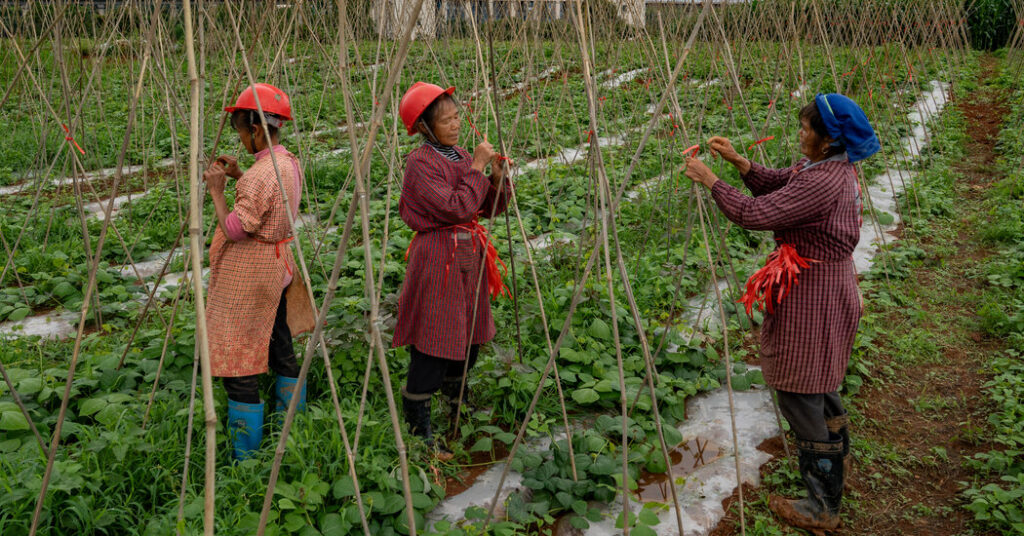
Ms. Guo described seeing farmers in their 80s or 90s still working in the fields, sometimes with canes or stooped backs. “They’re already very old and don’t have the physical ability to work anymore. But the cost of living is high,” she said, according to the Workers’ Daily, a Communist Party publication.
For many Chinese farmers, the payments are far from enough to live on. The average older rural resident spends about $80 a month on routine expenses, according to a government report published in 2024. About 180 million people receive the rural pension, a cohort that is set to grow as China’s population ages rapidly. (The pension also covers urban residents without salaried work, but the vast majority of recipients are farmers.)
The paltriness of the pension is one of the clearest examples of the vast inequalities in China’s economy, and the deep-rooted challenges that are often overshadowed by its much-touted progress in high-tech fields. While the country leads the world in sectors like robotics or electric vehicles, many of the workers who powered China’s economic rise, such as farmers and workers in low-end manufacturing, are suffering from stagnating wages and cutthroat competition.
Despite its socialist billing, China has a threadbare social safety net; the country’s top leader, Xi Jinping, has warned against the dangers of “welfarism.”
Rural residents have also long had far fewer benefits than their urban counterparts. While the average actual payout for rural pensioners is about 246 yuan, or $36, a month, retirees in cities receive on average almost 16 times more, or about $560 a month, according to the government’s 2025 Labor Statistical Yearbook. Retired officials get even more, on average $940 a month.
Zhou Shihong, a lawyer who is a member of a government advisory body, suggested the government work to close the disparity.
“If it relates to government funding or state subsidies, social security should be provided equally to everybody,” he told Chinese media, adding that the government should strive to raise the rural pension to $145 a month by 2030.
Indeed, the delegates’ calls for higher pensions were striking largely for their modesty. Some called for a rise to 500 yuan, or $70, a month. That increase, for farmers over 70, would cost less than 1 percent of the country’s budget for general public expenditures, one lawmaker pointed out.
Much of the discussion online has been supportive of calls for more money for rural pensioners.
But some delegates have sounded notes of caution. The president of a major Chinese electronic appliance company said that even a seemingly small increase would add up quickly. Major state media outlets have largely been silent on the outcry.
China’s finance minister, in an unrelated news conference last week, acknowledged the importance of ensuring people’s livelihoods but also said that the country’s revenue was “under pressure” and called for reducing expenditures. A slow-moving housing market crash has hurt local government revenues, which rely heavily on land sales.
Proponents of higher pensions said that with more money, residents would be willing to spend more, which in turn would help the government meet a major goal of increasing domestic demand.
For many, though, the main argument was more moral than pragmatic. China’s farmers had helped build the country, they said, when Mao-era policies required them to sell their crops for artificially low prices, turn their land over to the state and pay agricultural taxes.
They acknowledged that urban residents pay more into the pension system than rural residents do, but said the system did not account for the farmers’ historic contributions.
“These contributions cannot be measured by simple payment records,” a commentary in China Business Network, a Shanghai-based media outlet, said. “Increasing farmers’ pensions is not about providing them with welfare, but rather about paying back a debt.”
Siyi Zhao contributed research.
Vivian Wang is a China correspondent based in Beijing, where she writes about how the country’s global rise and ambitions are shaping the daily lives of its people.
The post At China’s Big Political Meeting, a Rare Debate About Inequality appeared first on New York Times.