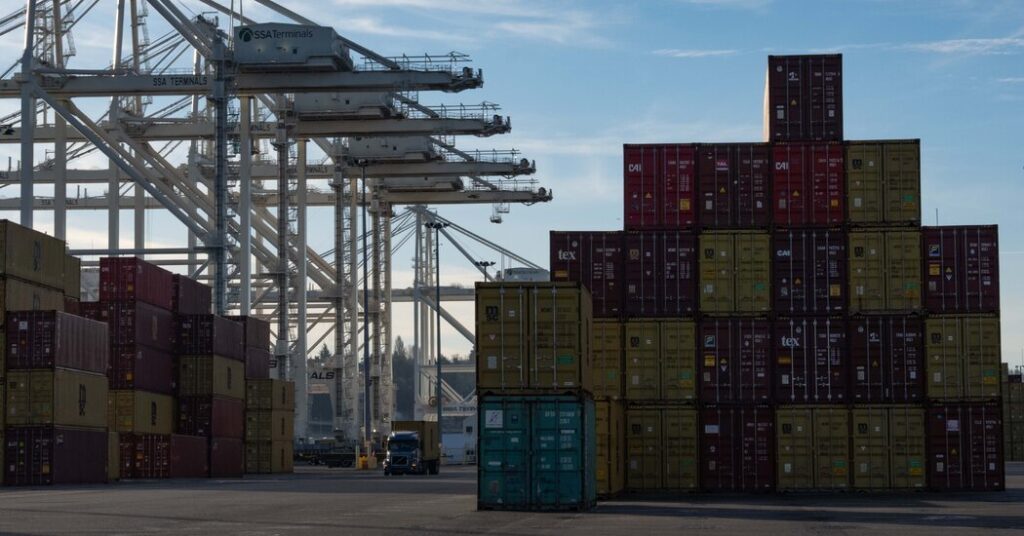
The Trump administration on Wednesday announced a new trade investigation into unfair trading practices by 16 of America’s largest trading partners, as it works to resurrect a system of tariffs recently struck down by the Supreme Court.
The trade investigation will look into what the administration called “excess capacity” in the factory sectors of foreign countries, which it said had resulted in overproduction and large and persistent U.S. trade deficits with those nations.
The investigation will target China, the European Union, Singapore, Switzerland, Norway, Indonesia, Malaysia, Cambodia, Thailand, South Korea, Vietnam, Taiwan, Bangladesh, Mexico, Japan and India, Jamieson Greer, the United States Trade Representative, told reporters on Wednesday.
Mr. Greer said that he had briefed those countries and that the announcement would not come as a surprise. But the move is likely to further anger America’s trading partners. Foreign governments have spent months negotiating and making concessions to the Trump administration to reduce previous tariffs, only to have many of those levies overturned by the Supreme Court.
Mr. Greer said the government would announce another sweeping trade investigation as soon as Thursday. That case would cover 60 countries to determine whether they had passed laws against the import of goods made with forced labor.
More trade investigations are on the way, he said, potentially into issues including digital services, pharmaceutical pricing and unfair trade in sectors like rice and seafood. Mr. Greer did not say how high the new levies would be, but he has previously said he would try to replicate the previous tariff structure struck down by the court.
The administration is pursuing a patchwork of actions to replace the tariffs that were rejected by the Supreme Court. President Trump has issued a 10 percent global tariff, but that is set to expire in July unless Congress agrees to keep it in place.
The new trade investigations appear likely to result in tariffs before that deadline. They will be carried out under Section 301 of the Trade Act of 1974, a law that allows the United States to impose tariffs in response to unfair trade practices.
The administration is required to carry out an investigation and hold consultations and hearings before it can impose those import taxes. Mr. Greer’s office said a hearing would be held on May 5 for the excess-capacity investigation.
That investigation would consider a wide range of trade practices, which Mr. Greer said would vary from country to country. Those include the use of subsidies, policies that suppress domestic wages, the role of state-owned enterprises and market access barriers for foreign products. It would also look at inadequate labor and environmental protections and social safety nets, subsidized lending and currency manipulation.
In a notice published on Wednesday, the Trump administration said that many sectors were plagued by excess capacity, including aluminum, cars, batteries, electronics, processed food, robotics and solar modules.
Scott Paul, the president of the Alliance for American Manufacturing, a group that supports domestic factories, commended the new investigation and said that overcapacity was “a serious problem.”
“In some cases, such as Chinese autos and steel, it has wrecked economies and industries, as well as cost jobs in America,” he said.
The announcements come as Mr. Trump prepares to travel to China at the end of the month to discuss trade relations and other issues with Xi Jinping, China’s leader. It also comes amid protracted trade discussions with countries including the European Union, whose officials have slowed their work toward a trade deal as they try to understand their new terms of trade.
Mr. Greer said the trade deals that countries had signed were “independent” of the new investigations. Foreign countries were interested in maintaining their deals, he said, and that the prior commitments they had made “will be considered.”
The Supreme Court greatly curtailed Mr. Trump’s use of tariffs last month when it ruled that the president had exceeded his legal authority in using an emergency law, the International Emergency Economic Powers Act, to issue tariffs. The president had used the law to impose tariffs on Canada, Mexico and China for what he said was their role in funneling fentanyl to the United States. He drew on it again during “Liberation Day” in April, when he announced a slew of import taxes on foreign countries that were ostensibly directed at balancing trade.
The Supreme Court ruling does not affect other trade statutes that the president can use to impose tariffs, albeit less flexibly. That includes Section 122 of the Trade Act of 1974, which Mr. Trump has used to impose the 10 percent, 150-day global tariff. It also includes Section 301 and another national-security-related statute, Section 232 of the Trade Expansion Act of 1962, which is under control of the Commerce Department.
Commerce Department employees have been looking into new trade investigations using Section 232 on industries including batteries, chemicals, plastics and equipment for telecommunications and the electrical grid.
Ana Swanson covers trade and international economics for The Times and is based in Washington. She has been a journalist for more than a decade.
The post Trump Targets Major Trading Partners With New Investigation appeared first on New York Times.