In the wake of the Trump administration’s removal of President Nicolás Maduro from Venezuela and amid the U.S. bombing campaign in Iran, it may soon be Cuba’s turn.
Less than two months after imposing a brutal oil blockade on the island in order to maximize pressure on the government, President Trump is now bragging that the Cuban regime is on the verge of collapse and that its leaders want to “make a deal.”
As may have been the case in Iran, Mr. Trump’s focus on Cuba appears to be driven by the perceived ease of the Venezuela operation, in which the capture of Mr. Maduro led to the quick emergence of a more accommodating partner, Delcy Rodríguez. But the president seems to lack a clear vision for a Cuba intervention: He has recently floated options including a friendly takeover, a “liberation,” or, according to recent reporting, economic liberalization without full regime change.
Any resolution forged in the current standoff between Washington and Havana risks being a hollow victory, offering only a temporary reprieve for Cubans and a fleeting achievement for an administration that has yet to define what lasting success in Cuba looks like. A continued squeeze on the island aimed at the destruction of the state could bring chaos and perhaps even a new refugee crisis. A deal limited to managed economic liberalization could offer a brief diplomatic win, but it would most likely close off the chance of a real political opening.
Still, catastrophe in Cuba is not a foregone conclusion. It also presents an opportunity — a chance for broader international engagement that could head off impending disaster.
For more than half a century, the United States has maintained an embargo on Cuba. Though its theory of political change for the island nation was never clear, the approach was presumably intended to either force Cuba’s Communist government to surrender or to spark a massive popular uprising that would overthrow it. But as the cases of Iran, Venezuela and Cuba all demonstrate, sanctions rarely topple entrenched authoritarian systems, which use external threats to justify internal repression and consolidate their grip on dwindling resources.
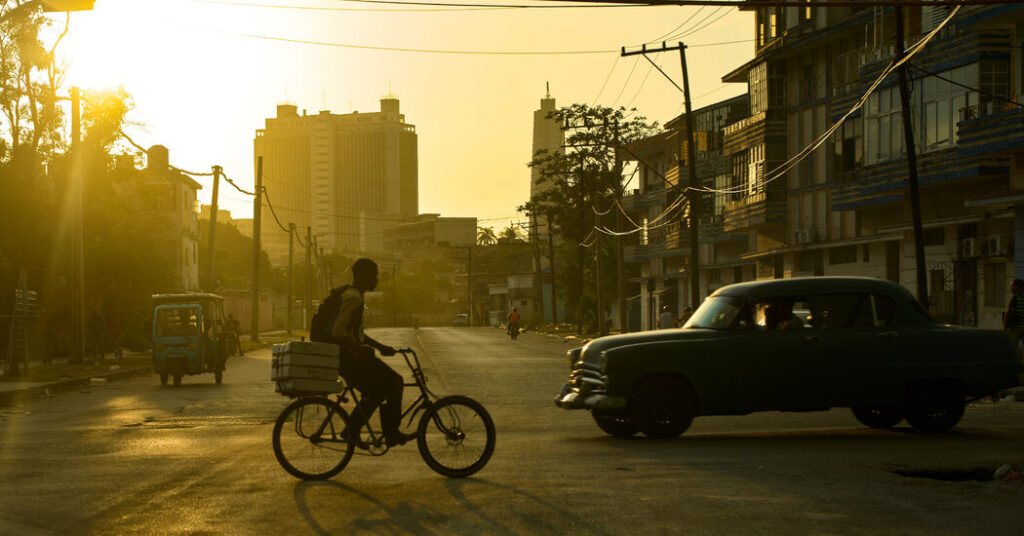
This year, the Trump administration nonetheless decided to turn the screws further on Havana by blocking oil shipments to the island. Rather than provoking the government’s collapse, though, the move has only plunged the country further into a dire humanitarian crisis. With Cuba’s oil reserves running low, power cuts of up to 20 hours have become normal. Lack of access to fuel is bringing transport and tourism to a standstill and has altered work and school schedules, increased food shortages and prices, devastated an already weakened health care system and forced most people to focus on the basic, existential chores of daily survival.
Yet the regime lives on. Sixty-seven years since the revolution that brought Fidel Castro to power, the Cuban government survives on its smothering control over the country’s society and economy. Even in the throes of an emergency, the Cuban state and its leadership remain relatively aligned and politically consolidated, having built a deep-seated siege mentality over decades of confrontation with its neighbor to the north.
The coherence and loyalty within Cuba’s state apparatus preclude the sort of smash-and-grab operation that delivered Mr. Maduro and his wife to a Brooklyn jail. There is no one person to take out, no compliant deputy waiting in the wings to replace them. An air bombing campaign of the sort now occurring in Iran would be likely to just create a power vacuum and deepen the desperation on the island.
Reports that Secretary of State Marco Rubio has been involved in behind-the-scenes talks with Raúl Castro’s 41-year-old grandson signal an unexpected — and inauspicious — trajectory. If true, these discussions appear to be heading toward a modest government reshuffling and a settlement for some economic reforms.
Cuba’s decrepit state-led economic model has indeed failed. But an opening that injects market incentives without political change will not provide the security and predictability that an emerging private sector and foreign investors require. (It also sounds surprisingly like the Cuba policy of former President Barack Obama, who, through his modest liberalization of the embargo, sought to expand and empower Cuba’s independent economic sector and introduce liquidity into the market by boosting tourism.) Such concessions are also unlikely to be accepted by many in the politically powerful Cuban-American community, who have long advocated complete regime change.
There is still an opportunity for a softer landing that could alleviate Cubans’ suffering and pave the way for a more stable and peaceful political and economic transition. But it requires Washington to coordinate with allies in the Western Hemisphere and in Europe.
The first step would be to work with other international actors invested in Cuba’s future to mount a joint campaign of humanitarian assistance. The Trump administration seems to recognize the severity of the crisis in Cuba, but funneling aid through either the Catholic Church or the private sector, both of which are being advanced by the White House as options to bypass state channels, is insufficient to meet the needs of the population.
The second involves establishing formal talks between the U.S. government, the Cuban government and the Cuban diaspora. These negotiations should include representatives from Europe, Canada, Latin America and the Vatican who could serve as neutral arbiters and provide the institutional guarantees that neither Washington nor Havana currently trusts the other to uphold. These individuals could guide a process of meaningful talks to push for human rights protections, a gradual de-escalation of the embargo and genuine political pluralism.
If conditions on the ground continue to get worse, Cuba may soon descend into chaos. Alongside further state repression, this could prompt a refugee crisis that would make the Mariel boatlift exodus of 1980, in which around 125,000 Cubans fled to the United States, look small in comparison. It could also motivate members of the Cuban diaspora to take things into their own hands, either through violence or through uncertain, fantastical models of regime change.
That impulse came to a tragic end recently when a group of 10 people, including at least one U.S. citizen, was intercepted in Cuban waters, having set sail from Florida armed to the teeth in an apparent attempt to sow instability on the island. Other such efforts could force the United States’ hand to intervene militarily to defend the lives of Americans.
There is still, at least for now, a window in which the world can defuse the consequences of Washington’s cruel and reckless adventurism. Onlookers, U.S. voters and especially Cuba’s long-suffering citizens can only hope.
Christopher Sabatini is a senior fellow for Latin America at Chatham House. Katrin Hansing is an associate professor of anthropology at Baruch College at the City University of New York.
The Times is committed to publishing a diversity of letters to the editor. We’d like to hear what you think about this or any of our articles. Here are some tips. And here’s our email: [email protected].
Follow the New York Times Opinion section on Facebook, Instagram, TikTok, Bluesky, WhatsApp and Threads.
The post Cuba Doesn’t Have to Be Next appeared first on New York Times.