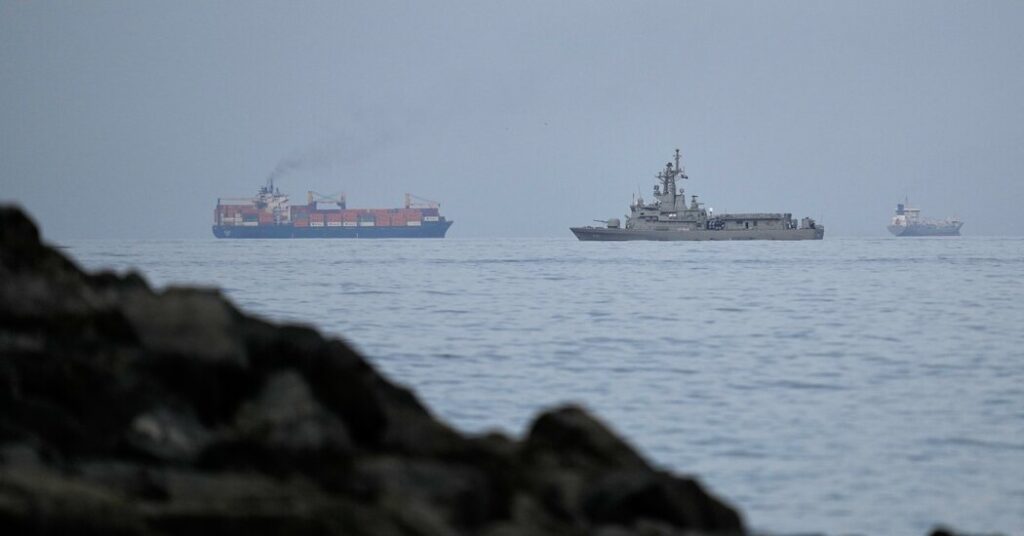
World leaders raced on Wednesday to shore up the global oil supply as the war in the Middle East and retaliatory attacks by Iran threatened to choke off the Strait of Hormuz, a vital passage for oil tankers. The threat was punctuated when three ships in or near the strait were damaged by strikes.
Hours later, the International Energy Agency said that its 32-member countries — which include Britain, Germany, Japan and the United States — would release 400 million barrels of oil from their strategic reserves, the most ever and the first such coordinated action since 2022, after Russia launched its full-scale invasion of Ukraine.
Fatih Birol, the agency’s executive director, did not say when the countries would begin releasing the oil, which would be enough to meet about four days’ worth of global demand. The coordinated effort came as high oil prices have driven up costs for consumers, with gas prices in the United States rising for the 11th straight day on Wednesday to a national average of $3.58 a gallon.
“This is a major action aiming to alleviate the immediate impacts of the disruption in markets,” Mr. Birol said in Paris, where the International Energy Agency, which was created in 1974 to help prevent price shocks, is based. “But to be clear, the most important thing for a return to stable flows of oil and gas is the resumption of transit through the Strait of Hormuz.”
On Wednesday evening, the U.S. Energy Department said the United States planned to release 172 million barrels of oil from its strategic reserves over the course of four months, beginning next week, as part of the coordinated effort.
The moves came as Israel and the United States launched more attacks against Iran and the Israeli military said on Wednesday evening that it had begun a “wave of extensive strikes” against what it described as Hezbollah infrastructure in the southern outskirts of Beirut, the Lebanese capital.
Explosions echoed across the city as night fell, rattling windows and sending thick plumes of acrid smoke rising over the capital.
Earlier, residents of central Beirut’s densely populated Aisha Bakkar district awoke to explosions after Israeli strikes hit an apartment building in the area. At least four people were wounded, the Lebanese health ministry said. Parts of the multistory building were blasted apart, sending debris, twisted rebar and rubble crashing onto cars in the street.
“I woke up and found myself on the floor,” said Ahmad Ballout, 67, an English teacher who lives in an apartment building facing the one that was struck. “We didn’t expect this at all.”
In Iran, crowds of people thronged the streets of Tehran on Wednesday to mourn military commanders killed by U.S. and Israeli strikes. As coffins were driven through the streets on flatbed trailers, state media showed thousands of men and women waving flags of the Islamic republic, slapping their chests with their hands and chanting slogans of devotion to Iran’s clerical leadership, and “Death to Israel.”
In interviews, some Iranians, however, described feelings of anxiety and despair because of the ongoing American and Israeli bombing campaign.
“Day by day, we have become more discouraged and hopeless,” said Iraj, 48, a resident of Tehran who asked to be identified by only his first name for fear of retaliation. “We only go outside when it’s absolutely necessary, mainly to get basic essentials or food, and even then only if we really have no other choice.”
Saeed, 38, another resident of Tehran, said that he had been staying awake at night, waiting for airstrikes to end.
“The war was supposed to focus on military sites, but we are seeing that residential areas around us have also been attacked,” he said, adding, “Our lives have been paralyzed, and work has completely stopped.”
Mr. Trump, who has sent contradictory signals about the duration of the war on Iran, told Axios on Wednesday that it would end soon because there was “practically nothing left to target.” But Mr. Trump has also said only Tehran’s “unconditional surrender” would end the war, and Iran has shown no sign of halting its attacks.
U.S. and Israeli strikes have killed more than 1,300 people in Iran, according to Iranian officials, a toll that has undoubtedly climbed since the last figures were released days ago. Dozens of people — including seven U.S. service members — have been killed by Iran’s retaliatory strikes on neighboring countries. The Pentagon said on Tuesday that 140 U.S. service members had also been wounded, eight severely.
In Lebanon, officials said more than 630 people had been killed and over 800,000 had been displaced from their homes.
On Wednesday, the Israeli military said it had sent an additional infantry battalion to its border with Lebanon, as the Israeli military appeared poised to escalate its campaign against Hezbollah. Israeli forces have already been pushing deeper into Lebanon — expanding a de facto military buffer zone — since Hezbollah began attacking Israel last week.
As concerns rose about the safety of international shipping during a war that appeared to have no endgame, projectiles hit three vessels on Wednesday in or near the Strait of Hormuz, the narrow passage off Iran’s southern coast where one fifth of the world’s oil is transported, according to the United Kingdom Maritime Trade Operation.
A Japanese container ship owned by Mitsui, a large global shipping line, was among those hit, according to Kpler, a global ship tracking company. The two other ships, according to Kpler, were bulk carriers, which are designed to transport cargo like cars, grain and iron ore.
“This increasingly points to a sustained pattern rather than isolated incidents,” said Dimitris Ampatzidis, a senior risk and compliance analyst at Kpler. “The pace of attacks does not suggest any intention to de-escalate.”
Iran appeared to take responsibility for at least one of the attacks, on the Mayuree Naree, a Thai-flagged bulk carrier. Oman’s Navy rescued 20 of the 23 the ship’s crew members after a fire broke out in the vessel’s engine room, and efforts were underway to rescue the remaining three, the Thai Foreign Ministry said.
A photo released by the Royal Thai Navy showed orange flames and gray smoke billowing from the ship. All crew members on the other two ships were safe and accounted for, the British maritime organization said. No information on any injuries was immediately available.
Alireza Tangsiri, the Iranian commander of the navy of the Islamic Revolutionary Guards Corps, said in a social media post that “any vessel that intends to pass must obtain permission” from Iran.
He issued the warning a day after the U.S. military said that it had attacked 16 Iranian mine-laying vessels in or near the Strait of Hormuz, although it was unclear whether Iran has deployed mines.
U.S. officials have said they believed that Iran was preparing to mine the strait but had not actually begun, according to an American official. The preparatory efforts spooked the Trump administration, the official said, prompting the White House to order the attacks.
On Wednesday, the U.S. military signaled that it might be preparing attacks on Iranian commercial ports on the strait. In a statement, U.S. Central Command, which oversees American military operations in the Middle East, warned civilians to avoid those ports, saying they had been commandeered by the Iranian government and used “to conduct military operations that threaten international shipping.”
The leaders of the Group of 7 group of nations — the United States, Canada, Japan, Italy, Britain, Germany and France — agreed on Wednesday to explore the possibility of sending ships to escort commercial vessels in the region, according to France, which holds the group’s presidency.
The attacks on ships have given Iran some economic leverage in the war, analysts say, allowing it to block a significant amount of oil and natural gas from world markets.
At least 13 ships in the strait, the Persian Gulf and the Gulf of Oman have been struck by projectiles since Feb. 28, when the United States and Israel began bombing Iran, prompting Iran to fire missiles and drones at Israel and its Arab neighbors.
On Wednesday, the United Nations Security Council voted 13-0 in favor of a resolution condemning Iran’s retaliatory strikes on other countries. The resolution, presented by Bahrain, was supported by 135 countries, Bahrain’s representative to the United Nations said. China and Russia, which have backed Iran for many years, abstained.
Pentagon officials told lawmakers in a closed-door briefing in Washington on Tuesday that they had estimated that the war on Iran had cost the United States more than $11.3 billion in the first six days alone, according to three people familiar with the briefing. The estimate did not include the military buildup ahead of the first strikes.
Reporting was contributed by Aaron Boxerman, Vivian Nereim, Yeganeh Torbati, Leily Nikounazar, Sarah Chaayto, Euan Ward, John Ismay, Johnatan Reiss, Sanam Mahoozi, John Yoon, Rawan Sheikh Ahmad, Eshe Nelson, Peter Eavis, Sui-Lee Wee and Chris Cameron.
Rebecca F. Elliott covers energy for The Times.
The post Countries Scramble to Shore Up Global Oil Supplies as Ships Are Attacked appeared first on New York Times.