DUBAI — The International Energy Agency on Wednesday announced that it would carry out its largest-ever release of oil reserves — 400 million barrels — in a bid to control spiking energy prices caused by the United States-Israel war against Iran, which shows no signs of slowing as it ends its 12th day.
The plan, aimed at stabilizing oil prices that have soared since the United States and Israel attacked Iran on Feb. 28, came as Iranian leaders declared they were widening their assault on countries in the Persian Gulf, aiming to raise the economic price of the U.S.-Israeli military campaign to oust the government in Tehran.
About a third of global emergency stockpiles will be depleted once the IEA’s 32 members release the reserves — a decision that the organization’s executive director, Fatih Birol, said was made to address challenges in the oil market that are “unprecedented in scale.”
“Oil markets are global so the response to major disruptions needs to be global too,” Birol said in a statement. By early afternoon Wednesday, the price of Brent oil futures, an international benchmark, was up more than 5 percent to about $92.50 a barrel. On Monday, at one point, it had rocketed to nearly $117.
Israel and the United States continued to strike Iran on Wednesday, and Iran appeared to dig in, declaring on state mediathat it had launched its “most intense” wave of operations against Israel.
Iran also fired drones at Saudi Arabia, Qatar, Kuwait and the United Arab Emirates, including two that landed near Dubai International Airport, and announced that banks and other businesses it sees as tied to the U.S. and Israel now would be targeted.
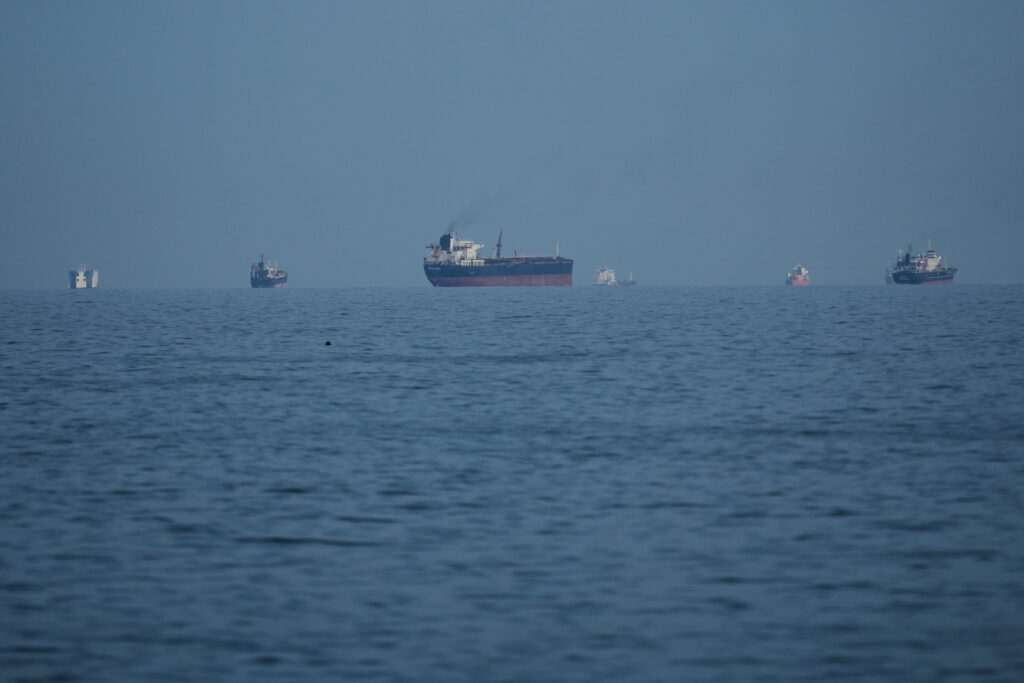
As Iran expanded its retaliatory strikes, three commercials ships traveling near the Strait of Hormuz were hit, and Tehran declared that the vital global shipping passage was fully under its control.
Analysts said that Iran was moving to increase pressure on President Donald Trump and Israeli Prime Minister Benjamin Netanyahu. The two have acted largely without soliciting the direct support of allies and have not provided any clear endgame for their joint military operation, which has now engulfed the entire Middle East, other than to say they intend to topple the Iranian regime.
“It’s about inflicting direct damage on the U.S. and global economy,” said Yasmine Farouk, the Gulf and Arabian Peninsula Project Director for International Crisis Group.
While the gulf remains “focused on defense and defending its airspace,” Farouk said, the attacks could reach a point where some gulf nations might want to take military action against Iran. But if they did so, she added, that would be with each other and the Europeans, before Israel or the United States.
Yoel Guzansky, a senior researcher and head of the Gulf Research Field at the Institute for National Security Studies, a research group based at Tel Aviv University, described Iran’s strategy as one of “attrition.”
“Iran is putting more and more pressure on the energy market, so it isn’t just hitting the gulf countries but Europe, Asia and the United States,” Guzansky said. “And that pressure is working.”
He said that gulf countries had tried “as much as possible” through mediation to avoid the war but found “that mediation and hedging has its limits, and that they found those limits.”
Traffic in the Strait of Hormuz, a narrow shipping lane that is a transit point for about 20 percent of the global oil supply, had already slowed to a trickle because of Iran’s threat to sink vessels. The disruption has had a cascading impact on world markets. Oil prices have soared to heights not seen since the pandemic and threaten to push average gasoline prices in the United States above $4 per gallon.
The chairman of the Joint Chiefs of Staff, Gen. Dan Caine, said the United States was looking at a “range of options” to protect the Strait of Hormuz. Last week, Trump had promised to use the U.S. Navy to escort oil tankers through the Strait.
But the plans might not include escorts, at least not immediately, because the U.S. focus for now is on taking out Iran’s navy and its stores of ballistic missiles and drones — the source of its power over the waterway, a U.S. official said. The official spoke on the condition of anonymity to discuss sensitive operations.
There are thousands of threats, including deeply buried munitions and drone storage sites, that the United States has now begun to hit with bombers carrying 2,000 pound munitions. It is also hitting mobile launch sites with smaller guided munitions, the U.S. official said, cautioning that the process would “take time.”
So far, the U.S. military has struck more than 5,500 targets and destroyed 60 Iranian warships, the commander of U.S. Central Command, Adm. Brad Cooper, said in a recorded video posted to social media Wednesday.
Centcom said Tuesday that its forces had eliminated “multiple Iranian naval vessels,” including 16 minelayers — which U.S. officials have said are endangering shipping — near the Strait of Hormuz.
The United Kingdom Maritime Trade Operations (UKMTO), a monitoring agency that is part of the British royal navy, said three ships were hit by “unknown projectiles” Wednesday. One was a cargo ship traveling north of Oman, another was a bulk carrier hit north of Dubai, and the third was a container vessel struck near Ras al-Khaimah in the United Arab Emirates.
Two of those ships — a Liberia-flagged vessel and the other Thai-flagged — were hit after they disregarded warnings, according to Iranian state media.
As leaders reacted with alarm to the surge in energy prices, French President Emmanuel Macron on Wednesday afternoon convened a videoconference of leaders of the Group of Seven advanced economies “to discuss the economic consequences of the war in the Middle East, particularly the energy situation and measures to mitigate it.”
The impact of the oil release from the emergency stockpile could be limited because moving oil out of reserves is logistically complicated and time-consuming. At a time when the daily flow of oil has been reduced by roughly 20 million barrels per day, the release is expected to backfill just a small fraction of that amount.
Meanwhile, the crisis is escalating among gulf state oil producers, which are running out of places to store their crude. They are being forced to ramp down operations and may have to shut some facilities altogether until shipping routes reopen. That has a domino effect, as the operations cannot be quickly resumed. Ramping them back up takes weeks, potentially adding to the chaos in oil markets.
The strikes on the commercial vessels occurred the same day that Iran’s Islamic Revolutionary Guard Corps threatened to attack “economic centers and banks” in the region that have links to the United States and Israel. A government-linked news agency released a list of companies that it said could be targets, including Google, Microsoft and Palantir.
In Dubai, the UAE’s glitzy metropolis, many employers have encouraged staff to work from home, and a wave of residents have left the city altogether. Those who remain exchanged worried calls and WhatsApp messages on Wednesday afternoon as news spread that Iran planned to target businesses.
Several banks and U.S. tech companies in the UAE ordered employees to evacuate their offices, according to an individual briefed on the security situation who spoke on the condition of anonymity because he was not authorized to speak to the media. Others instructed staff to work from home for the remainder of the week as a precaution.
Come nightfall in Dubai, missile alerts were again blaring from residents’ phones, urging them to take shelter amid a potential wave of missiles.
Halper reported from Washington. Ellen Francis in Brussels and Susannah George in Washington contributed to this report.
The post Nations agree to release oil reserves as war in Iran hits global economy appeared first on Washington Post.