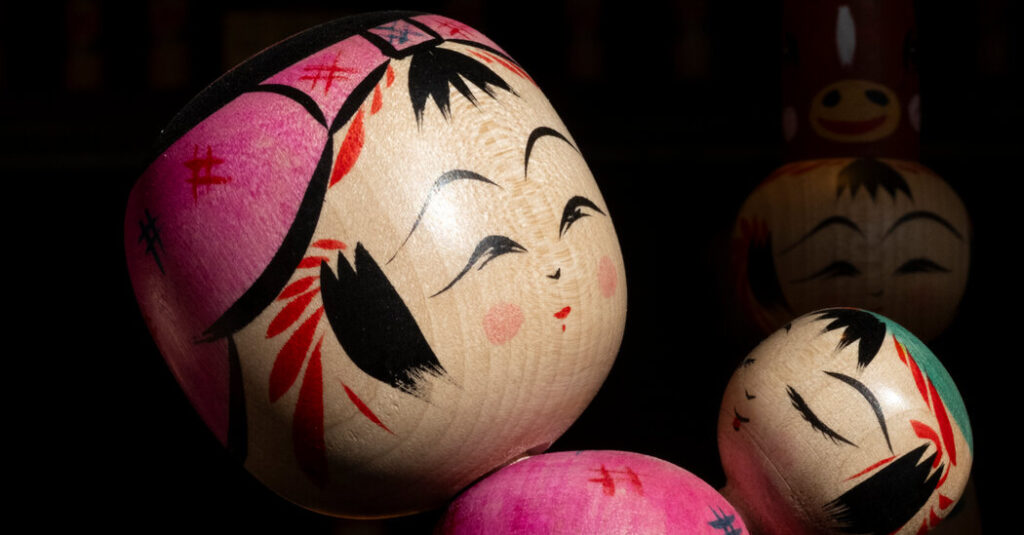
As snow fell recently over Sakunami Onsen, a hot-spring district in Japan’s Tohoku region, two oversize dolls known as kokeshi stood next to the train tracks, greeting the arriving passengers. They were a colorful reminder that this area has long been a center for those traditional wooden figures.
According to the Tohoku region’s Bureau of Economy, Trade and Industry, kokeshi (koh-keh-shee) originated in the late Edo period, which ended in 1868, in the area’s hot-spring villages, where woodworkers began making toys that over time developed into distinct local traditions.
Typically made from mizuki, or dogwood, and painted with spare yet expressive faces, they were once children’s toys — objects meant to be held, dressed and played with — and now are considered a regional craft.
About 50 traditional kokeshi artisans are currently active in Miyagi Prefecture, according to the Miyagi Traditional Kokeshi Association Federation. A five-minute drive from the station, past snowy fields and large hotels featuring onsen (hot-spring baths), is the workshop of one of them, Teruyuki Hiraga, an eighth-generation kokeshi artisan. The two-level building houses his workshop and a small boutique, where visitors browse neatly arranged dolls.
Inside the shop, kokeshi in all shapes and sizes filled every corner, ranging from traditional forms to more modern interpretations. In the workshop, the scent of wood filled the room.
Boxes filled with kokeshi (some as-yet unpainted) rested on tables, surrounded by tools, pots of paint and brushes while a wood-burning stove at the center kept the space warm.
Mr. Hiraga, 54, did not follow a traditional academic path. “I apprenticed under my father, Kenichi, and my grandfather, Kenjiro, when I was 15,” he said. “I never really enjoyed studying at school. I was happier working with my hands.”
After his father’s death in 2007 and his grandfather’s in 2012, he gradually assumed responsibility for the workshop. “Today, I carry out all the production myself,” he said, making about 5,000 dolls a year.
The roots of Sakunami kokeshi are deeply intertwined with the region’s wood-turning tradition (a craft in which a block of wood is shaped while spinning on a lathe, allowing artisans to carve smooth, symmetrical forms such as bowls, toys and, in Tohoku, kokeshi dolls).
The earliest artisans in Sakunami were wood-turners with ties to other craft centers in Japan, and over generations, marriages and family networks helped shape the distinctive aesthetic that defines Sakunami dolls today. “Through these family ties,” Mr. Hiraga said, “the tradition became firmly established.”
According to Mr. Hiraga, a document discovered by a researcher and written by a wood-turner to an apprentice in 1860 records the dimensions and prices of wooden goods and kokeshi dolls of that era. “Because this document exists, Sakunami is regarded as the birthplace of kokeshi,” Mr. Hiraga said.
In those early years, wood-turners primarily produced bowls and everyday utensils for sale to travelers passing through their town. Toys soon followed: spinning tops for boys and simple painted dolls for girls — early forms of kokeshi that gradually evolved into the figures recognized today.
Kokeshi begin as carefully selected logs, usually the fine-grained mizuki, prized for its smooth finish.’
“Mizuki is the main material,” Mr. Hiraga said, noting that Japanese maple and cherry are occasionally used, depending on availability. Artisans once cut their own trees or sourced wood from local charcoal makers, but shifting rural economies have complicated the process. “Now we buy from lumber mills,” he said. “The wood is expensive, and sometimes it’s simply unavailable.”
Timing matters. Trees are ideally felled between November and March, when moisture levels are lower. After purchase, the bark is stripped to encourage drying, and the logs are left to cure naturally, a process that can take anywhere from six months to three years. Only then are the logs cut into blocks sized for individual dolls.
Unlike many traditional crafts that divide labor among specialists, kokeshi production is typically handled start to finish by a single artisan. “Every step is extremely difficult,” Mr. Hiraga said. “And every day is still a learning experience.”
It all starts with logs of raw wood that must be cut to the required dimensions. (Mr. Hiraga cuts his wood in a building behind his workshop, where stacks of logs are stored). To demonstrate, he split a log in half before sawing it down into a neat block, ready for shaping. He then moved to a spinning lathe, where the rectangle of wood became a rounded shape that would become the doll’s body.
“The carving blades are handmade, a tradition that has remained largely unchanged across generations,” Mr. Hiraga said, adding that he forged most blades himself. Some kokeshi are made from a single block of wood; for others, the head and body are done separately.
Back in the main workshop, Mr. Hiraga carried out more-detailed lathe work, refining the head and carving fine circular lines into the surface.
When it came time to color the doll, it spun quickly on the lathe as he touched it with red and green dye using a thin brush. The controlled rotation allowed the patterns to form with striking precision. He then took the doll from the lathe, finishing the face with black paint for the eyes and hair, and a touch of red for the mouth, before adding red and green patterns to the body. He signed his name in black on the base.
Of all the steps, the painting is the most delicate. “Drawing the eyes is the most nerve-racking,” he said, explaining that a single brushstroke determines the doll’s personality. While tools and materials have evolved slightly through exchanges with other kokeshi lineages, the essential motifs (the spare faces and traditional patterns) remained largely unchanged.
It took about 30 minutes for Mr. Hiraga to make one doll from start to finish. At the boutique, kokeshi prices range from 1,500 yen, or $9.60, to 20,000 yen, or $128, for larger or more intricate pieces.
The market for kokeshi has changed significantly over the course of Mr. Hiraga’s career. “From the time I began my apprenticeship, sales gradually declined,” he said, noting shifts that followed Japan’s economic downturns. In earlier decades, his grandfather and father produced large quantities of traditional dolls for inns, hotels and tourist facilities across the region, as well as large commemorative pieces commissioned by municipalities.
Today, smaller homes mean smaller dolls, and seasonal or contemporary variations have become increasingly popular alongside traditional forms.
Rising material costs, especially for wood, present another challenge. “We have to raise prices, which is difficult,” he said. “And there is also the issue of successors.” While some kokeshi lineages now rely on government-supported training programs, Sakunami currently has no apprentices.
Mr. Hiraga has chosen to navigate these changes by holding onto tradition while adapting to the present. “I continue to make traditional kokeshi without changing them, while also creating new types,” he said. “I try to maintain a good balance. I don’t think it’s good to focus exclusively on only one.”
Even as technology reshapes daily life, he still believes in the power of making something by hand. “I want people to feel the warmth of wood and to create kokeshi that bring comfort simply by being seen,” he said. “The world is becoming increasingly convenient, but the warmth of handmade work will not change.”
For now, he works alone in the workshop, still refining his own skills. The workbenches of his father and grandfather remain, their tools left untouched along with some kokeshi they had made.
“I am still learning every day,” Mr. Hiraga said, adding that his 10-year-old son has expressed interest in the craft. Mr. Hiraga said he looked forward to the day they might make kokeshi side by side.
The post A Centuries-Old Tradition Making Wooden Dolls appeared first on New York Times.