An environmental group is raising concerns about high levels of bacteria recently found in a Montgomery County stream nearly two months after a major wastewater pipeline collapse caused more than 200 million gallons of raw human sewage to spew into the Potomac River.
The findings from the Potomac Riverkeeper Network come as a group of land and boat owners has filed a class-action lawsuit against D.C. Water — the independent utility responsible for the pipeline — seeking damages for alleged harm to their businesses and property from the disaster.
D.C. Water crews have been racing to contain the sewage spill since the January break in the Potomac Interceptor, a 54-mile-long pipeline that carries about 60 million gallons of raw sewage a day from the Maryland and Virginia suburbs to a treatment plant in the District.
Over the past few weeks, there have been spikes in the waterway in the levels of E. coli and the bacteria that causes staph infections, according to water quality testing by scientists in environmental groups and government agencies. At times, E. coli levels have been more than 10,000 times the Environmental Protection Agency’s standards for recreational water quality.
That led authorities in the region to temporarily warn the public against contact with the Potomac or engaging in boating, fishing or other recreational activities in it. Advisories remain in place in Montgomery County and parts of Virginia.
The region’s drinking water has remained safe; in D.C., the system operates separately from the wastewater and sewage pipelines.
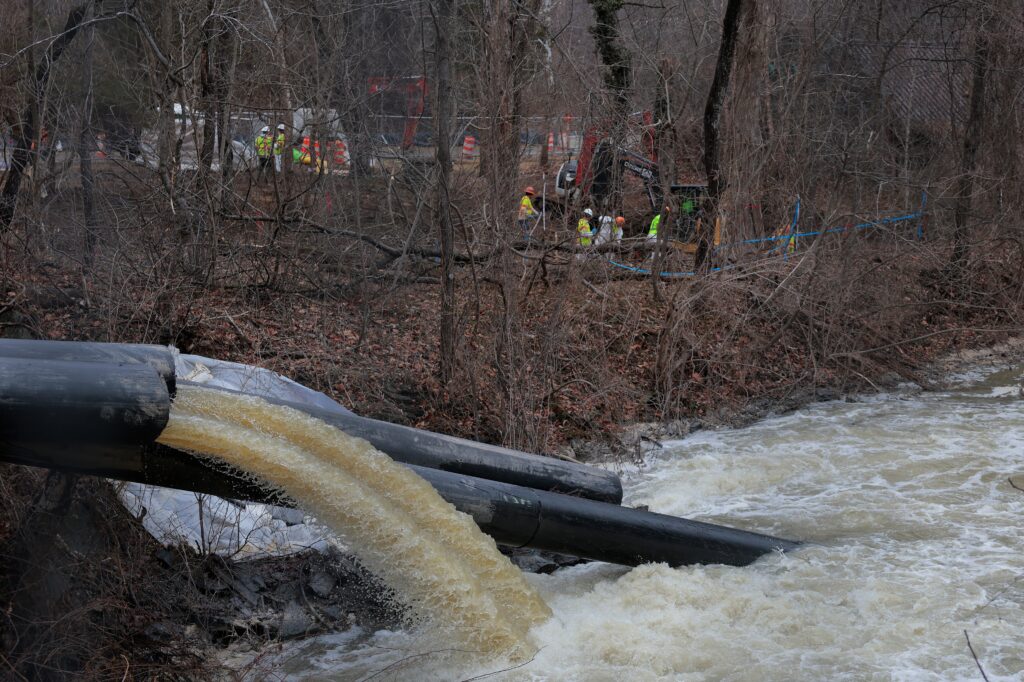
D.C. Water has said there have been no overflows into the river since Feb. 8, as crews set up a bypass pumping system to divert the sewage around the damaged part of the pipeline and into the nearby Chesapeake & Ohio Canal, where it’s then redirected back into the sewer line.
But the Potomac Riverkeeper Network said Tuesday that recent testing shows concerning levels of bacterial fecal contamination in a nearby stream. The stream travels through a tunnel, underneath the canal where sewage has been diverted.
The group said tests in the area of a culvert showed E. coli levels “consistently one to two magnitudes” higher than the EPA’s standard for what is considered safe.
“The canal has raw sewage running through it, and that may be dripping into the tributary,” said Betsy Nicholas, president of the Potomac Riverkeeper Network.
She said her group alerted environmental officials in Maryland and authorities at D.C. Water of its findings. The group said in a statement that “D.C. Water, federal and state environmental regulators should urgently respond by investigating and abating the source of the contaminated discharge.”
D.C. Water said Tuesday it was “aware of the testing” done by the group and it is “actively investigating the impact of the bypass on the culvert and adjacent tributary, while ongoing mitigation efforts have been underway.”
The U.S. Army Corps of Engineers planned to install a containment system in the area of the stream and culvert to “allow crews to wash the inside of the historic structure [of the culvert] using National Park Service-approved preservation methods.” D.C. Water said the work was “already in progress at the time of the Potomac Riverkeeper report” and has since been finished.
D.C. Water said in an email that “water that collects below the culvert will be pumped through the existing C&O Canal bypass, thereby avoiding the adjacent tributary” to the river. The efforts will “reduce the amount of water flowing out of the culvert” and allow it “to assess the impact of the interceptor bypass on the culvert,” officials said.
John Lisle, a D.C. Water spokesman, said in the email that since Jan. 24, the bypass “has prevented over 1 billion gallons of wastewater from reaching the Potomac River.”
Lisle said the bypass system will be removed once emergency repairs are complete and flow to the pipeline is restored. Environmental rehab is planned for the impacted areas and the C&O Canal. The utility and other environmental agencies have been doing routine water testing at several spots near the spill site.
The new findings come days after a class-action lawsuit was filed in U.S. District Court of Maryland in Greenbelt alleging that D.C. Water failed to adequately respond to corrosion in the interceptor pipeline detected during inspections between 2011 and 2015.
D.C. Water is in the midst of a long-term, $625 million project to rehabilitate the most vulnerable sections of the 60-year-old pipeline, but crews had not yet reached the section where the collapse occurred.
At a Feb. 26 community meeting in Bethesda, D.C. Water chief executive David Gadis said that the interceptor pipeline’s thinning walls may have contributed to its collapse and that the weight of large rocks and boulders used as backfill when it was constructed may have put too much pressure on the pipeline.
The lawsuit alleges D.C. Water knew of “systemwide corrosion” but “failed to implement adequate interim safeguards, emergency preparedness plans, or monitoring protocols to prevent or contain a catastrophic failure in the highest-risk unremediated sections of the system.”
Because of the spill, the lawsuit alleges, boat owners, businesses and nearby landowners have had to deal with contamination, cleanup costs and lost use of the waterway. It also says there are concerns that property values could be diminished and marinas, boathouses and outfitters that depend on river access could suffer financial losses.
The lead plaintiff — Nicholas Lailas, of Great Falls, Virginia — alleges that he’s “incurred specific out-of-pocket costs for vessel cleaning and decontamination” for the 45-foot long boat he keeps at Columbia Island Marina, which is downstream from the collapse site, and he’s been “deprived of use of his vessel.”
Lisle, of D.C. Water, said in an email Tuesday that the utility would not comment in detail on pending litigation. He wrote the agency believes “the collapse of the Potomac Interceptor was a serious and unexpected event, and our teams remain focused on the response, environmental protection, and restoration efforts.”
D.C. Water said crews are expected to finish emergency repair work by mid-March. Contaminated material is being hauled away, and workers are clearing brush, trees and other debris near the collapse site.
As the emergency repairs have been underway, several agencies have repeatedly tested the water quality.
On Tuesday, the Maryland Department of the Environment lifted its precautionary shellfish harvesting closure in part of the Potomac. Officials said in a statement that they had conducted “continuous testing” in areas nearly 60 miles from the sewage spill site over the last few weeks and the results showed “bacteria levels below the laboratory detection limit.”
The public could “confidently enjoy seafood” from the Potomac River and the Chesapeake Bay, Environment Secretary Serena McIlwain said in a statement.
Officials in Maryland also said advisories on limited recreational contact with the water have been lifted in Prince George’s and Charles counties, but there’s still a warning in place for Montgomery County.
Earlier this month, D.C. officials lifted an advisory steering residents away from the river, saying water quality levels within city limits had returned within limits for safe recreation, aside from expected bumps in bacteria levels after rain and snow.
The Virginia Department of Health also recently lifted part of its advisory against recreational activities on the Potomac from the Route 120 Chain Bridge in the Arlington area to the Gov. Harry W. Nice Memorial Bridge (Route 301) in King George County. The advisory remains in place in other areas of the river.
The post High bacteria levels found in nearby stream after Potomac sewage spill appeared first on Washington Post.