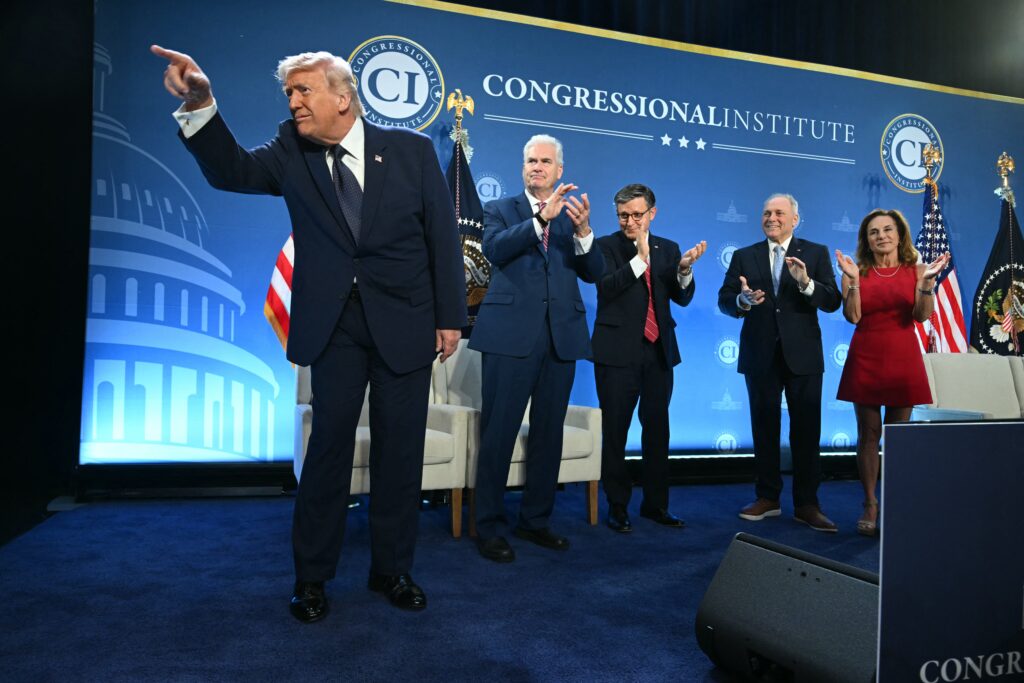
DORAL, Fla. — House Republicans, who risk losing control of their narrowly divided chamber in November, are scrambling to agree upon a legislative agenda for the remainder of the year that could unify their splintered conference and strengthen their standing with voters heading into the midterms.
During a policy retreat here that wrapped Wednesday, GOP leaders outwardly projected optimism that they can maintain their majority if they pass an agenda that builds upon what they see as a major win last year: President Donald Trump’s massive tax and immigration legislation, which he dubbed the “One Big Beautiful Bill” and became law without any Democratic votes.
But Republicans face major hurdles in coming months, and some lawmakers acknowledged privately that they are preparing to return to the minority. The GOP has yet to coalesce around specifics of a legislative package, and historically the president’s party loses seats in the midterms. Several recent developments, including economic fallout from Trump’s war with Iran, have only added to the headwinds Republicans face.
“I’ve been telling people it’s time for the handwringers and the bed-wetters to sit this one out, because it’s going to be hard. There’s no question,” Majority Whip Tom Emmer (R-Minnesota) said of increasingly nervous GOP lawmakers. “Being in the minority and acting like you’re going to the minority are the laziest, easiest things to do in the world.”
Republicans, however, have their work cut out for them as they sprint to deliver a second “big bill” of Trump priorities.
Addressing the GOP conference at its retreat Monday, Trump ticked off several initiatives he would like to see included, most of which face long odds on Capitol Hill.
Chief among them: an expanded version of the Save America Act, a bill previously passed by the House that would require Americans to prove they are citizens by showing a passport or a birth certificate when they register to vote and require voters to show photo identification at the polls. Trump has since demanded adding provisions that would restrict voting by mail, bar trans women from participating in women’s sports and restrict gender transition care for children.
Trump also encouraged Republicans to: send health care subsidies directly to consumers to buy their own health care; codify an executive order pegging U.S. prescription drug prices to other countries’; and ban Wall Street firms from buying single-family homes.
Speaker Mike Johnson (R-Louisiana) told reporters Tuesday that it is “still a priority” to pull together a second bill with assorted GOP priorities, but he added that he’s working to figure out what “small subset of issues” can get every Republican vote — and make it through the Senate.
“Let’s be realistic about it: It will not be as big, but it can be just as beautiful,” Johnson said in an interview with NBC News.
One major hurdle for the House: Senate rules.
Some GOP senators have suggested including the Save America Act in a larger bill that could be considered through a process known as reconciliation, which lets the Senate bypass its filibuster rules. But Senate Majority Leader John Thune (R-South Dakota) made clear Tuesday that doing so would be “very, very difficult.”
“We’ve looked at it,” Thune said. “There are no easy ways to do this. Believe me, we’ve examined all the options.”
It’s still an open question whether such a bill even makes it to the Senate.
Many House GOP lawmakers and top legislative aides, some of whom spoke on the condition of anonymity to discuss private deliberations, cited complications, including the razor-thin majority in the chamber, divisive internal party politics and limited time.
House Ways and Means Committee Chair Jason T. Smith (R-Missouri) — the chamber’s top tax writer who was instrumental to crafting Republicans’ first party-line package — said he would love to pass another bill, but he said it’s unrealistic to expect one in the lead-up to the midterm elections.
“I still stand by the fact that a second one is nearly impossible to do,” Smith told The Washington Post on Tuesday.
Some Republicans are also speculating that a request from the White House to give the Pentagon more money to replenish funds used in the war with Iran could be included in the broader legislative package — if it actually has a chance of passing.
Fiscal conservatives also say this is a moment to chip away at federal spending. House Freedom Caucus Chairman Andy Harris (R-Maryland) argued that legislation should target fraud in social services programs.
“I firmly believe that we should do a reconciliation bill targeting fraud, waste and abuse,” Harris said. “I think you can easily find $100 to $200 billion.”
House Budget Committee Chairman Jodey Arrington (R-Texas) — who is retiring at the end of the term — has been one of the biggest boosters in the House for a second party-line package. He argued it could aim to bring down prices, likely through policies on health care and housing; target “massive fraud” in the federal government; and fund additional munitions for the Pentagon.
The party would be making a mistake not to attempt using the majority’s “most consequential legislative tool” for a second time, Arrington said.
But as of now, many other Republicans, including some from all parts of the ideological spectrum, do not seem overly eager to move ahead.
Rep. David G. Valadao (California), a swing-district Republican who chairs the moderate Republicans Governance Group, said “most” members in the group “do not believe there is a path forward.”
“Some don’t even want me to be in the conversation with leadership about this because they do not believe this is a viable path or a worthy use of our time,” he said.
Valadao has relayed that his colleagues would want to spend the next roughly 60 legislative days before the midterm elections on funding the shuttered Department of Homeland Security in the short term and all government departments by late September. They should also work on consensus legislation such as an outstanding farm bill and bipartisan permitting reform, he added.
Johnson had also tried to temper the naysayers, telling reporters Tuesday that he has encouraged lawmakers to “be realistic” and that cobbling together the bill might not take as long as last year because it will not be as expansive.
Making matters more difficult for Johnson is his narrow majority: Republicans can lose only one vote to pass any bill just on party lines, and Rep. Thomas Massie (R-Kentucky) has frequently voted against his party over the past year. The majority has struggled with attendance all year, as lawmakers campaign for higher office, and there are concerns that lawmakers who are not seeking reelection or have lost their primary races might not show up for work.
Emmer, who is responsible for ensuring all members are present and voting with the conference, said he has had conversations with many lawmakers and believes they will continue showing up because they “are honorable people that have made a commitment.”
Republicans are seeking to keep the conference focused on agenda-setting in part to counter Democratic attacks on the economy and ongoing foreign entanglements under Trump.
While many Republicans publicly expressed optimism that the party can hold onto the majority come November, many here hinted that they’ll have a better read by the end of the summer.
Several GOP lawmakers said that any prolonged escalation in Iran could hamper their standing with voters.
“If we’re still in Iran fighting, and we have ground troops in November, that’s going to be an issue,” said Rep. Richard Hudson (R-North Carolina), who chairs the National Republican Congressional Committee. “Trump says we’re not. So I take him at his word.”
Some Republicans are holding out hope that the economic environment improves before Labor Day, when voters traditionally begin to focus on the November election.
“The real issue is, wages got to catch up. And as wages continue to rise and prices stabilize, guess what? The economy grows, people start to feel — because it’s all emotional — I’m winning,” Emmer said of what will keep voters with the Republican Party. “Now, you got to stick the landing at the end.”
Theodoric Meyer contributed to this report.
The post House Republicans struggle to craft legislative agenda ahead of midterms appeared first on Washington Post.