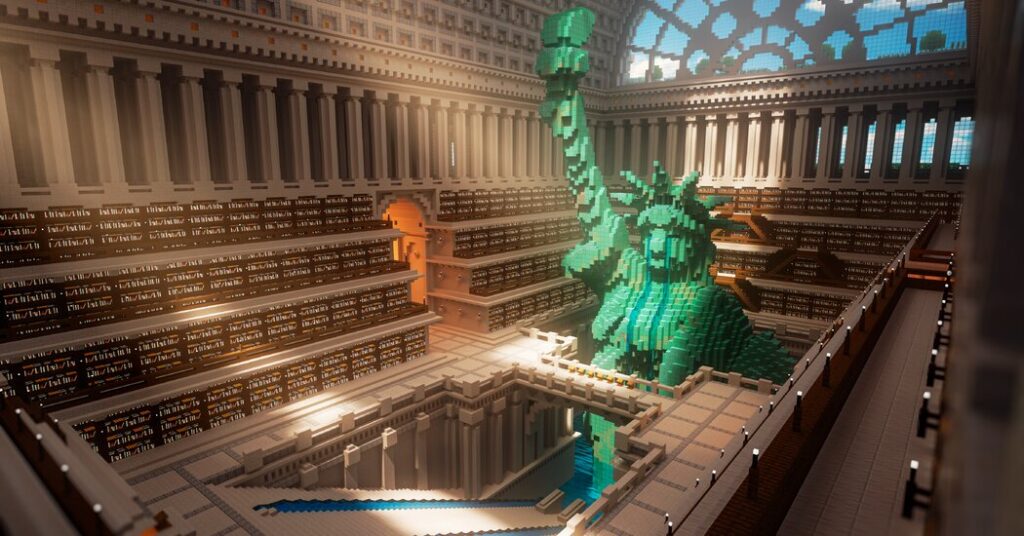
I’m standing in the middle of a cavernous hall, watching the Statue of Liberty drown in a pool of her own tears. Twin blue streams run from her emerald eyes, collecting in a reservoir that submerges the statue up to her waist.
A series of podiums line an observation deck beneath this tableau. Each displays a divisive text: Stephen Colbert’s interview with a Senate candidate that he said CBS barred from television; a report on sea-level rise that was scrubbed from government websites in President Trump’s second term; a two-volume interactive timeline of the Jan. 6, 2021, riots at the Capitol.
On the far wall, flanked by torches, is a mural of Ann Telnaes’s rejected cartoon for The Washington Post, featuring tech moguls like Jeff Bezos and Mark Zuckerberg bending the knee to Trump, offering up bags of cash. Hanging just above is an enormous American flag, stars and bars rendered in pixel.
Welcome to the new United States wing of the Uncensored Library, an unlikely stronghold of online press freedom within Minecraft, the best-selling video game of all time.
Since 2020 the Uncensored Library has functioned as a devilishly clever, and thoroughly modern, information loophole. Because the library is enmeshed within Minecraft, governments cannot ban access to its content — more than 300 examples of censored or restricted work from writers across the globe — without banning Minecraft outright. A player in Riyadh can visit the library’s Saudi Arabian wing and read the assassinated dissident Jamal Khashoggi’s writings at the click of a button.
Even in countries where Minecraft is constrained — its servers in Iran have been shuttered because of U.S. sanctions, while China has released a state-approved version of the game — players can use a virtual private network to gain access to the library.
The new U.S. wing, opening on Wednesday just before the World Day Against Cyber Censorship, is one of 10 rooms dedicated to writings from specific nations struggling with press freedom. Americans may balk that their country shares synthetic real estate with Belarus, Brazil, Egypt, Eritrea, Iran, Mexico, Russia, Saudi Arabia and Vietnam, but the team behind the Uncensored Library says this is very much the point.
Clayton Weimers, an executive director at Reporters Without Borders, an international journalistic watchdog, said that while the United States does not have institutionalized state censorship, its use of covert tactics to suppress the news media helped earn it a library wing. These tactics include restricting access to reporters, weakening norms, political and financial pressure, and the normalization of hostility toward journalists.
“These dynamics deserve attention precisely because they are subtler and more difficult to categorize than overt censorship,” Weimers said. “No country is immune to press freedom threats or democratic backsliding.”
For the uninitiated — say, for most of us over 30 — Minecraft operates essentially like Lego for the internet age. Players can use “blocks,” the game’s base material, to create whole landscapes that other users can explore. Some of the creations are stunning: gargantuan spaceships housing a to-scale McDonald’s and football field, cities that would make Italo Calvino blush and a computer that can run a 2-D version of Minecraft itself.
Among the more basic craftable items in the game, which has sold 350 million copies, is a “book,” an object of up to 100 small pages that can be written in and then read by other players. It is this feature that first attracted the creators of the Uncensored Library.
Tobias Natterer, who works for a German advertising agency, is the project’s mastermind, the Uncensored Librarian himself. In 2020, he partnered with Reporters Without Borders and the Minecraft architectural firm BlockWorks to lay the blueprints for the library.
Trump Administration: Live Updates
Updated
- Trump says he’s open to Iran playing at the World Cup this year.
- The Global Entry program restarts after being paused because of the D.H.S. shutdown.
- Bondi is said to move to military housing because of threats.
The founder of BlockWorks, James Delaney, is trained in neo-Classical architecture, and it shows: The library is styled like a Grecian temple, encircled by columns and formal gardens. Its central dome is the highest that a building can physically be within the game; its rotunda reaches above Minecraft’s troposphere so that flat digital clouds drift inside the building. Above the harbor, where visiting users first appear, is a statue of a fist clenched around a fountain pen — the emblem of the defiant journalist. The whole scene sits on an island in the midst of a digital sea, which glitters like the Aegean.
Expectations were low when the library was first unveiled in 2020, Natterer said. The team set the server limit at 30 visitors. “Let’s be honest with each other,” Natterer recalled telling his team. “It’s a game. People aren’t going to show.”
He was wrong. So many users visited that the server crashed and needed to be rebooted. Walk-through videos on YouTube with clickbaity titles (“Come See Minecraft’s Illegal Library!”) soon garnered hundreds of thousands of views. In its opening weeks, Delaney said, the library also experienced a lot of deliberate hacking attempts. But Alexandria this isn’t: The Uncensored Library has proved all but impossible to destroy.
If players download the map and upload it again on their own private server, the library respawns. This guerrilla brand of information sharing perfectly mimics the library’s founding ethos: The way to fight censorship is by spreading the censored material from one decentralized user to another.
At first chunky glance, Minecraft and political activism may seem strange bedfellows. But there is precedent. In 2016, an awareness campaign rolled out in Minecraft after Poland’s environment minister at the time, Jan Szyszko, approved a plan to triple logging efforts in the Bialowieza Forest, among the last and largest stretches of primeval forest in Europe. An advertising firm worked with Greenpeace Poland and local wildland photographers to create a scale model of the forest and release it as a Minecraft map.
Players flocked to the simulated woods, which looked about as primordial as a digital landscape could — Cubist trees towered through the mist and bogs gleamed beneath an ersatz sun. It was gorgeous and popular. And then, one day, it was gone.
Overnight, without warning, the creators ordered a clear-cut. Every last tree was reduced to its pixelated stump except for one. A popular Polish livestreamer uploaded a walk-through of the virtual devastation, arriving at the sole remaining tree. Upon touching this final trunk, the forest sprang back. But the message had been delivered.
Players were outraged at the devastation. The campaign responded in kind, urging users to channel their indignation to preserve the real at-risk ecosystem. Public support for the campaign surged, and large-scale logging operations in Bialowieza Forest have since ceased.
The Uncensored Library’s nucleus, housed within its sprawling central dome, is the Press Freedom Index. Published annually by Reporters Without Borders, the index ranks 180 countries by journalistic liberty, from Norway at No. 1 to Eritrea at No. 180. (Eritrea’s wing is hidden beneath the fist statue in the library garden, its books encircled by flames to suggest a literal firewall.)
In 2025, the United States was ranked 57th, a fall from the 45th spot when the library was founded. The most recent report by Reporters Without Borders cited the Trump administration’s hostility toward journalists, compounded by its removal of climate and emissions data from government websites, as reason for the decline. The new wing is meant as a warning: Absent constant vigilance and resistance from the reading public, Lady Liberty will weep on.
A White House spokesman, Davis Ingle, said in a statement that President Trump was “the most transparent and accessible president in American history.”
“His return to the White House saved the legacy media from going out of business,” Ingle added. “There has never been a greater champion of the First Amendment than Donald J. Trump, who has implemented an unprecedented expansion of press access to cover him.”
Over the Statue of Liberty’s pool of tears, my Minecraft avatar flits through the open air. I levitate down to the footbridge and alight by a podium. I click open the book displayed there: an article by Byron Tau of The Associated Press that chronicles the Trump administration’s intimidation of the San Francisco-area radio station KCBS.
Barely a week into the president’s second term, the station reported on unmarked vehicles rolling through the San Francisco streets. These were among the very first wave of an immigration crackdown. After Brendan Carr, the Federal Communications Commission chairman appointed by the president, accused KCBS of “failing to operate in the public interest” and putting immigration officers’ lives in danger, he threatened an investigation. KCBS acquiesced and its political coverage cooled. Veteran political journalists were demoted and sidelined.
“What we’re seeing right now,” Al Sikes, a former F.C.C. chairman, said in Tau’s article, “is new boundaries that are being set on the exercise of authority: punishing those that you don’t like and ensconcing those that you do.” I turn back to a previous page of the book, whose words are presented in Minecraft’s signature ultradigital font: “‘Chilling effect,’” said Doug Sovern, a KCBS journalist, “does not begin to describe the neutering of our political coverage.”
Outside, drifting freely through the library’s clouds and out of the domed ceiling, I head down to the harbor, where there is an Easter egg of sorts. Across from the statue of the clenched fist is a staircase, wending its way up the jagged rock. Players can ascend the stairs and, if they stand just so, witness an anamorphic illusion.
Hovering above the sea, right before the map’s very edge, is a word written in bold letters against the sky: “TRUTH.” But the message is visible only from this precise spot. Move slightly to the left, to the right, up or down and the word begins to break apart into fragments. It becomes nothing but disparate pixels, floating through the air.
The post Where Censored Words Find a Safe Haven: Inside Minecraft appeared first on New York Times.