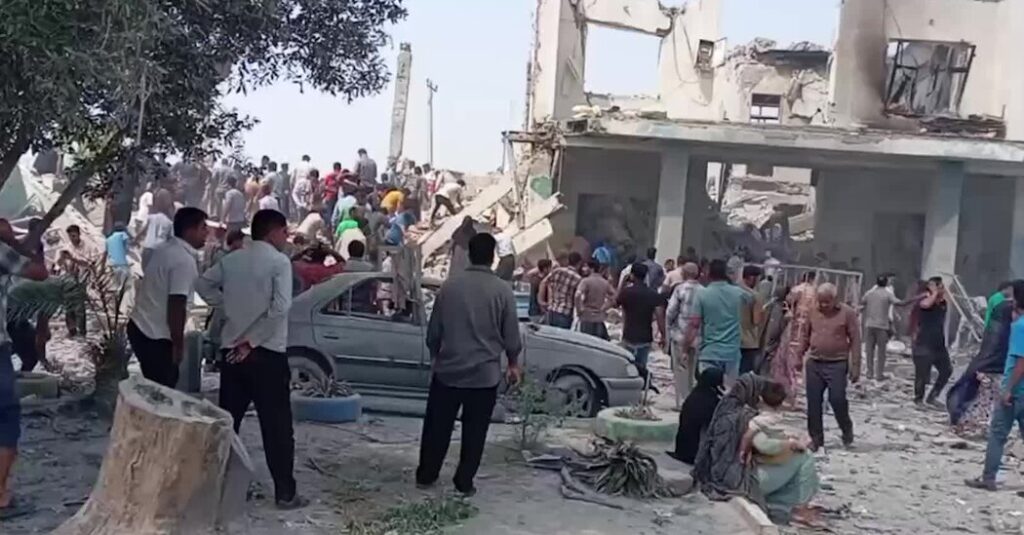
An ongoing military investigation has determined that the United States is responsible for a deadly Tomahawk missile strike on an Iranian elementary school, according to U.S. officials and others familiar with the preliminary findings.
The Feb. 28 strike on the Shajarah Tayyebeh elementary school building was the result of a targeting mistake by the U.S. military, which was conducting strikes on an adjacent Iranian base of which the school building was formerly a part, the preliminary investigation found. Officers at U.S. Central Command created the target coordinates for the strike using outdated data provided by the Defense Intelligence Agency, people briefed on the investigation said.
Officials emphasized that the findings are preliminary and that there are important unanswered questions about why the outdated information had not been double checked.
Striking a school full of children is sure to be recorded as one of the most devastating single military errors in recent decades. Iranian officials have said the death toll was at least 175 people, most of them children.
While the overall finding was largely expected — the United States is the only country involved in the conflict that uses Tomahawk missiles — it has already cast a shadow on the U.S. military operation in Iran.
President Trump’s attempts to sidestep the blame for the strike have also already complicated the inquiry, leaving officials who have reviewed the findings showing U.S. culpability expressing unease. The people interviewed for this story spoke on the condition of anonymity, citing the sensitive nature of the ongoing investigation and Mr. Trump’s assertion at one point that Iran, not the United States, was responsible.
“As The New York Times acknowledges in its own reporting, the investigation is still ongoing,” Karoline Leavitt, the White House press secretary, said in a statement.
People briefed on the investigation said many questions were yet to be answered around why outdated information was used and who failed to verify the data.
Still, the error has not surprised current and former officials.
The school, in the town of Minab, is on the same block as buildings used by Iran’s Islamic Revolutionary Guards Navy, a top target of the U.S. military strikes. The site of the school was originally part of the base. Officials briefed on the inquiry said the building was not always used as a school, though it is not clear precisely when the school opened on the site.
A visual investigation by The Times showed the building housing the school had been fenced off from the military base between 2013 and 2016.
Satellite imagery reviewed by The Times showed that watchtowers that once stood near the building had been removed, three public entrances were opened to the school, ground was cleared and play areas including a sports field were painted on asphalt, and walls were painted blue and pink.
The “target coding” provided by the Defense Intelligence Agency, the military intelligence agency that helps develops targets, labeled the school building as a military target when it was passed to Central Command, the military headquarters overseeing the war, according to people briefed on the preliminary findings of the investigation.
Investigators do not yet fully understand how the outdated data was sent to Central Command or whether the Defense Intelligence Agency had updated information.
Military targeting is very complex and involves multiple agencies. Many officers would have been responsible for verifying that the data is correct, and officers at Central Command are responsible for checking the information they receive from the Defense Intelligence Agency or another intelligence agency. But in a fast-moving situation, like the opening days of a war, information is sometimes not verified.
In addition to the Defense Intelligence Agency and Central Command, investigators are examining the work of the National Geospatial-Intelligence Agency, known as the N.G.A., which provides and examines satellite imagery of potential targets.
U.S. officials and others emphasized that the investigation was ongoing and there was more to learn, according to people briefed on the inquiry. Officials from Central Command declined to comment. Officials from the Defense Intelligence Agency referred questions to the Pentagon, which declined to comment, saying the incident was under investigation. The National Geospatial-Intelligence Agency did not immediately respond to a request for comment.
The Defense Intelligence Agency and the National Geospatial-Intelligence Agency have dozens, even hundreds, of analysts at combatant commands who work with military operational planners and intelligence offices to develop targets.
When the Defense Intelligence Agency’s targeting data is older, intelligence officers are expected to use imagery or data from the National Geospatial-Intelligence Agency to update and verify the target.
While Mr. Trump has made targeting Iran’s navy a top priority of the war to prevent it from interfering with global commerce in the region, historically it is not been a top priority of the Defense Intelligence Agency, which has focused more on Iran’s missiles and other priorities like China and North Korea.
Officials conducting the investigation have examined if any artificial intelligence models, data crunching programs or other technical intelligence gathering means were to blame for the mistaken targeting of the school, according to U.S. officials.
While Claude, the large language model created by Anthropic, does not directly create targets, it works with the National Geospatial-Intelligence Agency’s Maven Smart System and other software to identify points of interest for military intelligence officers.
But officials said the error was unlikely to have been the result of new technology. Instead, they said, it likely reflected a common — but sometimes devastating — human error in wartime.
The top line finding of the internal military investigation mirrors a growing body of public evidence that clearly suggests U.S. responsibility.
Satellite imagery, social media posts and verified videos assembled by The Times visual investigation team indicate that the school was severely damaged by a precision strike that occurred around the same time as attacks on the naval base. A Times analysis showed that base was hit again within around two hours of the first strikes.
A video uploaded Sunday by Iran’s semiofficial Mehr News Agency and verified by The Times also shows a Tomahawk cruise missile striking the naval base beside the school in Minab on Feb. 28.
Defense Secretary Pete Hegseth and other administration officials have declined to comment on the strike, other than to say it is under investigation. Despite that, the president has tried at times to put the blame on Iran.
“In my opinion, based on what I’ve seen, that was done by Iran,” Mr. Trump told reporters on Air Force One on Saturday, as Mr. Hegseth stood beside him, adding: “They’re very inaccurate, as you know, with their munitions. They have no accuracy whatsoever. It was done by Iran.”
On Monday, a Times reporter asked Mr. Trump why he was the only official in his administration blaming Iran. “Because I just don’t know enough about it,” Mr. Trump answered, asserting incorrectly that Iran might also have Tomahawk missiles but adding that he would accept the results of the inquiry into what happened.
Although most presidents might refrain from commenting or couch their statements while an investigation is underway, Mr. Trump has not hesitated to weigh in, and has not fully backed down even as evidence has mounted of U.S. culpability.
On Tuesday, Ms. Leavitt, the White House press secretary, reiterated that Mr. Trump would accept the findings of the investigation.
While the investigation into the school is not complete, the use of old data evoked the biggest misstep of the Kosovo war.
In 1999, old, outdated maps and poor tradecraft led the C.I.A. to provide erroneous targeting data to the military, resulting in an airstrike on the Chinese Embassy in Belgrade that killed three Chinese citizens. The C.I.A. wrongly assessed that the building was the headquarters of a Yugoslav arms agency.
“Database maintenance is one of the basic elements of our intelligence effort, but it is also one that has suffered in recent years as our work force has been spread thin,” George J. Tenet, the C.I.A. director at the time, told a congressional committee in 1999.
Military planners assumed the intelligence agency had verified the site and ordered the strike.
Julian E. Barnes covers the U.S. intelligence agencies and international security matters for The Times. He has written about security issues for more than two decades.
The post U.S. at Fault in Strike on School in Iran, Preliminary Inquiry Says appeared first on New York Times.