David Easterbrook is an unlikely influencer. The retiree has more than 1 million followers watching him water his plants on Instagram. Easterbrook doesn’t have your average backyard garden. The horticulturalist and former curator at the Montreal Botanical Garden is one of the world’s leading experts in bonsai.
The art of bonsai originated in Asia more than a thousand years ago. The word translates, roughly, to “potted tree,” and growing a bonsai involves strategically and often aggressively pruning a plant and its roots to create a miniaturized version.
For Easterbrook and other experts, bonsai is a fascinating and fun hobby, but it also has potential as a tool for conservation. Bonsai trees can be remarkably long-lived — some examples in Japan are hundreds of years old — and Easterbrook sees them as a way to ensure species persist in an uncertain environmental future. Trees threatened by climate change, habitat loss, overharvesting and invasive species can often thrive in a smaller form.
“Bonsai preserves genetics,” he says. “Every tree has an ecological memory in miniature. So, in that sense, bonsai practitioners are sort of very quiet conservationists.”
A bonsai tree is no different genetically from its full-size brethren. Despite their small size, they function like normal trees. They lose their leaves and needles in autumn, and some varieties even bear fruit. Chris Baker, curator of bonsai at the Chicago Botanic Garden, believes bonsai collections can act as DNA repositories, with the potential to use them for future restoration projects, or to further work to find pest- and disease-resistant varieties of threatened species.
“Institutions can work together to continue to do that work,” he says, “looking for genetic anomalies, or subspecies that are more adapted to certain temperatures. Bonsai can help us find those survivors, and they can be propagated and maybe even reintroduced.”
This creates an opportunity, Easterbrook says, “to try to preserve some of our native species so that our children and grandchildren can see them.”
The art of bonsai was introduced to North America relatively recently, Easterbrook says, “basically after the Second World War. It took a long time for bonsai to become established, and at first people thought a tree could only be a bonsai if it came from Japan.”
In fact, explains Baker, when most people imagine a bonsai tree, they probably picture a commonly used species native to Asia, like some types of juniper, Chinese elm, or Japanese maple or pine.
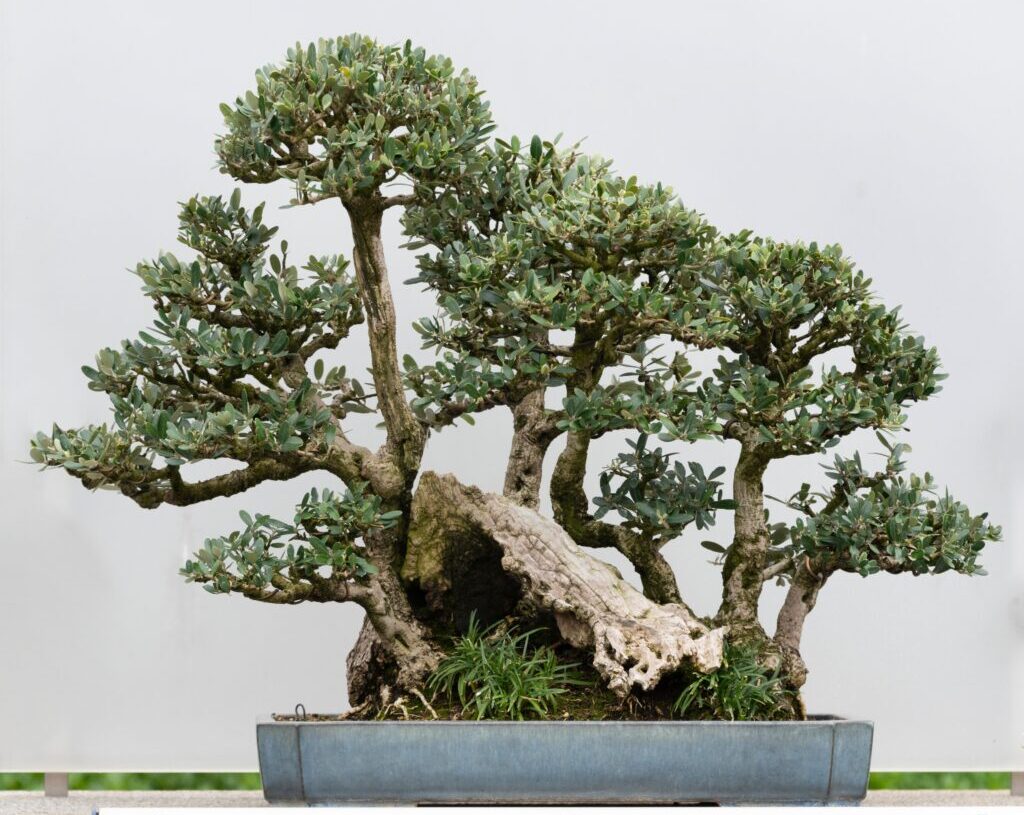
“But through the years, we’ve begun utilizing more and more of our native species here in North America, and species from other regions throughout the world,” he says. A project at the botanic garden highlights bonsai versions of many of those species, including European olive trees, coastal redwoods, the limber pine and the metasequoia.
“It’s a great opportunity to expose a broad audience to these trees which grow in threatened areas, or that are dying because of climate change,” Baker says. “We’re losing their native environments, and at some point, we’re going to get to where these trees don’t exist in nature anymore. There is going to come a time where certain species might only exist in captivity, if you will.
“In the meantime, not everybody can go walk in Muir Woods [National Monument] on the West Coast,” he adds. “Not everyone can go down south and experience the swamps. But far more people can come to the Chicago Botanic Garden or visit other public and private bonsai collections.”
The trees can act as educational ambassadors, Easterbrook says, offering an opportunity for people to get close to species they might not get to experience otherwise. “I have several American elms in my collection,” he says. “They’ve pretty rapidly disappeared from the landscape because of Dutch elm disease.” He has an American chestnut, which dominated eastern forests until it was almost completely wiped out by an early 20th-century blight. “I’ve often gone to the very far north of Quebec, on the tundra, collecting several-hundred-year-old larch trees,” he says.
And in addition to preserving native species, Easterbrook says, the hobby can help control non-natives. In New York state, where a variety of euonymus (otherwise known as burning bush) has become invasive, “a nature reserve asks bonsai people to go in there and dig them out to use as bonsai,” Easterbrook says. He also points to the pine-like casuarina, which is native to Australia and has “become a menace in Florida.” Their sale, cultivation and transport are now restricted by state law and require a permit, “but bonsai people still find wild ones and collect them,” Easterbrook adds, “and they’re doing the environment a favor.”
Many bonsai growers and enthusiasts get interested in the hobby simply because the trees are cool to look at, says Baker. But the art is a gateway, he believes, to a much deeper ecological understanding.
“The best bonsai isn’t just a tree in a pot, but a composition,” he says, “with understory and herbaceous plants, rocks, mosses. You create an ecosystem, and now it can teach people not just about a single tree, but how that tree ties into the environment. I think that’s where the real value is.”
Easterbrook agrees, and part of what makes his work so popular is that he’s not just miniaturizing one tree at a time. He makes bonsai forests: Complete, thriving biomes several feet high, which offer an opportunity to study and understand a forest ecosystem. His most-watched videos feature him simply watering his miniature forests of larch, sequoia, ginkgo and more. Whenever he displays his work, Easterbrook says, the forests are what really seem to capture audiences’ imaginations.
“Especially children,” he says, “because they’re at eye level with the forest, and they’re just fascinated. Most people go gaga for them, and they’re a wonderful tool for understanding forest ecology and the way the trees grow together as a community. In that very visceral way, I think people can sometimes connect with forests more than individual trees.”
Kate Morgan is a freelance writer in Richland, Pennsylvania.
The post The tiny forests that could save endangered trees appeared first on Washington Post.