IN THE DAYS OF MY YOUTH I WAS TOLD WHAT IT MEANS TO BE A MAN: A Memoir, by Tom Junod
When Tom Junod was growing up, before he laid eyes on his father in the mornings, he would hear him — the pop of ankles cracking as Lou Junod took his first steps out of bed, a sound that demanded vigilance, “like a twig snapping in the forest.” Lou wasn’t a violent man, or not exactly. Sure, he could be emotionally volatile; there were the times he lost so much money gambling on a football game that he punched holes in doors.
But what Lou was above all was a big, swaggering character. He didn’t just command a room; he dominated it. He was a traveling handbag salesman during a time of postwar plenty. Whenever he left his Long Island home, he always brought his collection of toiletries that kept him fragrant and gleaming. He was an indefatigable philanderer whose roster of lovers included the mother of Tom’s friend. Lou’s embodiment of midcentury manliness could be so over-the-top that it verged on caricature. He was wounded at Normandy and briefly worked as a nightclub singer. He dropped Italian slang even though he wasn’t Italian. He drove a red Thunderbird convertible and wore a velvet smoking jacket.
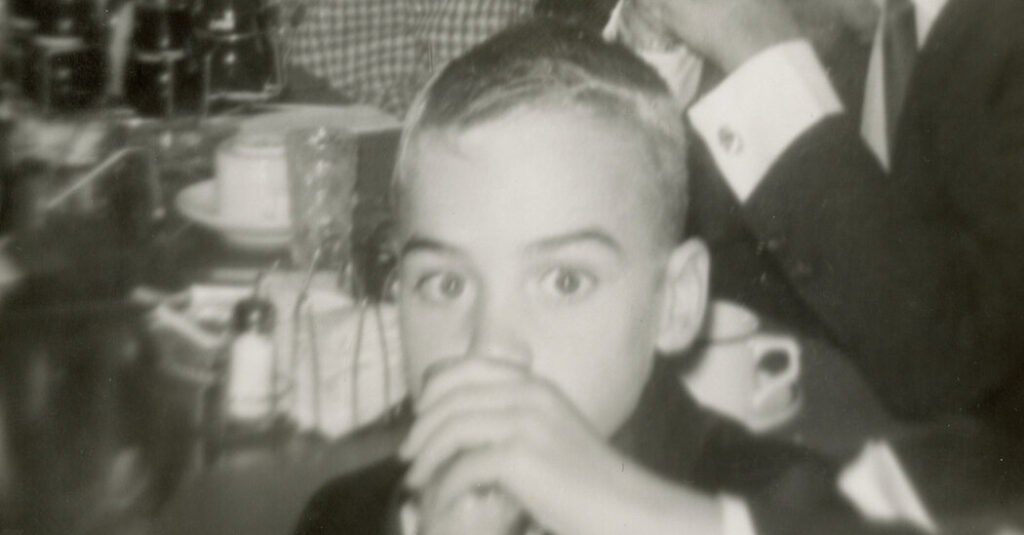
The young Tom loved his father but was also scared of him. Lou was swarthy, charismatic and reckless. Tom was nervous and attached to his put-upon mother. Still, Tom was drawn to his father’s tantalizing example, even as he tried to avoid it. He became a celebrated writer at GQ and Esquire and profiled a range of men, including Norman Mailer and Mister Rogers. In a 2011 essay titled “My Mom Couldn’t Cook,” he wrote like someone who was imprisoned by gender and struggling to get free: “In order to endure cooking like a woman I have to cook like a man — which is to say, for myself.”
His memoir, “In the Days of My Youth I Was Told What It Means to Be a Man,” traces the younger Junod’s attempt to find out who his father really was, underneath the indomitable facade. It opens with a scene from his father’s memorial service, in 2006. Junod remembers staring at the modest urn containing his father’s ashes, “stunned into silence by the spectacle of the genie squeezed back into the bottle.”
But the genie couldn’t be contained. A woman showed up to the service who had worked for his father decades before, as a “showroom girl.” When she began speaking, he realized that she had also been one of his father’s lovers. “The last word went not to me but rather to a woman who knew him as I never did,” he writes, “and my mind went blank as paper.”
The rest of the book moves back and forth through time as Junod tries to untangle his father’s convoluted past, which turns out to be darker than he ever could have imagined. There were early portents that the suave gentleman had a secret life. At one point Junod flashes back to being a teenager riffling through his father’s briefcase and finding some pornographic Super 8s (a few are “captioned in German and scare me”) and two “mallet-sized dildos.” He was especially confused by the discovery because Lou, despite all his showboating as a ladies’ man, would talk disgustedly about other men he deemed “sickies” and “degenerates.”
But Lou never cared much for consistency. He could be judgmental, even priggish, when it came to the lives of others but was endlessly indulgent when it came to getting whatever it was he wanted. Junod says that his father had four categories of friends: the enablers, the sidekicks, the rivals and the worshipers. The one friend Junod recalls his father admiring was a truly loathsome bookie who said vile things to women and bragged about keeping a trophy from Vietnam that was a necklace of human ears. “Oh, the things he says — the things this man gets away with,” Lou would say, his voice tinged with awe. “Listen to him. He’s like … a Nazi.”
Given the noxious varieties of masculinity on offer, it’s no wonder the heroes of Junod’s book are mostly women: his wife, his sister and his long-suffering mother, who stayed married to Lou for 59 years, until his death. Junod admits that even afterward he was still so in thrall to his father’s self-mythologizing that he couldn’t bear to accept the possibility that his dad was anything as “commonplace” as an emotionally manipulative “abuser,” until an aunt told him about his mother’s greatest fear. She didn’t want any of her children to turn out like Lou — and “she worried the most about you.”
Junod’s stemwinder of a title comes from a Led Zeppelin track, and the book, too, moves like a song, drawing you in with its melody before delivering an emotional wallop. Some of the revelations in this book are truly startling, even if the outsize figure of Lou Junod and his caginess about his family’s history should alert you from the beginning that some unnerving surprises are in store.
But at the core of the memoir is the persistent hum of a simple truth. Junod’s father may have led a full life, but it wasn’t a whole one; he was always juggling so many secrets that he could never integrate his disparate selves. Junod, for his part, and despite his own mistakes, resolves not to fall for the same clichés of masculinity that bedeviled his father and wreaked havoc on the family: “I have to figure out a way to be a man by becoming a human being.”
IN THE DAYS OF MY YOUTH I WAS TOLD WHAT IT MEANS TO BE A MAN: A Memoir | By Tom Junod | Doubleday | 404 pp. | $32
Jennifer Szalai is the nonfiction book critic for The Times.
The post The Extravagant Secret Life of a Handbag Salesman, as Told by His Son appeared first on New York Times.