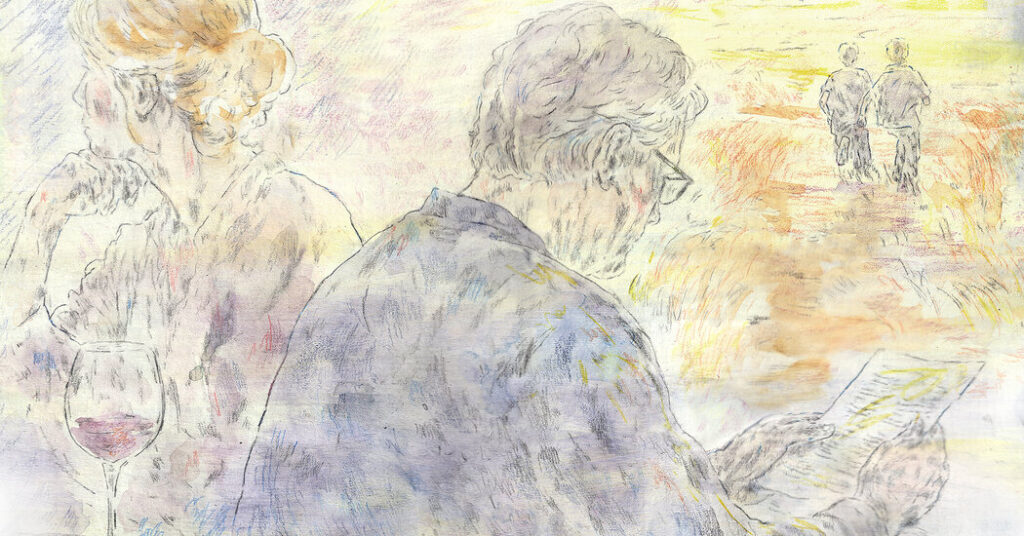
THE GOLDEN BOY, by Patricia Finn
It’s early in Patricia Finn’s debut novel, “The Golden Boy,” and Agnes Hopkins, the long-suffering wife of the retired television executive Stafford Hopkins, has already had it with Aristotle.
“Enough,” she says to Stafford. “Do whatever you want. Translate the evening news into Latin if you want to. … Just don’t practice your philosophy talk on me. Or on any of our friends.” Stafford, never one to miss an opportunity for intellectual point-scoring, shoots right back at her: “Aristotle wrote in Greek, not Latin.”
Maybe it’s just coincidence, but the ancient Greeks have been popping up everywhere in my reading lately, as if a frazzled zeitgeist is reaching deep into the past to grasp some rock on which to steady itself. A former classics scholar propelled by personal crisis to try his luck in network television, Stafford rose to glory as the industry’s so-called “philosopher king” with a potent nose for hits. Appropriately, it is hubris that topples him from his throne, forcing him into self-described “exile” on Maui when his latest bet doesn’t pay off.
“We are lost people, both of us lost,” he proclaims to Agnes, “and the best place to be lost is paradise.” To which she replies: “Get a fricking hobby.” Stafford turns to his long-neglected graduate thesis on “Nicomachean Ethics and Epithumia,” which is not what Agnes had in mind.
It turns out the rock Stafford really needs lies buried not in the ancient past, but in his own. A letter duly arrives from Ontario, recalling him to the farmland outside Kingston where he grew up, and to the ghosts of a rural childhood with all the trimmings: the austere farmhouse, the alcoholic brother, the phlegmatic older parents, and the neighbor, Bobby Shepherd, whose friendship nourishes the brilliant young Stafford’s starved inner life. How he emerged from this upbringing to pursue a graduate degree in ancient philosophy; to marry Agnes, an “uneducated American girl with a trashy mouth”; and to leave Canada for a high-flying TV career takes up most of the book’s attention, along with the most perplexing mystery of all — what really happened the night young Bobby was killed, when the boys were 16.
Like Stafford, Finn studied classics before working in television, and they’re both keen to awaken us to the beauty of Aristotelian thought. In their defense, not every reader these days will have stumbled into a working knowledge of Greek philosophy during a dozen or more years of formal education, and we could all probably use a refresher. But what typically constitutes the architecture of a drama, the unseen beams that shape and support the story, here presents as part of the story itself. We are meant to engage consciously in the ways the protagonist’s redemption arc contains the elements of heroic tragedy: “‘Mimesis,’ Stafford once said to an established Hollywood writer, ‘is an imitation of an action leading to tragedy. It is not an excuse to bypass the laws of probability.’”
Of course, Aristotle’s ideas are essential and enduring, and Finn explains them well. But fiction is powerful because it embodies ideas, rather than explaining them. (Think of, say, the early “Star Wars” saga, which was influenced by Joseph Campbell’s work of comparative mythology “The Hero With a Thousand Faces,” but wouldn’t dream of saying so out loud.) Do we need to be told why tragedy moves us? Doesn’t it move us more profoundly when we aren’t? Is Finn spoiling our fun when she feeds us the study notes as we go along, matching each plot twist to its Greek underpinnings? Or does she intend the Aristotelian mansplaining as a feature instead of a bug?
That is, after all, the lesson Stafford needs to get over himself and learn: that there is philosophy, and there is real life. “‘Spirituality is not disincarnate,’ he was warned by the professor who introduced him to Aristotle. ‘It is rooted in what is human.’ But Stafford dismissed this, commencing instead his rise up the academic ladder, clinging to Aristotle and the rubrics of philosophy like a dying man.”
Perhaps counterintuitively for a former television writer, Finn often resorts to exposition to weave a voluminous back story into the narrative, and not always seamlessly. Diversions into the Hopkins and Shepherd ancestral histories and into Canadian history and geography might have brought more texture and dimension to the story if they didn’t read as info dumps, dragging the reader outside the experiences of the characters themselves.
Finn also has a lot to say about the lives of rich people, and she shines best when she allows them to reveal these insights themselves — by how they speak and act and think. When we first meet Agnes she seems shallow and vain, the cold wife and careless mother, the diamond-edged society hostess; but just as we’re about to give up on her Finn deftly peels back the layers to reveal her toughness and loyalty, her survivorship, her flinty sense of humor. It is Agnes who, fed up with Stafford’s pompous preoccupations, gives the necessary yang to his yin, walking out of a tedious art film in the middle of an extended kitchen scene with the immortal observation: “We could be at home washing our own dishes.”
These staccato conversations with Stafford, at first trivial to the point of mindlessness, accumulate into a portrait of a complicated and foundering marriage between two fundamentally mismatched people who still, improbably, love each other, until we can’t help rooting for them to make it.
The much-teased secret of Bobby Shepherd’s fate is laid bare somewhat clumsily; Finn seems less interested in shocking the reader than she is in examining the impact of events on her characters. She directs her best talents into Stafford’s journey to redemption, which gathers momentum in the final chapters, giving way to an immensely moving conclusion. The storytelling might be uneven, but like an old television pro, Finn knows how to stick the landing.
THE GOLDEN BOY | By Patricia Finn | Cardinal | 311 pp. | $29
The post An Exiled TV Exec Sees Greek Tragedy Everywhere appeared first on New York Times.