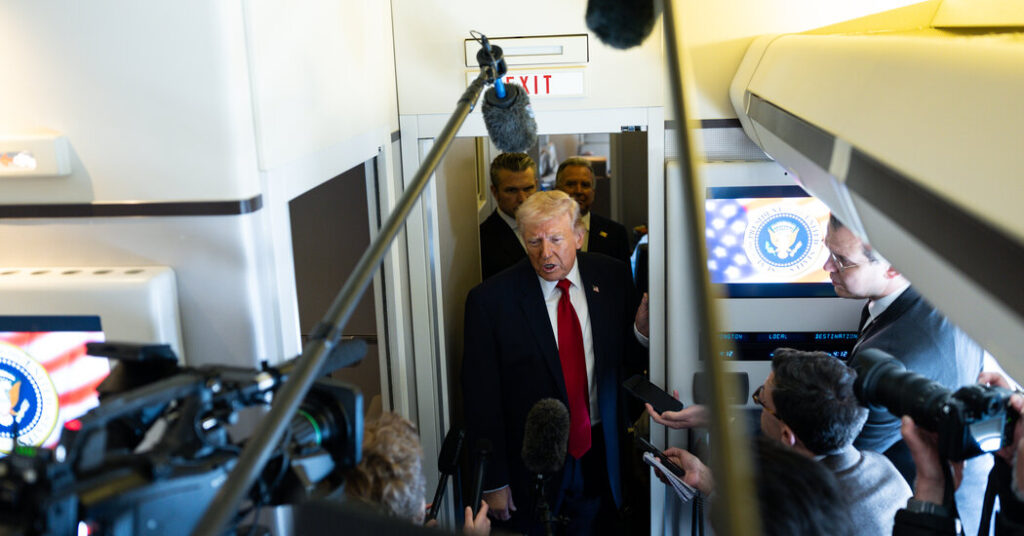
Since the United States and Israel launched their assault on Iran on Feb. 28, President Trump has given conflicting indications on how long it will continue.
After he said near the outset of the war that it could last “four to five weeks,” the president and members of his administration have issued shifting statements on the timeline and the goals for the war.
They have at times suggested that the United States was striving to topple Iran’s government and achieve an “unconditional surrender” and will continue an assault as long as it takes. At others, Mr. Trump and his officials have delivered the message that the war had already succeeded in its objective of decimating Iran’s military.
That has left wide-open the possibilities for how the conflict with Iran could wind down and how long it will take, even as some in his administration try to assure the public that the United States will not be drawn into another long war in the Middle East.
Here’s a look at officials’ often contradictory statements since the war began.
March 1
President Trump
‘We intended four to five weeks.’
In an interview with The New York Times the day after the initial strikes on Iran, Mr. Trump already had contradictory visions of how the war would pan out.
He said that the United States and Israel intended to continue the assault for about a month, and predicted that it “won’t be difficult.” But he did not seem to have decided on what changes among Iran’s government he would consider a victory.
March 2
Defense Secretary Pete Hegseth
‘This is not Iraq. This is not endless.’
During a news conference at the Pentagon last week with Gen. Dan Caine, the chairman of the Joint Chiefs of Staff, Mr. Hegseth suggested the campaign was being kept to a smaller scope compared with the “nation-building quagmire” of past American interventions in the Middle East.
He suggested this campaign could take anywhere from two to eight weeks, not settling on a number.
March 2
Gen. Dan Caine
‘This is not a single overnight operation.’
At the same news conference, General Caine dismissed any suggestion that the U.S. campaign in Iran might mirror the one in Venezuela earlier this year and said that the Pentagon’s military objectives would “take some time to achieve.”
He added, “We expect to take additional losses.”
March 2
President Trump
‘Whatever the time is, it’s OK, whatever it takes.’
As his defense secretary assured the United States would not be dragged into a long conflict, Mr. Trump said the United States was “substantially ahead of our time projections,” which had put the campaign at four to five weeks.
But he added that the United States had the capability “to go far longer than that.”
March 6
President Trump
‘There will be no deal with Iran except UNCONDITIONAL SURRENDER!’
Six days into the bombing campaign, Mr. Trump took to Truth Social to demand that Iran capitulate and said that the United States and its allies would “work tirelessly to bring Iran back from the brink of destruction, making it economically bigger, better, and stronger than ever before.”
That appeared to shift the timeline further, into both regime change and rebuilding Iran, even as its current leaders have expressed defiance and expanded the battlefield by striking American bases across the Middle East.
March 6
Karoline Leavitt
‘The achievable objectives of Operation Epic Fury we expect to last about four to six weeks.’
Later that day, Ms. Leavitt, the White House press secretary, was asked what the president would consider a surrender.
She declined to give a timeline beyond the plan she said the president had laid out. But she seemed to soften his demand for a surrender, saying it would “essentially” occur when Mr. Trump concluded his war objectives had been met.
March 7
President Trump
‘This is a short excursion.’
After attending the dignified transfer of six American service members who were killed when Iran struck a command center in Kuwait, Mr. Trump suggested to reporters that the United States was achieving its military objectives.
“We’re winning the war by a lot,” he said. “We decimated their whole evil empire.”
Asked if he was worried about high gas prices, which have risen nearly 17 percent since the war began, he said he was not and that the campaign would be “short.”
March 9
President Trump
‘The war is very complete, pretty much.’
U.S. markets rebounded at the start of this week after Mr. Trump told CBS News that the war was “very complete, pretty much” and “very far ahead of schedule.”
But after markets closed, in remarks to Republican lawmakers gathered for a retreat in Florida and in a news conference afterward, he left open the possibility of more comprehensive aims, even as he said the war would end “soon, very soon.”
“We go forward more determined than ever to achieve ultimate victory that will end this long-running danger once and for all,” he said.
March 10
Defense Secretary Pete Hegseth
‘It’s not for me to posit whether it’s the beginning, the middle or the end.’
At a news conference on Tuesday with General Caine, Mr. Hegseth joined others in the administration in asserting that Mr. Trump alone was in charge of the timeline.
“He gets to control the throttle,” Mr. Hegseth said, though he added, “I want the American people to understand is this is not endless. It’s not protracted.”
March 10
Karoline Leavitt
‘President Trump will determine when Iran is in a place of unconditional surrender.’
Speaking to reporters on Tuesday, the press secretary again appeared to qualify Mr. Trump’s demand of “unconditional surrender.”
“When President Trump says that Iran is in a place of unconditional surrender, he’s not claiming the Iranian regime is going to come out and say that themselves,” Ms. Leavitt said. She added that Mr. Trump would decide when Iran no longer posed “a credible and direct threat.”
Aishvarya Kavi works in the Washington bureau of The Times, helping to cover a variety of political and national news.
The post When Will the War End? Trump’s Responses Are All Over the Place. appeared first on New York Times.


