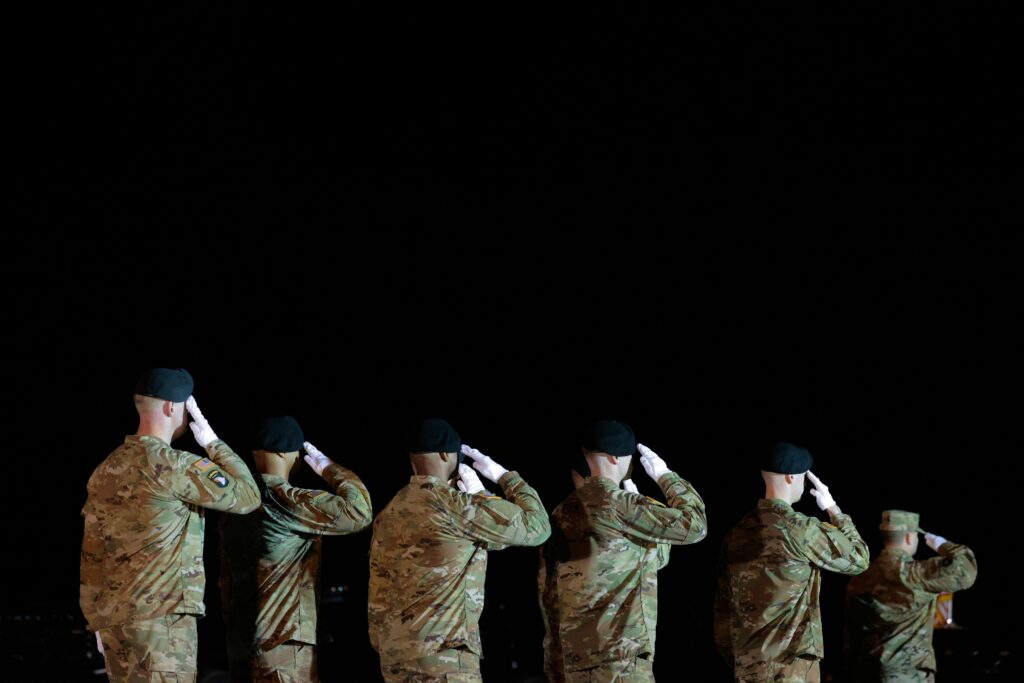
About 140 U.S. service members have been wounded in the war with Iran, a Pentagon official said Tuesday, as personnel remain under threat from drones and missiles that have left seven U.S. troops dead.
The vast majority of the wounded had minor injuries, Pentagon spokesman Sean Parnell said in a statement, adding that 108 have returned to duty. Eight are severely wounded, he said, and “receiving the highest level of medical care.”
One of the recent fatalities, Army Sgt. Benjamin Pennington, died days after he was injured in an attack in Saudi Arabia. The other six were killed in a drone attack in Kuwait.
Defense officials have previously described the number of wounded as fewer than a dozen, specifying them as the most grievously injured. Parnell did not respond to a request for comment on the types of injuries suffered and the increased casualty figures.
The number of wounded underscores the pernicious threat of Iranian drones and missiles, which have targeted troops on U.S. bases across the Middle East. While it is unclear how the troops received their injuries, the types of attacks point to shrapnel wounds and traumatic brain injuries as likely contributors.
Brain injuries were the signature wound of the Iraq and Afghanistan wars and often resulted from blast exposure or falls. Some troops may not initially report concussions or brain injuries because they seem minor, or they cannot be screened right away, which can lead to a lag in reported numbers. More than half a million troops have suffered brain injuries since 2000, accordingto Pentagon data.
Defense Secretary Pete Hegseth did not address the wounded in a news conference at the Pentagon on Tuesday or provide an estimate on when the United States would wind down operations in the Middle East, but both he and President Donald Trump have declared large portions of the Iranian military destroyed.
Gen. Dan Caine, the chairman of the Joint Chiefs of Staff, told reporters that Iranian ballistic missile attacks have fallen 90 percent since the war began and one-way drone attacks have decreased 83 percent. The Iranians are adapting to U.S. operations, Caine said, declining to elaborate on how they have shifted. “They’re fighting, and I respect that, but I don’t think they’re more formidable than what we thought,” he said.
Defense analysts have cautioned that a decrease in overall attacks may point to other factors. An 83 percent reduction in drone attacks may be measured against launches observed during the first day of the conflict, Kelly Grieco, a defense policy expert at the Stimson Center, said on X.
Damage assessments take time, she noted, and it may not be immediately clear if Iran has permanently lost its ability to launch drones or if it is preserving the capability for future attacks. “That’s a real and significant operational achievement,” she said of the Pentagon statistics. “But it may say more about Iran’s strategy right now than its remaining capacity. Hard to know with certainty.”
The Pentagon statement came soon after Reuters reported the number of wounded, prompting frustration on Capitol Hill that the Defense Department was not proactively announcing the casualty figures.
“Just own it and be transparent,” said a congressional aide, speaking on the condition of anonymity to discuss ongoing personnel matters. “You owe it to the service members.”
Trump has occasionally downplayed the severity of brain injuries, notably after an Iranian ballistic missile attack in 2020, during his first administration. Tehran attacked an air base in Iraq in retaliation for the U.S. killing of Iranian military commander Qasem Soleimani. Pentagon officials at the time were slow to publicly disclose the number and severity of injuries.
“I heard that they had headaches and a couple of other things,” Trump said following the attack. “But I would say, and I can report, it is not very serious, not very serious.” No U.S. troops were killed, but 110 survivors were ultimately diagnosed with traumatic brain injuries, some requiring long hospitalizations and intensive therapies.
The post Pentagon says about 140 troops wounded, 8 severely, in war with Iran appeared first on Washington Post.