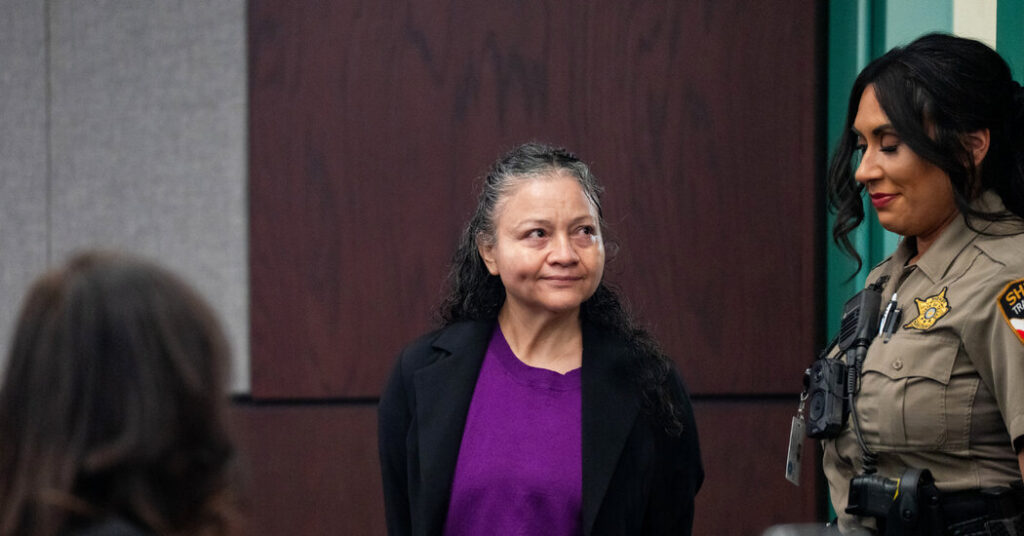
A Texas woman who was declared innocent on Monday, after spending more than 22 years behind bars for a wrongful conviction in a child’s death, is now facing a deportation threat because her immigration status lapsed while she was incarcerated, a judge and her lawyers said.
The woman, Carmen Mejia, 54, was convicted of murder and injury to a child in 2005 in connection with the death of a 10-month-old, who suffered third-degree burns from scalding bath water, while in Ms. Mejia’s care at her home in Austin in July 2003. The baby later died from the injuries. Ms. Mejia was sentenced to life in prison with parole but she had maintained her innocence.
On Monday, Judge P. David Wahlberg of Travis County dismissed the charges, formally declaring her innocent. In January, the Texas Court of Criminal Appeals, the state’s highest criminal court, overturned Ms. Mejia’s previous conviction, citing new evidence that proved she was “actually innocent.”
But Ms. Mejia was not released from custody, owing to an immigration hold from U.S. Immigration and Customs Enforcement, after her legal status expired while she was imprisoned, according to the Innocence Project, an advocacy organization that seeks to overturn wrongful convictions and which represented Ms. Mejia in her appeals case. She came to the United States from Honduras in 1995 and had lawful permission to live and work in the country before her conviction, the organization said.
She is being held in the Travis County Correctional Complex, according to jail records. ICE had 48 hours after her exoneration to decide whether to transfer Ms. Mejia into immigration detention or release her, the Innocence Project said, but it was not clear exactly when the clock would run out.
The Trump administration has been arresting and detaining immigrants it seeks to deport in cities from Los Angeles to Minneapolis. In recent weeks, those operations had become more targeted after opposition to its aggressive tactics.
Vanessa Potkin, one of the Innocence Project lawyers working on Ms. Mejia’s case, said on Tuesday that the federal agency could allow Ms. Mejia’s release, which would give her an opportunity to be reunited with her four children, of whom she has lost custody.
“She lost her lawful status as a direct consequence of her wrongful imprisonment and she had no ability to renew her status and to maintain it,” Ms. Potkin said, adding that a deportation would “perpetuate the profound injustice” Ms. Mejia faced.
Neither ICE nor the Department of Homeland Security, which oversees the immigration agency, immediately responded to requests for comment.
In signing the order to dismiss the charges, Judge Wahlberg said on Monday that he wished the decision would be “the end of this tragedy” for Ms. Mejia, whose possible removal from the country could be imminent.
Judge Wahlberg urged federal authorities evaluating the case to consider Ms. Mejia’s lawful status and lack of criminal history, along with her years under incarceration, during which she remained in good standing. He added that Ms. Mejia did not have the financial resources or documentation to flee the country and was not a “flight risk.”
“I hope that all of those factors are taken into account when some federal authority looks at this, because a removal at this point would be compounding the tragedy that’s already occurred,” Judge Wahlberg said.
According to the Innocence Project, Ms. Mejia was granted Temporary Protected Status and legal authorization to work in the United States after fleeing abuse and poverty in her native Honduras.
On July 28, 2003, Ms. Mejia was home with her four children and babysitting a 10-month-old child, the organization said. While she was breastfeeding her youngest daughter, one of her children tried to bathe the baby, but the water heater in Ms. Mejia’s rental apartment lacked safety features, and the water quickly reached a scalding temperature. The baby received third-degree burns and later died from the injuries, the organization said.
Testimony from a doctor and a law enforcement expert, who said they believed the child was held under water and that the burns were intentional, helped secure a conviction, Ms. Potkin said at a news conference on Monday.
“That testimony just was flat-out wrong,” Ms. Potkin said. No medical burn expert had reviewed the case at the time of trial, she said.
Additionally, recorded video statements of Ms. Mejia’s children corroborating her account that the child’s death was an accident went missing before the trial, the organization said.
Ms. Mejia was convicted of felony murder, injury to a child and injury to a child by omission, according to court documents.
The Innocence Project took on Ms. Mejia’s case in 2021 after being contacted by Art Guerrero, the courtroom bailiff at the time of Ms. Mejia’s trial, the organization said.
New evidence considered in the case included a review of evidence by a medical burn expert and testimony from an expert in scalding injuries from hot water heaters. One of her children also testified that she was the one who had turned on the faucet and that Ms. Mejia was not in the bathroom at the time.
In 2024, the state’s witnesses from the initial prosecution swore in affidavits that they could no longer opine that the injuries were caused intentionally. The state’s medical examiner, who testified in the 2003 trial that the manner of death was a homicide, reversed the findings in 2025, ruling it accidental.
The Texas Court of Criminal Appeals found Ms. Mejia innocent earlier this year and remanded the case to Travis County for dismissal.
Ms. Mejia should know by Thursday morning if she will be reuniting with her family, or will instead go into immigration custody, Ms. Potkin said.
Ms. Mejia’s daughters wrote impact statements that were submitted to the court for the hearing where the charges would be dismissed. One of her daughters, identified only as Anna, wrote that she and her family hope “that this moment will not only restore her freedom, but also begin to bring healing to our family after so many years of loss and separation.”
Rylee Kirk reports on breaking news, trending topics and major developing stories for The Times.
The post Woman Found Innocent After 22 Years in Prison Faces Deportation Threat appeared first on New York Times.