In a social media post, the United States Central Command said Tuesday evening that it had attacked 16 Iranian mine-laying vessels near the Strait of Hormuz.
A video accompanying the post showed munitions hitting nine vessels, most of which were moored at the time of the attack.
Whether any Iranian mines have been deployed in the water since the current war began on Feb. 28 is unclear.
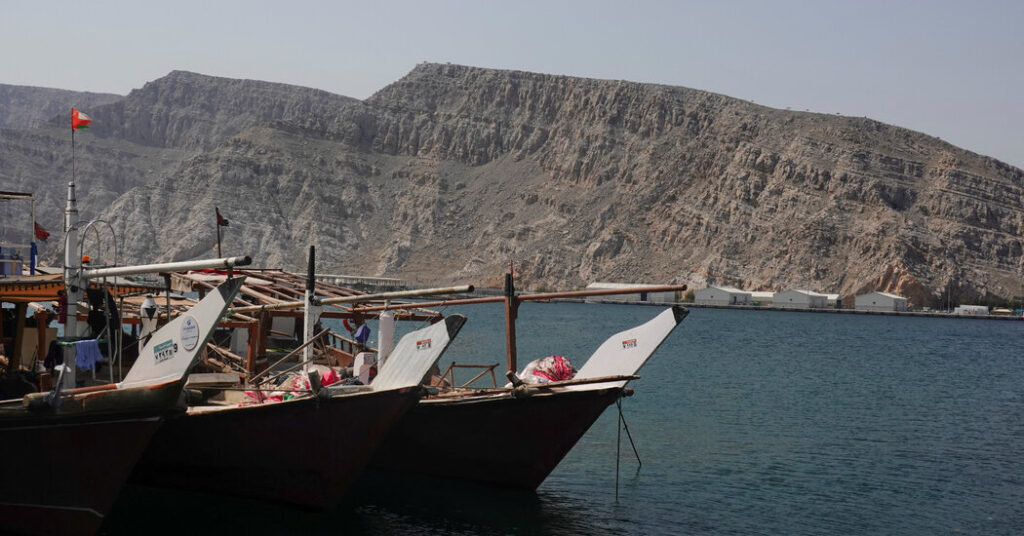
The Strait of Hormuz is a strategically important waterway that connects the Persian Gulf to the northern Arabian Sea. Iran’s southern coastline runs along the strait, and military and civilian vessels transiting through are routinely questioned by Iranian authorities via maritime radio communications when entering and exiting the gulf.
About a fifth of the world’s oil transits the strait via large civilian-run oil tankers. A pause in tankers passing through the Strait of Hormuz because of security concerns since war with Iran began on Feb. 28 has contributed to a global spike in oil prices and higher gas prices for consumers in the United States.
In the 1980s, Iranian forces laid mines in the Persian Gulf that required clearance by U.S. Navy minesweepers. In April 1988, an Iranian mine severely damaged — but did not sink — an American frigate, leading to U.S. forces launching retaliatory strikes.
Last week, President Trump said he might order Navy warships to escort merchant ships through the Strait of Hormuz, which U.S. forces did for a period of time in the late 1980s during similar tensions with Iran.
Tuesday afternoon, Energy Secretary Chris Wright said on social media that a Navy warship had “successfully escorted” an oil tanker through the strait; he deleted the post soon afterward.
A military official said that no Navy warships were escorting civilian ships in the Persian Gulf or through the Strait of Hormuz.
The official, who spoke on condition of anonymity because they were not authorized to speak publicly about current operations, pointed to comments made by Gen. Dan Caine, the chairman of the Joint Chiefs of Staff, who said at a briefing on Tuesday morning that the Pentagon had not been given the task of escorting merchant ships.
Today the mission of clearing mines from the Persian Gulf and the Strait of Hormuz would be assigned to the Navy’s Task Force 56 in Bahrain, led by explosive ordnance disposal sailors who operate advanced autonomous underwater vehicles that use side-scan sonar, greatly reducing the amount of time required to locate mine-like objects on the seafloor.
The sailors, who are all trained as divers, can use remote-operated vehicles to investigate any suspicious objects, and then dive as deep as 300 feet to neutralize or destroy mines.
Peter Eavis contributed reporting.
John Ismay is a reporter covering the Pentagon for The Times. He served as an explosive ordnance disposal officer in the U.S. Navy.
The post U.S. Forces Attack Iranian Mine-Laying Ships Near the Strait of Hormuz appeared first on New York Times.