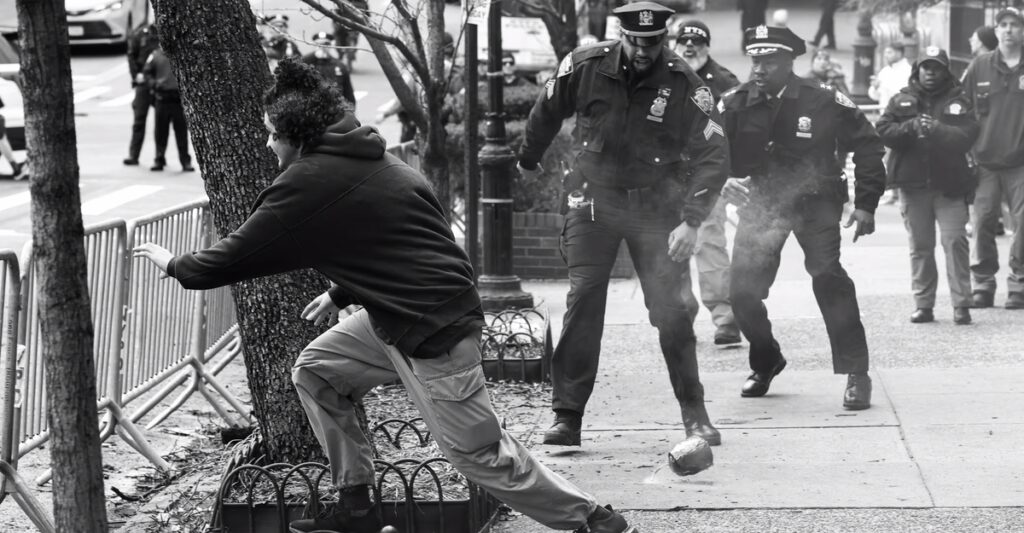
On Saturday, a far-right group organized a sparsely attended anti-Muslim demonstration outside of Gracie Mansion, the home of New York City’s first Muslim mayor, Zohran Mamdani. A “Stand Against Hate” counterprotest attracted far more people, but perhaps the only reason why Americans know about these events at all is because two men threw homemade bombs at the Islamophobic demonstrators. Authorities say the suspects told police officers they were inspired by the Islamic State, an Islamist terrorist group.
“This was not random violence. This was a planned attack motivated by extremist ideology and inspired by a violent foreign terrorist organization,” New York Police Commissioner Jessica Tisch said at a press conference yesterday. With this, she promptly raised the profile of both the suspects, Emir Balat and Ibrahim Kayumi, and of ISIS itself. It hardly seemed to matter that no evidence has surfaced that directly ties these men to the larger movement.
This case drives home some of the challenges of counterterrorism efforts today: The bold mission of international terrorist groups can motivate bad actors, even those who lack a clear link to the groups themselves. Fortunately, neither explosive device at Gracie Mansion actually detonated, and no one was hurt. But simply by claiming some relationship with ISIS, perpetrators can spin a largely unsuccessful act into something grander and more terrifying.
Neither Balat, 18, nor Kayumi, 19, both from Pennsylvania, had a criminal record. In police custody, prosecutors say, one suspect confessed to watching ISIS propaganda videos, and the other said he wanted to carry out an attack bigger than the 2013 Boston Marathon bombing. According to federal prosecutors, Balat also pledged his allegiance to the Islamic State and wrote the phrase “Die in your rage yu [sic] kuffar!”—using an Arabic term for “nonbelievers” or “infidels”—in custody. Federal prosecutors have charged them with using a weapon of mass destruction and providing material support to a terrorist organization, among other accusations, despite the absence of evidence of a relationship between ISIS and these two young men.
[Gal Beckerman: Just don’t say the w-word]
This ambiguity is in keeping with ISIS’s strategy, which is to maximize its reach without increasing its vulnerability to disclosure or disruption. Although calls for violence from ISIS, al-Qaeda, and Iranian terror groups have reportedly intensified since America’s war with Iran began, these appeals are typically vague and unspecific. They are still dangerous. Armed with incendiary YouTube videos and a few homemade bombs, attackers can easily become martyrs in a global jihadist movement. ISIS need not direct an attack to take credit for it.
Oddly, the FBI has yet to issue a statement warning state and local agencies of what may be a growing terror threat from Islamist backers of Iran—itself a known state sponsor of terror. The White House reportedly halted a federal security bulletin warning of Iran-backed threats, owing to concerns over “accuracy.” This is an unprecedented move from the executive, but in keeping with President Trump’s assurances that the war he started would be simple and without consequence to the American public. Neither promise has proved true.
The challenge of Islamic terrorism in America is that, just like the home-grown terrorism of white supremacists, the radicalism is often diffuse. The pernicious, radicalizing ideas involved are larger than any one source or one figure, and they can reach anyone with a wifi connection.
The message of terrorism speaks to anyone who believes that violence is a natural response to political differences, and who presumes they may not be seen or heard otherwise. Inspiring unspeakable dread across an entire country doesn’t require much planning—just some warped ideas and an internet connection. That’s how would-be terrorists like it.
The post The Peculiar State of Islamic Terror in America appeared first on The Atlantic.