The song began just after the commercial break.
Seven young women were standing before a semicircular pink couch, waiting to learn who among them could be voted off “Love Island.” A tense beat ticked like a clock as a voice sang: “Twisted nightmare/All my love’s lost in your sin.” The camera closed in on nervous faces, and the tick grew heavier. The voice continued: “On my side it’s/You and me against the end.”
The music was blandly down-the-middle, a thoroughly conventional piece of modern pop. But there was something about how apt and specific it was, how it did its job too perfectly — it felt uncanny, how unnervingly appropriate it was.
Things got weirder when I Shazammed it. The search turned up nothing. I consulted Spotify and Apple Music — nada. I couldn’t find the song on SoundCloud or YouTube, on Tidal or Qobuz or Deezer. It didn’t seem to be anywhere. On Reddit I found posts from people who were equally mystified, trying to discover the song’s identity.
Eventually I tracked it down: The song was “Love’s a War,” by a Los Angeles composer named Hendric Buenck. But learning this turned out to raise even more surreal questions than it answered. As soon as I figured out where the song came from, I found myself deep within what psychologists call the frequency illusion — that experience where, having taken notice of something for the first time, you suddenly find it popping up in every corner of your life (where, of course, it was waiting all along).
I was, I realized, hearing music like “Love’s a War” constantly — not just when I watched television, but when I watched any video, anywhere. It was the soundtrack to my kids’ favorite YouTube video. It was the background music for the TikTok urban-homestead tutorials a friend sent me. It was in Super Bowl commercials and Instagram spon-con. Even when I listened to talky highbrow podcasts, it sneaked in behind the ads. As I moved through each day, I was encountering more of this type of music than any other. I had never noticed it. Now I couldn’t stop noticing it.
Sync, it’s called. Once it was known as library music; sometimes it’s called production music. It’s not really a genre. It’s a category, defined by its function: This is music that exists to be paired — synced — with video. That’s why it’s so ubiquitous. Modern American life is absolutely steeped in video, which follows us, at every hour, from TV screens to smartphones to laptops, from movies to social media rants to workplace anti-harassment training modules. The soundtrack to most of it is some form of sync. This is partly because sync tends to be the cheapest and easiest option. But it’s also because sync is specifically crafted to be cut to video — and in a time when more and more of human communication involves editing video, this stuff is rapidly becoming our dominant form of music.
Sometimes that means an unobtrusive backing track like “Sunny,” available royalty-free from the Bensound sync library. You have most likely heard “Sunny,” or some equivalent mix of upbeat guitar and jaunty marimba, dozens or hundreds or thousands of times. It’s too bland to be actively annoying and too annoying to be anything but what it is: the backing track for a corporate video or a demonstration of how to assemble a flat-pack credenza. Its chipper whimsy used to be everywhere, but sync must change with the times, and the “Sunny” sound has given way to something more electronic. A video-editor friend sent me a whole playlist of such stuff from a library called APM Music, bearing the perfect title: “Music for Corporate and Technology.”
We are awash in stuff like that: seemingly nameless and authorless, often free and (increasingly) not even made by humans. This state of affairs has arrived without many of us fully taking note of it. There are countless tunes from common music libraries — TikTok favorites, the cues that Apple provides with iMovie, the jingles and beats in YouTube’s Audio Library — that, like “Sunny,” feel instantly recognizable without many of us being able to place why.
Some are actually difficult to distinguish from something you might have heard from a pop artist. Sometimes this is because they are imitating pop, but sometimes it is because pop has started imitating them. (One of the most-used sync sounds of 2025 was the glitchy vocal hit in “Midnight Sun,” by the Swedish singer Zara Larsson: Did its constant appearance on social make it a pop hit? Or was it the other way around?) The more I looked into it, in fact, the more I became convinced that sync was some sort of skeleton key, a decoder that could explain the entire state of the music industry today, including the disappearance of the old “song of the summer” and the success of certain artists whose popularity I found baffling, like Benson Boone.
James Barker, an executive producer on the American “Love Island,” told me that he too had noticed a blurring of the lines between sync and pop. For most of its history, he said, sync music simply imitated whatever was happening in the mainstream. Now he’s watching that dynamic flip: Pop music is increasingly being shaped to work with video. People in the industry talk about how today’s songs are all about “the moment” — the 30 seconds that leap out enough to matter, the bit that might go viral on TikTok. Library music was crafted to suit the needs of people editing film. Now pop is being crafted to suit the needs of people editing social media clips.
That might sound bleak. But the more I looked into the vast universe of sync, the more fascinating I found it. There was plenty of forgettable dreck, but there were also, intriguingly, real artists, making real music. And that music was getting heard by millions and millions of people — some of whom noticed, most of whom did not.
Sync’s rise has been hastened by changes in the music industry itself, where income has dried up for all but the most successful artists. I spoke with one songwriter and producer, Dylan Callaghan, who spent the early 2000s playing guitar in a couple of indie-rock bands that never broke big. It was after he had a child and a mortgage, he said, that he dug into producing sync music. The work was steady, the licensing fees could provide a middle-class life and the market was so robust that it seemed to dwarf everything else you might think of as music. “This isn’t, like, a corner of the industry,” he said. “This is the music industry.”
The business, he explained, is like an iceberg. Economically, the part above water involves the very biggest stars, with their lucrative global tours of enormous venues. The other 90 percent of the iceberg — the unseen subsurface bulk — consists, in large part, of the people who create music for vast sync libraries. Some are owned by platforms, like YouTube (around 150,000 tracks) and TikTok (more than a million, combining sync music with regular pop licensed from record labels). Others have names you’ve most likely never heard of, like Epidemic Sound (50,000) or Audio Network (300,000).
Today’s music is treated like a free-flowing utility: It’s added to spaces the way air-conditioning is, providing the right vibe for TV shows, YouTube tutorials, stores, study sessions. That means many of today’s musicians, instead of selling records, operate more like the people who once played the piano in department-store lobbies, the organ at baseball games or the accordion in 19th-century cafes: Their job is to provide the appropriate background noise for some other experience. For a time, Callaghan said, there was “this thing called ‘artistic integrity,’ and sync music was very much frowned upon — and now it is the revenue stream.”
Callaghan’s clients are mostly music supervisors for TV shows. One of them, Ann Kline (of “Shameless,” “Reacher” and “The Pitt”), told me that her job is like set design: She absorbs a creator’s idea of how a show should feel and then she makes that feeling real. She does this, crucially, within the constraints of a budget. Instead of using a well-known song by, say, Fleetwood Mac, which could end up costing six figures to license, she might turn to someone like Callaghan, who can record a track that sounds like Fleetwood Mac, plus craft it to match the dramatic moment it’s meant for, at a much better price.
Other music-supervisor jobs are similar, only with the time frame starkly compressed. Barker, the “Love Island” producer, told me that he and his team come into each season having spent six months collecting music to soundtrack the moments they know will appear on the show: first kisses, backstabs, two people sharing a bed. “What we shoot on Monday airs on Tuesday,” he explained. “You come to battle with your arsenal of ammunition.”
Even when armed in advance, though, finding the right track is never a given. The song for a sexy moment might feel too explicit or fall flat when paired with real footage. In those cases, Barker goes back to the drawing board — which, for him, is the search bar on the website of a company called Extreme Music. He chooses a genre or a tempo, specifies some elements he’s looking for (a choir, a ukulele, a 1980s sound), maybe adds a lyrical phrase that captures the moment (“I miss you”) and starts to narrow the results from there.
Barker was the third producer I spoke to in a single day who talked about using Extreme as a go-to for sync tracks. I was a little surprised, especially since there are far larger libraries out there. I asked Barker what made Extreme so popular: Was it the search functionality, the ease of filtering? Or was there some cutting-edge secret sauce, like music churned out by A.I.? I kept hearing from insiders that A.I. was radically changing the industry: What if that was what was so uncanny about the track I heard on “Love Island,” that it was A.I. all along?
But no, it was nothing like that — in fact, it was the exact opposite.
I visited Extreme Music’s offices in Santa Monica, Calif. — a half-block campus shared with a sister company called Bleeding Fingers — and met with Russell Emanuel, one of Extreme’s founders, in an office featuring a seven-foot-tall polar bear holding a replica of Prince’s guitar from “Purple Rain.” There was an explicit joke nameplate on Emanuel’s desk that he said was a gift from Quincy Jones, who has sync tracks in Extreme’s library, alongside other prominent artists including Snoop Dogg, Timbaland, Mark Mothersbaugh and Atticus Ross.
Emanuel is bald and barrel-chested, with a gravelly North London accent that can make him seem like a character from a Guy Ritchie film. The secret to his company’s success, he told me, was no secret at all. You just hire the top composers and musicians, charge a lot for their work and split the profits straight down the middle. “I like to tell people that we are reassuringly expensive,” he said, “and that’s a good line, but there’s a truth behind it.” These days, if you aren’t dealing in premium music, you may well end up dealing with a lot of churn and slop, including A.I. slop. (A.I.-generated artists are already amassing millions of monthly listens on Spotify, and users of the A.I. composition tool Suno reportedly crank out seven million songs per day.) At around 28,000 songs, Extreme’s library is ridiculously small compared with the millions held by some competitors. And yet, Emanuel said, “we outperform them” — a claim that’s difficult to evaluate, since Extreme is owned by Sony Music Publishing, and its earnings aren’t individually broken out.
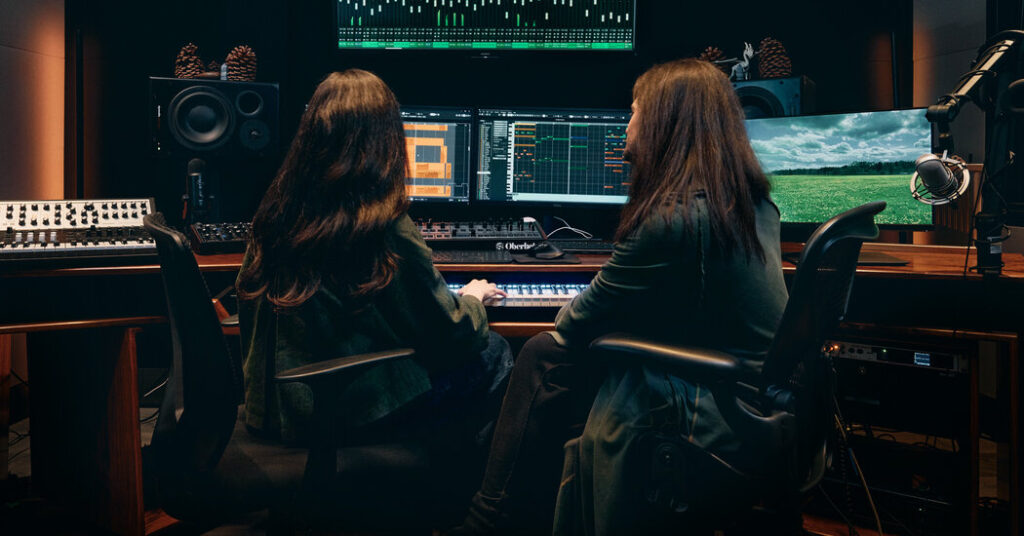
Emanuel ushered me down the hall into a warren of studios. Each was the work space of one of the 28 composers Bleeding Fingers employed. He would open a heavy soundproof door, and inside I’d see someone fiddling with a synthesizer or huddling over a bank of screens. Eventually we found three composers — Kara Talve, Sami Goldberg and Anze Rozman — playing through a pitch for HBO’s upcoming “Harry Potter” series. Hanging on one wall were several strange instruments, including one grafted onto what looked like a dinosaur skull. “It’s a Triceratone,” Talve said, laughing; she and Rozman made it for a series called “Prehistoric Planet.” She handed Rozman a clarinet-ish wind instrument inspired by the noises an ice age creature called a terror bird might have made. He puffed up his cheeks and blew into it, filling the room with a tremendous honk. “It’s a horrible instrument,” he said, before using it to honk out “Happy Birthday.”
This Bleeding Fingers work was close to the zenith of the industry, the most prestigious music that could still be called sync — writing for a high-profile HBO series under the umbrella of the Oscar-winning composer Hans Zimmer, one of Bleeding Fingers’ founders. (Zimmer was away on tour when I stopped by.) A vast majority of sync is not made in fancy studios by salaried employees. It’s made by musicians working from apartments and basements, cranking out tracks in hopes of placing them with libraries and having them pop up when somebody needs music for a “Corporate and Technology” video.
Much of it is deliberately generic. APM Music, which brings together the holdings of various sync libraries, features some collections, such as “Electronic Tension Builds,” that feel like turnkey audio solutions: Listen to “Cast Your Vote” and it’s hard not to see cameras panning over anxious reality-TV contestants. Similar collections cover “News & the Economy” (great for throwing to commercial after a segment on big market moves), “Pre School TV” (copious kazoo) and “Fashion and Luxury Advertising” (neoclassical, trip-hop, jazz).
For something less luxurious, you could head to AudioJungle, the kind of budget source where a nonprofessional might pay $10 to license music for a small-business video. Coming here from Extreme or AMP feels like walking from a high-end retailer to an outlet store. There are mountains of the obvious sync-music modes: “Fun Upbeat Whistle” for that maniacally cheery corporate sound, “Lo-Fi Chill Fashion Hip-Hop” for the twinking beats that replaced it, “Bayou Swamp Country” for the twangy slide guitar that used to announce gritty TV dramas. Some options are bizarre: cringe-inducing or bafflingly bad, or novel in ways that are surprisingly lovable. Some options are all these things at once. Even here you will occasionally run across sounds that make you think: This is more interesting than it has any right to be.
There was in fact some slippage between the high-end compositions at Bleeding Fingers and the main sync library at Extreme. Pitches that didn’t work for a Bleeding Fingers client, Emanuel explained, often went into the library catalog, waiting for somebody else to find them useful. When there was downtime between projects, composers made tracks for the library. Or sometimes things moved in the other direction: Music that began as a sync project would end up being customized for a particular production.
This is what happened on the reality TV series “The Valley.” Its opening titles feature a jangly, gospel-ish guitar stomp with the refrain “I’m all right” — a darkly hilarious choice, given that the show follows characters down not-all-right paths like addiction and abuse. When producers for “The Valley” first plucked this music out of Extreme’s library, the lyrics were different. The track was different. But it had the feel they were after. They contacted Emanuel, telling him they wanted to commission something just like this, only not this.
“It was definitely about the quote-unquote ‘vibe,’” says T.J. Stafford, one of the musicians who made the track. “They probably said something like, ‘Can you make it sound more purple?’ or ‘It needs to feel pancakey.’”
I was visiting Stafford and his partner, Mike Smith (a.k.a. Smidi), at their studio in Venice Beach, where they run their own music-production company, Saint Rogue. The two men are successful songwriters and producers in their own right, with credits on work featuring Miley Cyrus, Britney Spears and Charli XCX. But sync work, they said, was like their 401(k). It could have a longer shelf life than a pop song, and when it got picked up for a show, every airing brought a check in the mail.
When I asked what producers might mean by “pancakey,” Smith and Stafford laughed and admitted they had no idea. Or maybe they had some idea, but nothing they could put into words. “You’re the word guy,” Stafford told me. “We just — I don’t know.” Smith explained: “We just play it, man.”
Part of the job, they said, was interpreting vague, groping notes like “purple” and “pancakey.” It was not so different from the mainstream music industry, where meddling label executives might insist that, say, a drum sound should “soar” more. What producers really wanted, in their experience, was to make the music feel more alive, more human — and the best way to accomplish this was to record humans playing live. That was natural for Smith and Stafford; Smith toured with Keith Urban, played with Ben Folds and met Stafford via his church’s band. All their tracks use live musicians, which Smith said was becoming an ever-greater asset.
By way of explanation, Smith told me about a class he teaches in the music-production program at the University of Southern California. His students were technically excellent — but some, he had noticed, were more accustomed to working alone at a laptop than playing with other musicians. When he brought them into the studio for live sessions, it took some adjustment.
Some students, however, ended up building their careers almost entirely around sync. I spoke to one, Sam Vendig, who has more than a hundred songs in the Extreme library. Most jobs began with briefs from the company, outlining a particular need. One recent brief was for “strobe wave” music (pulsing electronic tracks in the vein of deadmau5’s “Strobe”); another was for “cocktail folk” (“basically white-guy bossa-nova-type stuff,” Vendig explained); another requested “hyper rock.”
These were not genres Vendig would normally listen to. But he could always get interested, he said, by thinking about the sound design, the guitar tones, the opportunity to learn and get paid. Regardless of genre, he found that leaning on his pop instincts made for successful tracks. There were structural tricks, too. Editors wanted moments to cut to: longer intros and outros, rising chords, big orchestral hits, an extra bar of bass between chorus and verse, gaps that made space for decisive edits.
This, too, isn’t so different from how many mainstream songwriters and producers work. When a pop star puts out a call for songs, it reaches plenty of talented musicians who might not be able to cultivate their own adoring audiences but are more than capable of crafting the right music to fit the star’s image and narrative. If you can write an anthem or a breakup ballad for a pop singer, you can do the same for a character on a TV show. The latter might well be easier, more lucrative and more creatively liberating.
Emanuel himself was playing in London’s 1990s punk scene when he and some friends tried making tracks for KPM, which has been supplying sounds for British TV, film and radio since the 1960s. By the ’90s, libraries like KPM’s were being eagerly rediscovered, particularly by vinyl collectors and hip-hop producers in search of samples. This music, they found, could be hugely fun and inventive. Often it let musicians explore ideas that were wilder or goofier than they might have on their own records.
The director George Romero understood this decades earlier: He used eerie library music for “Night of the Living Dead,” even after Dario Argento brought in the band Goblin to score the film. Some of the most memorable themes in TV history were similarly plucked from libraries, including the ones for “The People’s Court” (an almost comically funky track called “The Big One”) and “Curb Your Enthusiasm” (Luciano Michelini’s “Frolic,” now the stuff of countless memes, which Larry David first heard in a banking commercial).
For musicians, sync work can be loose and exploratory in useful ways. As Vendig put it, “I have to be less precious about my ideas.” We often imagine music as a medium for artists to express their own particular visions. Sync does something else entirely. Still, within the boundaries of a given prompt, it can end up in fascinating places.
Hendric Buenck, the man behind that mystery song from “Love Island,” is a staff composer for Bleeding Fingers. When I visited him in his studio, he walked me through his typical work flow. A job begins with him receiving a brief describing what the music should accomplish. He read from the one that prompted “Love’s a War.” It was seeking something “heavy with anticipatory energy,” since “emotions tend to run high during these scenes.” The music would be “pretty heavily layered and dynamic to support the build of the scene leading to a reveal.” The show, according to the memo, did “push the spectrum of tension relatively far,” but the composer should “bear in mind this is a reality TV show, not a horror film or ‘Game of Thrones.’” Also, no heavily orchestral stuff — too “epic.”
Buenck grew up much like Smith’s students: He made music (hip-hop beats) for the internet (SoundCloud) alone in his bedroom in Berlin. We listened to some of his recent music and talked about what made it work. Each track had a basic structure that made it easy for an editor to break down. There was a teasing atmospheric intro, then a first hook (not too intense), then a middle section that added new chords. Then, crucially, came the second hook, a big climactic one — plus a final hit that could serve as an outro. Each part could be looped or layered, shortened or extended, to be used in different scenes or at different visual paces. Buenck usually starts by writing the biggest hook and working backward until, over the course of a few hours, he’s completed a full track. Then, if he needs lyrics, he sends it to one of the singers he works with.
Ella Collier, 26, was the singer on “Love’s a War.” The day we spoke, she was working on country-pop sync songs, building stories based on words found in the briefs and taking care to leave ample space after certain phrases, gaps where “the dialogue of the show can happen.” After that, she’d be working off a brief for “swagger pop,” which she described as the type of music you hear “when the bombshells walk in.”
She and Buenck tend to work quickly, passing a recording back and forth for perhaps an afternoon; a full assignment can be completed within a day or two. The process sounded very formulaic, and I wanted Buenck to break down for me what made this formula successful — how he knew what chords or melodies would guide us to feel sadness, or happiness, or “anticipatory energy.” But for him, the job was as much about intuition as it was about technique. “I’m not sitting down thinking, How can I, like — what kind of chord progressions could I come up with that would really amplify this?” he said. “There’s not much thought going into this, like, in terms of music theory. I did not study music. I can’t even read notes. So, it’s like, I do this purely based off feeling.”
There was a moment, while talking to Collier, when I mentioned how uncommon it was that she made both mainstream pop and sync music under the same name. Many musicians I spoke with did not want their artist names associated with their sync work, and took care to keep the two careers distinct from each other. But Collier immediately corrected me: The sync work, she said, was mainstream too. It appeared on TV. It was heard by millions of people. What could be more mainstream than that? “I’m really proud of this work,” she said. “It’s interesting. And it’s the way I survive.”
Ryan Francis Bradley is a writer based in Los Angeles. He has previously written for the magazine about the Los Angeles fires, the director Ti West and the band Khruangbin.
The post It’s the Music You Hear All Day, Without Ever Noticing appeared first on New York Times.