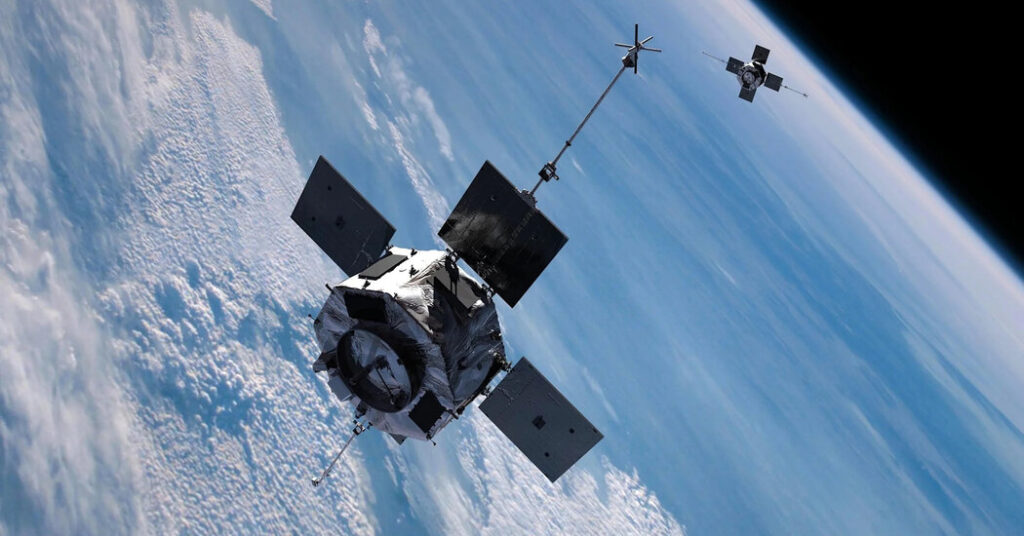
A 1,323-pound satellite that has been orbiting Earth for nearly 14 years is expected to re-enter the atmosphere on Tuesday, presenting a very slight chance that someone could be hurt by one of the pieces that does not burn up, NASA said.
NASA said that most of the satellite, the Van Allen Probe A, would be incinerated as it hurtles through the atmosphere but that some components would probably survive. The risk of harm to anyone on Earth is low — approximately 1 in 4,200, the agency said.
The U.S. Space Force expects the satellite to re-enter the atmosphere at about 7:45 p.m. Eastern time, give or take 24 hours, NASA said in a statement on Monday. A NASA spokeswoman said on Tuesday that the agency did not have any immediate update, and the Space Force did not respond to requests for comment.
Jonathan McDowell, an astrophysicist who retired from the Harvard-Smithsonian Center for Astrophysics, said that because the satellite was descending in an elliptical orbit and would re-enter the atmosphere at about 17,000 miles per hour, it was impossible to predict where and when any surviving fragments might hit Earth.
But he said there was no reason to panic.
“For the average person, it will be a nice light in the sky if you get lucky and, otherwise, don’t worry about it,” Dr. McDowell said. “We have much more scary re-entries that happen. Occasionally, there is a 20-ton Chinese rocket stage that comes down. Those are much scarier for me.”
But even the small risk, Dr. McDowell said, highlights the need to better organize the final fate of rockets and satellites launched by governments and by companies like SpaceX
“The aggregate risk is significant,” he said, “so we do need to figure out a better way of getting rid of our spacecraft then letting them re-enter at a random place and time.”
NASA launched the Van Allen Probe A and its twin, the Van Allen Probe B, into the night sky above Cape Canaveral, Fla., on Aug. 30, 2012, on what was supposed to be a two-year mission to gather data on Earth’s two permanent radiation belts.
The trusty probes lasted far longer than expected, until 2019, when NASA shut them down and announced that their observations had been cited in more than 600 scientific journals and more than 55 doctoral theses.
The satellites, NASA said, made several important discoveries about the radiation belts, which are named for James Van Allen, the physicist who discovered them in 1958, in the early days of the space race between the United States and the Soviet Union.
The belts, which protect Earth from cosmic radiation, solar storms and streaming solar winds, are made up of rings of charged particles trapped by Earth’s magnetic field, and the probes helped scientists understand how those particles are gained and lost.
They also collected the first data showing the existence of a transient third radiation belt, which can form during times of intense solar activity.
When the Van Allen probes were switched off, NASA predicted they would re-enter the atmosphere in 2034. But those calculations were made before the current solar cycle, which has been far more active than expected, NASA said. The changing conditions increased atmospheric drag on the satellites, resulting in an earlier-than-expected re-entry.
Van Allen Probe B is now expected to re-enter the atmosphere sometime after 2030.
Michael Levenson covers breaking news for The Times from New York.
The post ‘Don’t Worry About It’: NASA Satellite to Burn Up in Fall to Earth appeared first on New York Times.