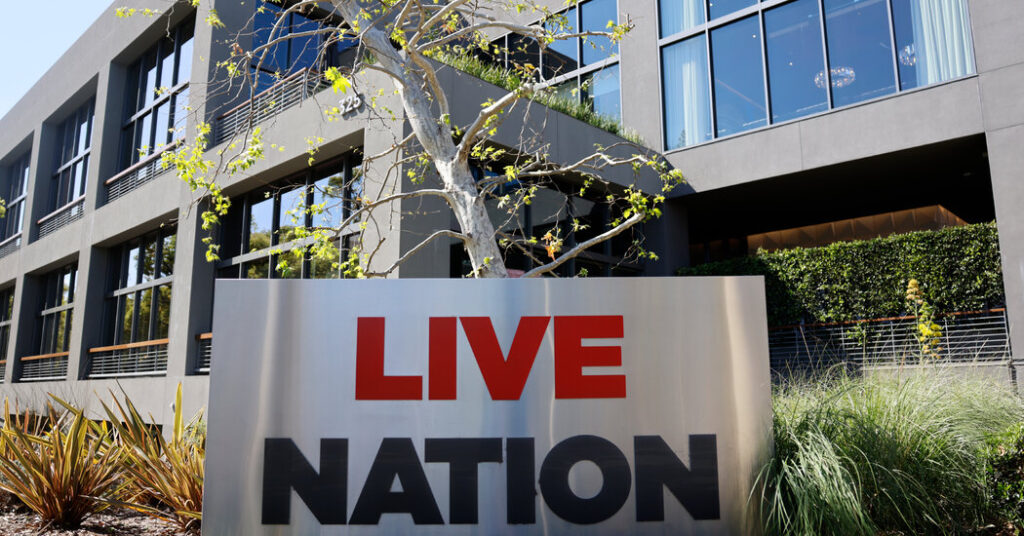
A group of dozens of states may continue to litigate an antitrust case against Live Nation, the concert giant that includes Ticketmaster, despite the settlement the company reached with the federal government one week into trial.
In a brief hearing on Tuesday morning at Federal District Court in Manhattan, the judge overseeing the case, Arun Subramanian, told lawyers for the states that they should be prepared to proceed with the trial, presenting to the same jury that had been selected last week.
But Judge Subramanian, who sent the jury home for the week after the settlement was revealed to the court on Monday, also urged the states to pursue a settlement in earnest, telling both sides to hunker down in the courthouse to make their best efforts to hammer out an agreement by the end of this week.
“You should be focused on ‘Can we make a deal,’” Judge Subramanian said after a representative of the New York attorney general spoke. “I want to see if you can get a deal done.”
If the states do not reach a settlement with Live Nation, they should expect to proceed to trial on Monday, the judge said.
After the judge ended the morning’s hearing, lawyers for a handful of states and representatives of Live Nation — including Michael Rapino, the company’s longtime chief executive, who made a brief appearance in court — left to negotiate in private.
Lawyers and executives for both Live Nation and the states said a new settlement was not likely to emerge by Friday. Dan Wall, Live Nation’s former antitrust lawyer, who is now a top executive at the company, said there was “zero” chance of a quick settlement given the large number of states involved.
The Justice Department, joined by 39 states and the District of Columbia, sued Live Nation in May 2024, arguing that the company was a monopoly that dominated the music industry through a series of interrelated businesses, including ticketing and concert promotion, in violation of federal and state antitrust laws. Among the allegations aired during three days of testimony last week were that executives from Live Nation had threatened to retaliate against venues if they did not use Ticketmaster as their exclusive ticketing vendor.
Live Nation denied that it was a monopoly, and said it did not threaten venues.
The judge began the hearing on Tuesday by scolding both the Justice Department and Live Nation for failing to disclose their settlement to the court in a timely manner.
Mr. Rapino and Omeed A. Assefi, the acting head of the Justice Department’s antitrust division, signed a term sheet on Thursday that settled the case. But neither side informed the judge on Friday, and the trial proceeded that day with two witnesses — one of whom, Jay Marciano, the chief executive of AEG Presents, Live Nation’s biggest rival, was in the middle of his testimony when proceedings in the case ended for the day. The judge called that turn of events “mind-boggling.”
“On all sides,” Judge Subramanian said, “this behavior strains the bounds” of the conduct expected from lawyers in court.
In its term sheet with the Justice Department, Live Nation agreed to allow any promoter to work concerts in their amphitheaters, and to let venues use any ticketing vendor, if they choose not to make an exclusive deal with Ticketmaster. The agreement, which was filed in court, also set aside a fund of up to $281 million for states that opt in to that settlement.
During a heated hearing in court on Monday when news of the settlement became public, lawyers for some states said they had been blindsided by the agreement. They later filed a motion for a mistrial and requested a stay of 60 days to allow their litigators to prepare to try the case since Justice Department lawyers had previously taken the lead.
The judge has not ruled on that motion, but he made clear that he wanted the states to pursue a settlement this week or be ready to resume the trial.
Elinor Hoffmann, an antitrust lawyer at the New York attorney general’s office, said the states wanted to go to trial, but renewed her request for a 60-day stay. “Our objective here,” Ms. Hoffmann said, “is to present the case the jury deserves to hear.”
Olivia Bensimon contributed reporting.
Ben Sisario, a reporter covering music and the music industry, has been writing for The Times for more than 20 years.
The post Dozens of States Weigh Continuing Live Nation Antitrust Case appeared first on New York Times.