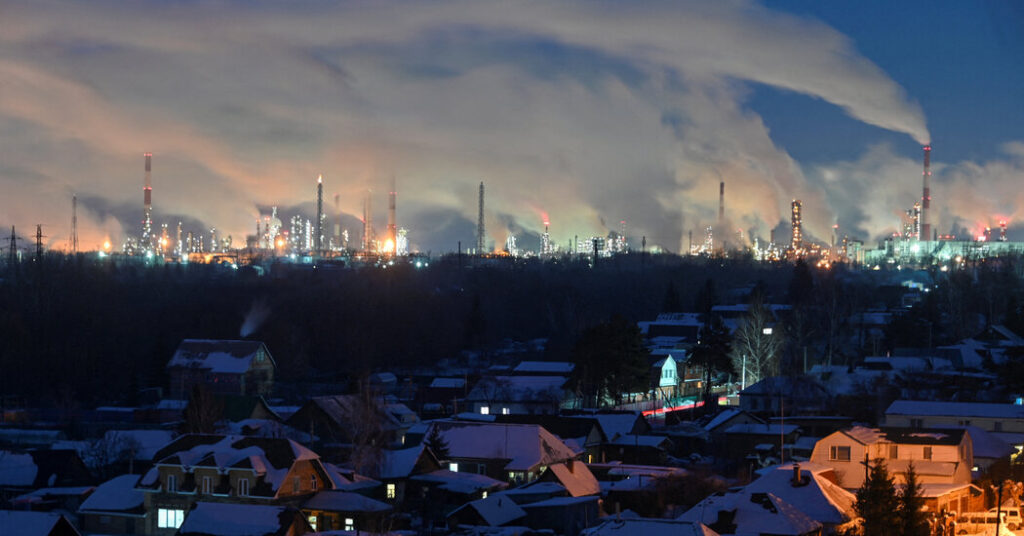
The Trump administration has started to loosen some restrictions on Russian oil exports that were designed to pressure the Kremlin over the war in Ukraine, as Washington seeks to ease the shock in energy markets from the U.S.-Israeli attacks on Iran.
Treasury Secretary Scott Bessent on Friday issued a 30-day waiver for India to buy Russian oil already at sea without retaliation from Washington, which he said would only have a modest impact on Russia’s revenues. The question is whether the United States will go farther.
Mr. Bessent later said that the United States was considering lifting more sanctions on Russian oil. And President Trump on Monday said in a news conference that his administration was “waiving certain oil-related sanctions to reduce prices.”
Mr. Trump did not say whether he was talking about the waiver for India or something else. He also stopped short of naming Russia but implied that Moscow, which has been holding peace negotiations with Ukraine mediated by Washington, would be a beneficiary.
“We have sanctions on some countries, we are going to take those sanctions off until this straightens out,” Mr. Trump said. “And then who knows, maybe we won’t have to put them on because there will be so much peace.”
The dramatic change in energy markets could not have come at a better time for President Vladimir V. Putin of Russia. The country’s energy revenues had been plummeting, with oil and gas companies contributing 44 percent less to Russia’s budget in February than in the same month a year earlier. This has forced Russia to draw on the dwindling liquid assets left in its National Wealth Fund.
“It’s important for Russian energy companies to take advantage of the current situation,” Mr. Putin said during a meeting with Russian officials on Monday about the oil and gas market, noting that the high prices were likely to be temporary.
Mr. Putin reiterated that his government was assessing the feasibility of halting all supplies to the European market, which has been seeking to wean itself off Russian energy since Moscow’s full-scale invasion of Ukraine in 2022.
He suggested that it made sense to divert the supplies from Europe “to more attractive destinations,” instead of “waiting for the door to be slammed in our faces.”
Analysts caution that the impact on the Russian budget, which has been weighed down by gargantuan state spending on the war in Ukraine, will depend on how long the disruption in the Middle East lasts. They note that a month or two of high prices will have a limited impact on Russia’s financial picture but that a longer run of high prices would make a difference.
Mr. Bessent said this weekend that the loosened restrictions on Indian purchases were narrow in scope and would not provide a significant financial benefit to the Russian government.
“There are hundreds of millions of barrels of sanctioned crude on the water, and in essence, by unsanctioning them, Treasury can create supply,” Mr. Bessent said Saturday on Fox News. “We are looking at that.”
Russia’s energy revenue problems began piling up last year, after global prices declined. Washington also imposed sanctions on two major Russian oil producers, Lukoil and Rosneft, and began pressuring India to stop buying Russian oil, widening the discount that Moscow needed to offer to sell Russian crude.
“It was a quite bad and difficult situation,” said Janis Kluge, a Russia expert at the German Institute for International and Security Affairs, a think tank. He said the measures had been some of the most effective that the West had taken since the start of the war to pressure Moscow through energy revenues.
But the picture has suddenly brightened for Mr. Putin.
“For now, it all evaporated, and the pressure is gone that was really starting to take a toll on the Russian budget,” Mr. Kluge said, though he added that it was difficult to predict what would happen in the long term.
Hungary’s Russia-friendly leader, Viktor Orban, on Monday asked the European Union to suspend sanctions on Russian energy.
Chancellor Friedrich Merz of Germany, however, said that there was “no reason” to consider easing the sanctions on Russia. Speaking in Berlin on Tuesday at a news conference, Mr. Merz said that solidarity with Ukraine took precedence, even if it meant enduring a period of higher energy prices.
Dmitri S. Peskov, the Kremlin spokesman, said on Tuesday that the possible lifting of U.S. restrictions on Russian oil was not discussed in detail during an hourlong call late on Monday between Mr. Putin and Mr. Trump.
Though oil is trading at much higher prices because of the war in Iran, Moscow is still coping with a strong ruble, meaning energy sales in dollars cover less of the Russian budget. Russia could take measures to try to weaken the currency, but that would risk increasing inflation, which the Russian central bank is trying to tame.
Paul Sonne is an international correspondent, focusing on Russia and the varied impacts of President Vladimir V. Putin’s domestic and foreign policies, with a focus on the war against Ukraine.
The post U.S. Eases Limits on Russian Energy as Oil Prices Soar appeared first on New York Times.