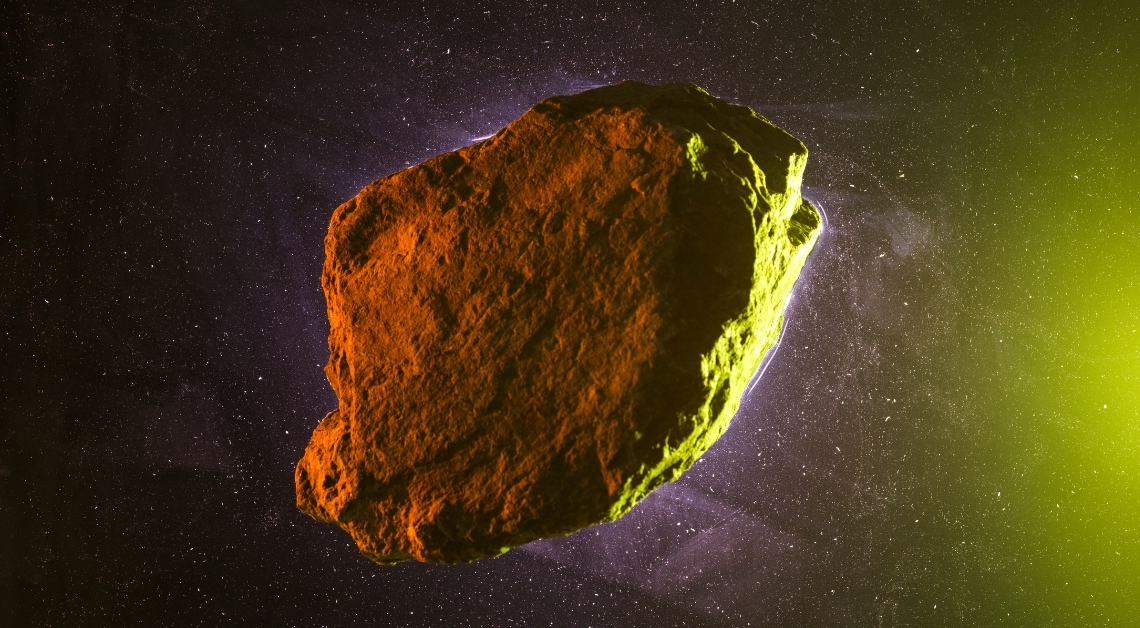
In 2022, NASA decided to test a very simple idea for saving humanity, so simple it was almost stupid: if a giant space rock threatens the Earth, we’ll just smack it really hard with a rocket. We’d be trying to hit a baseball with another baseball… in space.
It worked. That’s not news. We’ve known that for a while. We just didn’t fully understand how well it worked until.
NASA’s DART experiment, which stands for Double Asteroid Redirection Test, deliberately crashed a spacecraft into the small asteroid Dimorphos, which orbits a larger partner called Didymos.
The initial goal was just to prove that a kinetic impact could nudge an asteroid just off course enough to avoid impacting the Earth. And that’s exactly what happened. The collision shortened Dimorphos’s orbit around Didymos by about 32–33 minutes.
NASA’s Asteroid-Smashing Test Accidentally Messed With Another Space Rock
New research led by Rahil Makadia at the University of Illinois Urbana-Champaign shows that the impact didn’t just alter Dimorphos’s local orbit. It slightly shifted the entire Didymos–Dimorphos system’s path around the Sun. In other words, humanity’s first planetary-defense test was intended to move just one asteroid but wound up moving a pair of asteroids millions of miles away from Earth.
To be clear, the change was relatively small. The system’s velocity changed by only a few micrometers per second, effectively speeding up its solar orbit by about two inches per hour. This is where we are all smacked in the face with the reality of planetary defense systems.
They are going to be big, glitzy bombs that deliver spectacular displays of humanity’s dominance of space. All we need to do is smack a thing with another thing just hard enough to give it a minuscule little push away from us, sometimes years or even decades in advance, to change its trajectory and not blow it to smithereens.
That said, when DART hit Dimorphos at roughly 14,000 miles per hour, it blasted a massive cloud of debris into space. That ejecta acted like an accidental rocket engine, doubling the momentum transferred to the asteroid system. Scientists call this the “momentum enhancement” effect, essentially a recoil created as rock and dust shoot outward.
Despite the dramatic experiment, the Didymos system still poses no threat to Earth. Its closest approach remains about 15 lunar distances away.
The real significance of DART is that it’s shifted planetary defense out of the realm of science fiction and into reality. Next up, the European Space Agency’s Hera mission, scheduled to arrive in 2026, will study the impact site in detail.
The post NASA’s Asteroid-Smashing Test Worked Even Better Than Expected appeared first on VICE.