From pangolin scales to elephant tusks, from African gray parrots to manatees, the illicit trade in wildlife products and live animals is one of the most lucrative criminal enterprises in the world. The global black market for illegally harvested wildlife is estimated to be at least $20 billion a year.
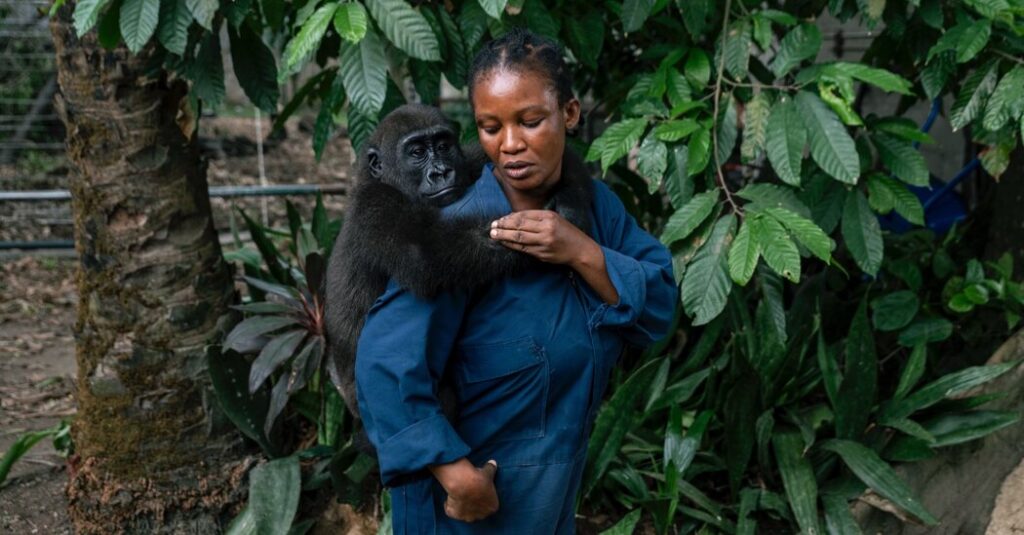
Last year, I traveled to Nigeria to report on the trafficking of apes out of Africa — a growing problem, driven in recent years by social media videos of chimpanzees and gorillas being kept as pets. While there, I learned about Bili, a baby gorilla who narrowly avoided such a fate. But the selling of chimps, gorillas and bonobos makes up only a small portion of the illegal wildlife business. These images, captured by the Congolese photojournalist Arlette Bashizi, show the breadth of the trade in Nigeria, as well as the efforts to police it.
Above, staff members at the Nigeria Customs Service’s storage facility in Lagos, Nigeria, weigh bags of pangolin scales seized by officers from the agency’s Special Wildlife Office. In one of the largest such seizures, officials intercepted 196 bags filled with scales, possibly representing as many as 38,000 pangolins, which are also known as scaly anteaters. A major factor behind the demand for wildlife products is an array of beliefs about their medicinal powers: The perceived health benefits of rhino horn, for instance, made it more valuable than gold a decade ago, fetching around $30,000 per pound at its peak. Pangolin scales, in traditional Asian medicine, are believed to have the power to treat a variety of ills, from abscesses to cancer.
Some 350 miles to the east, in Calabar, officers from the Nigeria Customs Service lay out animal parts seized from traffickers near the border with Cameroon. The crossing there is part of a route often used by animal traffickers to bring illicit wildlife products and live animals from Cameroon and other African countries into Nigeria, where they are then smuggled to other parts of the world. Last March, customs officers arrested a person entering Nigeria from Cameroon with parrot heads, packs of parrot feathers, heads of African hornbills and chimpanzee parts including hands, feet and heads.
When Anuhu S. Mani, above, started at the Nigeria Customs Service in 2009, the prevention of wildlife trafficking was a low priority. Starting in 2013, when Mani was assigned to an intelligence unit within the customs service, he began working with law enforcement agencies in other West African countries to track the smuggling of wildlife and wildlife products into and out of Nigeria. A few years later, as Nigeria continued to gain disrepute as a hub for this sort of trafficking, Mani and his boss proposed to combat the problem by creating what became the Special Wildlife Office, which Mani now heads.
In certain areas of West and Central Africa, bushmeat is the primary source of animal protein for the local population. The consumption of bushmeat has increased in recent decades, apparently driven by both population growth and wealthier consumers, especially in urban centers, where bushmeat is seen as a treat. Wildlife populations are unable to reproduce themselves at a rate that keeps up with demand. Above, a crocodile and a monitor lizard are displayed for sale at a market in Epe, about 40 miles from Lagos.
Wildlife trafficking is not the only peril faced by endangered species. The destruction of forest habitats is another significant challenge. Above, Paulina Udo prepares palm oil at an artisanal factory in Creek Town, in Nigeria’s Cross River State. While palm oil production provides crucial livelihoods for communities across West and Central Africa, the industry’s expanding footprint is accelerating deforestation, which threatens the survival of several wildlife species, in part by opening up to poachers access to deeply forested areas.
In Calabar, Peter Jenkins, left, a co-founder of a conservation organization called Pandrillus, carries a box containing seized African gray parrots, which are especially valued for their intelligence and are heavily trafficked as exotic pets in Nigeria. Pet shops can be used as trafficking fronts; sometimes animals that cannot be sold legally are hidden inside shipments of legitimately exported animals like ducks or rabbits. Corrupt customs officials and cargo handlers enable the smuggling across international borders.
The parrots were destined for Pandrillus’s wildlife-rehabilitation center, with its enclosures housing rescued birds, primates and other animals. Above, Brendan, a male chimp recovered from traffickers in 2023, sits inside the space he shares with two other primates: another chimp, Mili, and a baby gorilla, Bili. All three were taken from the wild as infants.
Over a couple of days, I watched the three of them playing together: Hanging from bars, swinging from ropes, tumbling, splashing around inside a bucket of water — they had distinct personalities, observing me with as much interest as I observed them.
Brendan and Mili, both males, were rambunctious, squealing and hooting excitedly whenever they saw their handler approach; they refused to let her go when she wanted to leave after a play session. Bili, by contrast, seemed more placid and conflict-averse, but she could be stealthy and mischievous to get her way.
This won’t be their permanent address. The plan is to transfer Bili sometime in the coming months to a sanctuary for western lowland gorillas in the Republic of Congo or Gabon. Brendan and Mili will be sent to Pandrillus’s Nigerian Chimpanzee Center, a hundred miles northeast of Calabar.
Until then, all three remain inseparable, especially at night. One evening, I got to see them sleeping together on one platform — two chimps and a gorilla bunched into a single lump of fur and feet.
This project was reported with the support of the Pulitzer Center. Yudhijit Bhattacharjee is a contributing writer who has been reporting on geopolitics,global security and espionage for more than a decade. He is the author of ‘‘The Spy WhoCouldn’t Spell’’ and ‘‘The Dinner Set Gang. Arlette Bashizi is a photographer based in the Democratic Republic of Congo, where she documents the daily life of her community, keeping women and youth at the center of her work.
The post The Race to Stop Wildlife Trafficking in Africa appeared first on New York Times.