The compulsion started soon after my marriage.
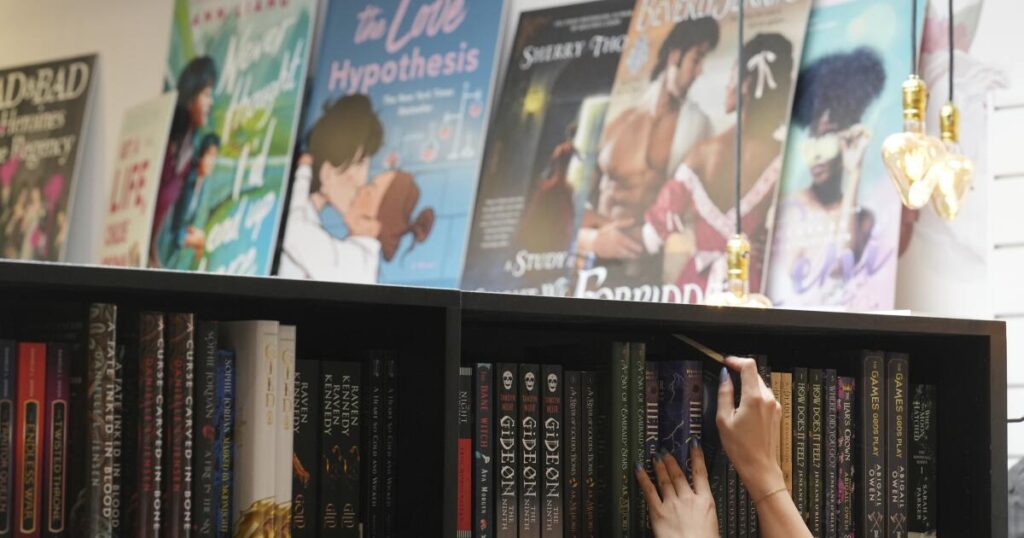
Long before e-books and audiobooks, I furtively read paperbacks whose covers featuring bosomy maidens and bare-chested men would have outed my obsession. Then, on a family car trip, my husband told my young stepdaughters why I liked sitting alone in the back seat.
“Diane is reading bodice rippers,” he said, citing the old-fashioned name for sexually explicit romance novels. Back then, they were my guilty pleasure.
More than 30 years later, I remain a fan of romance novels, but it’s no longer a craving I feel compelled to hide. In fact, I value the window it opens to my research interests in pop culture, religion and gender.
I’m not alone. Romantic fiction now makes up nearly 25% of books sold in the U.S., earning $1.44 billion globally in 2022-23. The Bible may be history’s bestselling book, but annual sales of romance novels even outpace the scriptures.
Among scholars, there’s a range of opinions on the genre’s enduring popularity.
Some describe romantic fiction as the literary equivalent of Marx’s “opium of the masses.” They argue these books are perennial bestsellers because they offer escapism and the promise of “happily ever after” — a quick sugar high to distract from the struggles of everyday life.
Other scholars cite the genre’s pedigree. Though canonized as literary classics, 19th century novels like “Pride and Prejudice,” “Jane Eyre” and “Wuthering Heights” can also be read as romances — stories written by women and centered on women’s emotional lives, courtship and desires. In a world circumscribed by the era’s narrow gender roles, these works featured clever, often headstrong women who exercised agency over their love lives and fates.
In my view, this explains their popularity: 19th century readers may have found vicarious pleasure in Jane Eyre’s journey from timid governess to independent heiress and happy wife. Likewise, Catherine Earnshaw’s decision to marry the wealthy Edgar Linton, thus abandoning the penniless Heathcliff, may have struck the female fans of “Wuthering Heights” as an understandable choice.
As readership grew and men penned their own novels, aiming to cash in on the expanding market, their perspectives dominated, pushing women’s fiction to the side. Changing social mores also made the once popular “woman’s novel” seem dated.
The genre was revived in the 20th century after authors gave readers edgier characters and put more oomph in their plots. Daphne du Maurier’s 1938 classic, “Rebecca” breathed new life into gothic romances. And Georgette Heyer revitalized historical romance with smoldering stories like “The Grand Sophy,” set in England’s Regency period (1811–1820).
Bodice rippers debuted in the 1970s. The name came, in part, from their covers, which often depicted a woman in a half-torn dress in the embrace of a buff man. A racier take on the genre, they were still set in early 19th century England and centered on happily-ever-afters. But characters were sexually active in ways that would have scandalized Jane Austen’s heroines.
Kathleen E. Woodiwiss’ “The Flame and The Flower” is widely credited with launching the modern bodice ripper: The first romance published in paperback, it became a huge bestseller, despite its graphic rape scenes.
These novels, which debuted amid the sexual revolution, were more explicit than their precursors, and heroines enjoyed more agency in their life choices. That said, the sex was male-driven and often implied that their idealized, muscular bodies could send the heroine into paroxysms of ecstasy.
The digital revolution further transformed romance novels. Self-publishing, digital publishing and BookTok brought new and younger readers into the mix. Anyone could become a romance novelist, leading to an array of new characters, plots and sexual adventures.
A genre that once mainly featured straight, British aristocrats now embraced Black, Latino and Asian protagonists. There were wanton witches, voracious werewolves and vampire lotharios. In others, LGBTQ characters and pro athletes took center stage. Readers drawn to bawdier fare could dive into erotic fiction, exploring plotlines featuring reverse harems and pairings with multi-limbed aliens or lovestruck mafiosos.
Many of these innovations have something in common. Rather than sticking to the male-driven plotlines of 20th century bodice rippers, most contemporary romance writers focus on female satisfaction. Men are far less likely to rush their own gratification, focusing their hunger on a partner’s pleasure and experience instead.
But contemporary female characters are not just sexually satisfied. They also enjoy successful careers and close friends. True to real life, some are plus size or have disabilities. Others were burned in past encounters. Their suitors need to scale their emotional walls before blowing their minds in the bedroom.
Put together, the genre has undergone a 180-degree turn from the books I hid in the 1990s.
Today’s romantic fiction is less about horny couplings and happy endings, and more about exploring emotional connections and power dynamics. Stories also play out the impact of race, class, gender and sexuality on relationships.
Consider the bestselling book and breakout HBO series “Heated Rivalry,” which explores the complicated romance between gay hockey players. It’s beloved by straight and gay female fans for depicting relationships characterized by emotional vulnerability, rather than toxic masculinity. And it reveals a trend previously underreported: Women like watching gay men enjoying sex.
While the “Heated Rivalry” phenomenon is intriguing, readership also has skyrocketed for romantasy, which features unconventional women navigating make-believe worlds populated by magic, faeries and dragons. Some heroines are timid, others brazen, but they share a drive to succeed on their terms.
The genre took off in 2015 with Sarah Maas’ “A Court of Thorns and Roses,” the saga of a beautiful but impoverished teen who finds herself in the faerie court. Eleven years and two series later, Maas’ books have sold more than 75 million copies. Each novel is kinkier than the last, and they’ve even inspired readers to spice up things in their own bedrooms.
The success of these new romance subgenres reflects a striking societal shift: Women are no longer shy about being on top. As writers and readers increasingly see powerful women in C-suites and boardrooms, they expect similar strength in the bedroom.
Although what women want has not changed over time, our ability to achieve it has. That’s why the popularity of books by, for and about women is as fervent today as when Elizabeth Bennet fell for Mr. Darcy. But Lizzie Bennet lived in a world where she could only do so much, hemmed in like her real-life counterparts.
Thankfully, women today enjoy more power, agency and pleasure. And thankfully, too, we have a lot more books by, for and about women as we contemplate what lies ahead.
Diane Winston is a professor in the USC Annenberg School for Communication and Journalism.
The post Why romance novels are no longer a ‘guilty pleasure’ appeared first on Los Angeles Times.