Punch the monkey ran away with our hearts. Watching him cling to a stuffed orangutan at a Japanese zoo as he struggled to make friends became a collective moment as people around the world grew invested in his emotional well-being.
Now, animal caregivers are saying Punch is in good company as they share stories of orphaned and rescued chimpanzees, penguins, mountain lions and elephants bonding with their own toys.
Newborn mammals find comfort in contact, and rescue animals sometimes seek solace from fuzzy toys in the absence of their families, said Marc Bekoff, professor emeritus of ecology and evolutionary biology at the University of Colorado at Boulder. Some adult animals might also look to toys for safety and companionship, according to Bekoff.
“It brings them joy, and it makes them feel good,” he said.
Here are six other animals that have formed attachments to their playthings — from dolls to tires.
Lizzy
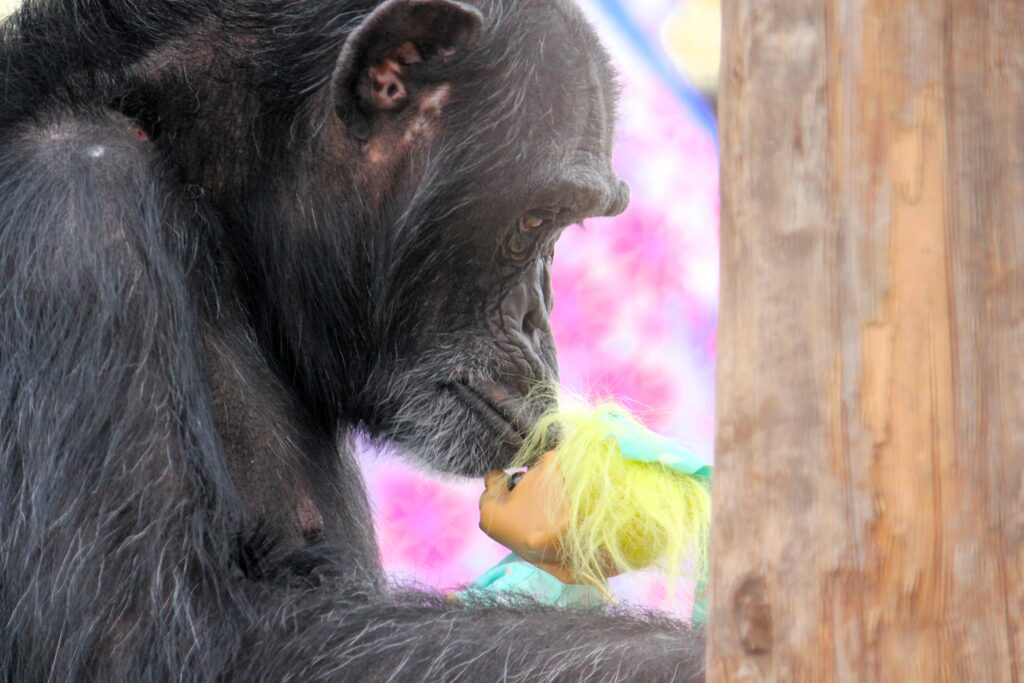
Lizzy had her choice of toys at her new home at a Georgia chimpanzee sanctuary in November 2021. There were balls, rings, stuffed animals and plastic chew toys.
But she was interested in only one: a small Grinch doll.
Now, Lizzy carries the green Dr. Seuss character everywhere, including when she roams the woods, sunbathes and sleeps in a villa with more than a dozen other chimpanzees. If she needs her hand to eat or climb a tree, Lizzy, 35, transfers the doll to her feet.
Lizzy’s dolls eventually become brown with dirt. Staff members at Project Chimps, a sanctuary for former laboratory chimpanzees in Blue Ridge, Georgia, stitch together the dolls’ floppy arms and legs, which can come apart when other chimpanzees try to steal the toys.
Once a doll loses two limbs, staff members order a new one online. Lizzy has gone through at least a dozen dolls, Executive Director Ali Crumpacker said. And she pays attention to only a specific Grinch doll — one that’s about 14 inches tall and has a tuft of fabric around its neck.
Lizzy grooms the doll and includes it in giant nests she builds with blankets, boxes, paper and other toys.
“A lot of the chimps do gravitate towards playing with primate-shaped toys,” Crumpacker said. “And the Grinch might honestly be a green version of that to her.”
Henry
The first fellow that penguin Henry met after hatching was a stuffed one named Tom.
Henry, who was born Jan. 30 at an English aquarium, needs about 45 days to grow and become waterproof before the bird is released into an enclosure with other little blue penguins — a species also known as fairy penguins. So Henry began life by snuggling with Tom, a toy about the size of an iPhone. Henry has since upgraded to a larger toy from the aquarium’s gift shop.
The toys are still bigger than Henry, who’s a member of the shortest penguin species. Henry fit in caregivers’ palms when the penguin was born and will probably grow to be about a foot tall.
Henry’s parents, Dandy and Tyrion, are a new couple who seem uninterested in incubating their eggs, Sea Life Weymouth aquarist Charlotte Edge said. The pair is incubating fake eggs to practice while aquarium staff members look after Henry.
“Giving him a little teddy provides him with a little friend that sort of smells like him, looks a little bit like him as well,” Edge said. “… Even though it’s obviously not a penguin, he’s got a bit of company to get used to being with somebody else.”
Even after Henry goes to the enclosure with more than three dozen other little blue penguins, aquarium staff won’t retire the toys. Henry’s sibling is expected to hatch in a few days.
Foxie
Diana Goodrich bought a troll doll with bright pink hair at a thrift shop in 2008, thinking the toy would be fun for one of the chimpanzees at the sanctuary where she worked. She never expected that Foxie, a chimpanzee who rejected all other toys, would immediately become attached to it.
Foxie kissed and snuggled the doll, which she carried on her back and in a pocket between her thigh and torso. Foxie, 49, has since expanded her collection and now plays with hundreds of dolls, including Strawberry Shortcake, Dora the Explorer and Disney princesses.
“It really is a security — a way for her to feel secure,” said Goodrich, the sanctuary’s co-director.
Before arriving at Chimpanzee Sanctuary Northwest in Cle Elum, Washington, Foxie was used in hepatitis vaccine research and as a breeder for the biomedical research industry, according to Goodrich. She had four children who were taken from her when they were young — twins Steve and David, who died in laboratories, and Angie and Kelsey, who moved to chimpanzee sanctuaries.
Foxie probably expresses her motherly instincts with her dolls, Goodrich said. Often, Foxie tosses the dolls with her caregivers — a sign she trusts them with her most valuable possessions, Goodrich said.
Kaikai
Many elephants like playing with tires, but Kaikai’s connection to a black rubber tire goes beyond the typical attachment.
Kaikai, a 9-month-old African elephant, enjoys rolling the tire, flipping it over and using it as a pillow when she sleeps.
Her life had a rough beginning. A wildlife official found Kaikai in May in a Kenya conservancy, beside the body of a lactating elephant. Officials learned Kaikai was the adult elephant’s daughter. She was flown to the Sheldrick Wildlife Trust, a Kenya wildlife conservation organization and elephant rescue, where she’s now living.
“To see her so joyful and outgoing, and finding toys and entertaining herself, shows us that she’s a really healthy elephant and a really happy elephant,” Sheldrick Wildlife Trust spokeswoman Sean Michael said. “Her survival wasn’t a given, so that’s extremely rewarding for us.”
Nyia
The blanket can be any shade of blue — sky, teal or dark — but it must be blue. Otherwise, Nyia the chimpanzee will ignore it.
Nyia, 20, carries a blue blanket with her everywhere at Project Chimps, the same sanctuary in Georgia where Lizzie has Grinch. She plays keep-away with the blankets with a friend, spins the blankets over her food before eating and sometimes wears the blankets on her head.
Staff members look for rare moments when Nyia isn’t holding a blanket, so they can wash away the dirt that quickly covers it.
Briar
Mountain lions typically stay with their mothers for the first one to two years of their lives. But that wasn’t possible for a cub found alone in El Dorado County, California, when he was about 4 weeks old in August 2024.
Wildlife officials couldn’t find the cub’s mother after searching the area for a few days, and sent him to the Oakland Zoo, where staff members named him Briar because his spots resembled a blackberry briar bush.
While Briar received treatment in the zoo’s veterinary hospital, staff members gave him a stuffed dog toy to play and cuddle with. They thought the toy would comfort Briar in the absence of his mother and help him adapt to his new environment. He stopped playing with it after a few weeks before moving to a mountain lion habitat.
Now, Briar lives with two other mountain lions, Coloma and Silverado. They groom one another, wrestle, play chase, climb trees and hang out on hammocks made of old fire hoses.
“They often teach us how to be resilient, how to be strong, how to bounce back,” chief executive Nik Dehejia said about the Oakland Zoo’s animals. “And certainly Briar is an incredible example of that. And, you know, I would expect and hope that Punch will follow that same process.”
The post Punch the monkey isn’t alone in bonding with his emotional support toy appeared first on Washington Post.