Travelers kicked off spring break this weekend facing “monstrous” security lines at some airports due to the partial government shutdown. Gas prices and airfare are increasing as the cost of oil spikes more than a week into war with Iran. Thousands of flights to and from the Middle East have been canceled.
“Travelers just can’t catch a break,” said Kyle Potter, executive editor of the travel site Thrifty Traveler. “Everything that can go wrong will go wrong right now.”
Recent disruptions followed violence in the Mexican beach town Puerto Vallarta last month after the killing of a drug cartel leader and restrictions on flying in the Caribbean after the U.S. struck Venezuela in January.
U.S. airlines expect 171 million passengers to fly over the spring break period that ends April 30, according to projections by trade group Airlines for America. That’s a 4 percent increase from last year. As Transportation Security Administration officers prepare for a missed paycheck this weekend, fears are mounting that staffing issues could persist.
“I’m concerned that it could be highly disruptive to spring break travel,” said Henry Harteveldt, a travel industry analyst and president of Atmosphere Research Group.
Here’s what travelers should prepare for.
Long TSA waits
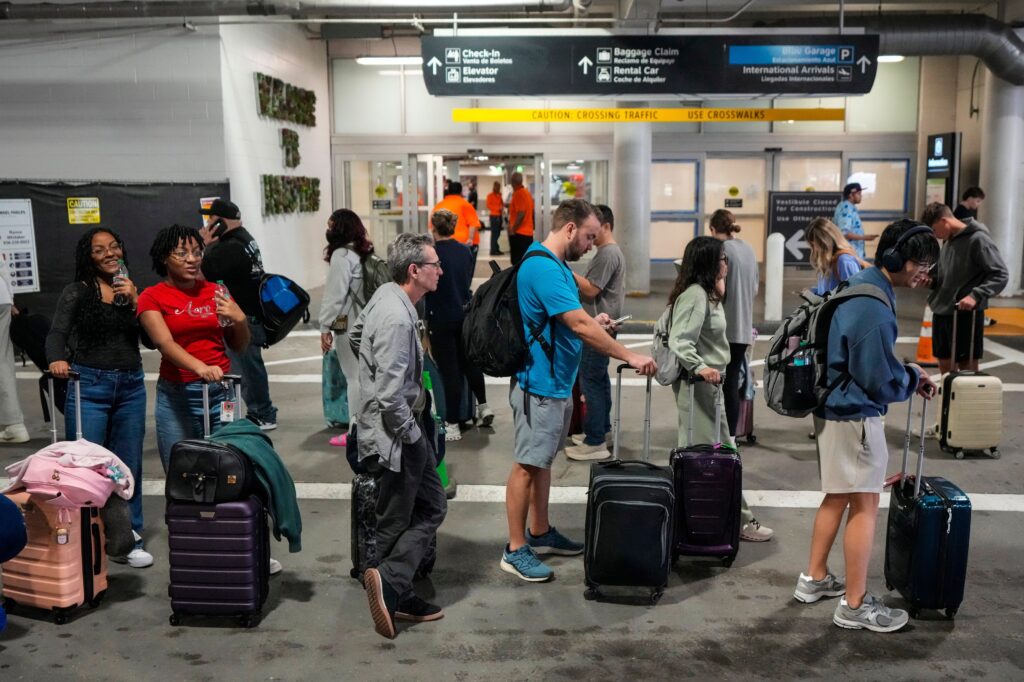
On Monday, travelers at William P. Hobby Airport in Houston continued to endure hours-long waits for security that reached a peak of more than three hours Sunday. Reuters reported that the waits averaged three hours at standard checkpoints midday Monday. By late afternoon, those lines had dropped— to two hours. The airport asked travelers to arrive four hours ahead of their flights Monday.
Louis Armstrong New Orleans International Airport asked travelers to arrive three hours early Monday in a social media post, warning that a shortage of TSA workers was causing long lines. Some people waited more than 75 minutes Sunday. Later Monday, the airport said wait times had improved and suggested arriving at least two hours before departure.
“The delays could continue through the rest of the week,” the airport said in a statement.
At #MSY airport in New Orleans and the TSA security line is backed up to a parking garage. How is this possible?! It will take close to an hour or longer to get thru security pic.twitter.com/ML3DokYk9g
— Matthew Garcia (@mgStorageTheory) March 8, 2026
Airports in Atlanta and Charlotte also saw long wait times Sunday, though Hartsfield-Jackson Atlanta International Airport said lines were back to normal by late afternoon.
Travel industry insiders are urging Congress to reach an agreement to fundthe Department of Homeland Security.
“More than 2.7 million people cleared through TSA yesterday, but too many had to wait in extraordinarily long — and painfully slow — lines at checkpoints,” Airlines for America president and CEO Chris Sununu said in a statement. “It’s unacceptable to have wait times of 2 or 3 hours. And it’s unacceptable that TSA officers will have $0 in their paychecks this week.”
In a statement, Lauren Bis, an assistant secretary in the Department of Homeland Security, placed the blame on congressional Democrats.
“Today, travelers are facing TSA lines of up to nearly 3 hours long at some major airports, causing missed flights and massive delays during peak travel,” she said.
Potter said travelers should try to avoid peak flight times whenever possible and “try with all of your might” to fly with a carry-on instead of checked bags.
“Then you’re sitting in one line instead of two,” he said.
Global Entry suspended
Since the Department of Homeland Security suspended the Global Entry program on Feb. 22, lines at customs have been unpredictable for international travelers. Some have reported nightmare lines while others have had no issue. Airports and U.S. Customs and Border Protection (CBP) have encouraged travelers to use Mobile Passport Control (MPC), a free alternative fast-pass service, to speed up their customs experience.
Unlike Global Entry or TSA PreCheck, MPC doesn’t require preapproval or an application process. You can install the smartphone app in seconds. To be eligible for MPC, you must be a U.S. citizen, a lawful permanent resident, a Canadian B1/B2 citizen visitor or a returning Visa Waiver Program traveler with approved Electronic System for Travel Authorization. Individual travelers and families of up to 12 can be processed together on the same app.
MPC is not a foolproof solution, however. Travelers have complained of spotty availability of MPC lanes, and still having to wait in long lines even where it is available.
Middle East flight impacts
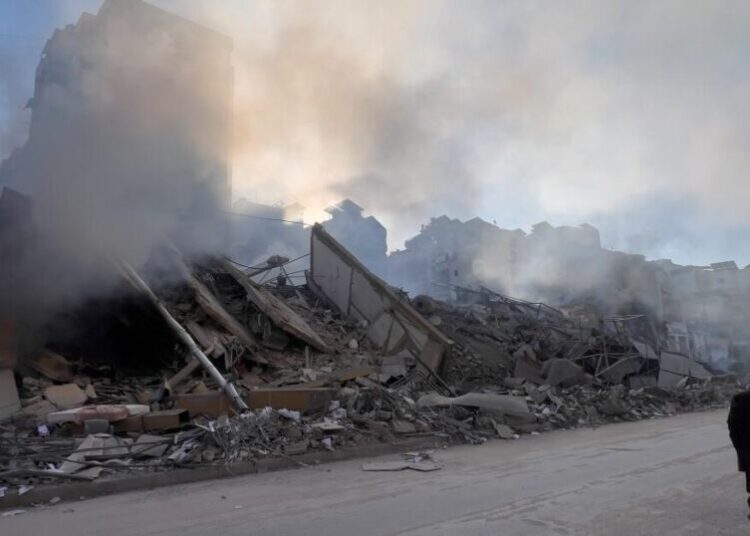
A week and a half after the United States and Israel launched military strikes on Iran, airlines continue to cancel flights to and from the Middle East. Between Feb. 28 and Monday, carriers have scratched around 40,000 out of more than 72,000 flights, according to Cirium, an aviation analytics firm.
Air service is slightly improving, however. On March 1, the day after the attacks, about 65 percent of flights departing the Middle East were canceled. The number of cancellations fell to 37 percent, or around 1,226 flights, on Monday.
Travelers planning to visit Doha, Abu Dhabi or Dubai for vacation or to break up a long-haul flight should consider changing their plans over the next several weeks, said Tyler Hosford, security director at International SOS. Jordan, Egypt and western Turkey, which are not in the direct path of the strife, are more prudent options.
“The places people go in Turkey are typically Istanbul or on the Aegean Sea, like the old Trojan ruins,” Hosford said. “Those are all safe because they’re far away” from the Iranian border.
Passengers flying through the region en route to Asia or Africa should field other itineraries, Hosford said. The issue is logistical challenges, he said, not safety. When planes must circumvent closed airspace — in addition to parts of the Middle East, Ukraine and Russia are off-limits to civilian or Western carriers — flight times can increase exponentially. Airlines may also reduce capacity to these troubled areas.
If possible, Hosford recommends traveling west instead of east.
“Look at flying the other way, via Hong Kong, Taiwan, Korea or Japan,” he said. “People from the West Coast typically do it this way.”
Though the trip might be longer from the East Coast, he said, “your options are a lot more open.”
The war’s impact on aviation has forced travelers in the Middle East to embark on more adventurous journeys home. Hosford, whose firm has organized evacuation flights from Muscat, said people stuck in Abu Dhabi and Dubai are traveling overland to Oman, then catching a flight out of the capital. From Doha and Bahrain, they are taking ground transportation to Saudi Arabia.
Rising fuel costs
Oil prices are shooting up amid the ongoing U.S.-Israeli war with Iran, which could hit road trippers and air travelers.
The average price of gasoline in the U.S. has gone up more than 51 cents over the last week to $3.45 a gallon, according to data from the gas station price comparison app GasBuddy. That average is more than 54 cents higher than a month ago, and more than 41 cents higher compared to the same time last year.
Patrick De Haan, head of petroleum analysis at the company, said he believes the prices could increase another 15 to 20 cents per gallon this week. Drivers should shop around before they fill their tank up, bearing in mind that state lines can be “danger zones for gas price volatility.” De Haan said road trippers should also avoid highway exits with only one station because less competition can lead to higher prices.
On the airfare front, Harteveldt said the rise in jet fuel is already being reflected in airfare.
“Airlines are already hiking fares,” he said, both base fares and fuel surcharges on long-haul flights that charge them.
Potter said his takeaway is book upcoming flights sooner rather than later.
“I booked a bunch of domestic flights over the weekend because odds are those prices are going to get worse, not better, in the days and weeks ahead,” he said. He said airlines will have to factor in competition and the price at which travelers will just decline to fly altogether.
“Flight pricing is about supply and demand and competition between the airlines, and jet fuel doesn’t really change that at all,” he said.
Mexico warning
In a messageto U.S. citizens, the U.S. Embassy and consulates in Mexico said that recent widespread violence had ended, but visitors needed to remain aware of risks of kidnapping and crime.
Hosford said spring breakers do not need to worry about any lingering safety risks in Mexico following the February conflict with a Jalisco cartel. All roads and airports are open, and the majority of tourist destinations, such as Cabo San Lucas, Cozumel and Cancun, are safe.
The one still sensitive spot, Hosford said, is Puerto Vallarta, which was embroiled in violence after the killing of the cartel’s leader. Before flying south, travelers should check the pulse of the Pacific resort area, he said, to make sure the situation has not flared up.
The State Department’s travel advisory lists Mexico as a Level 2, or “exercise increased caution,” but has labeled the state of Jalisco a Level 3, or “reconsider travel.”
Hosford said travelers still rattled by recent events are considering tropical alternatives, such as Jamaica, Dominican Republic, the Bahamas and Hawaii.
“Even if it’s safe, a lot of people are saying, ‘Look, if I’m going on spring break, I just want to be able to focus on having a good time with a margarita and taco on the beach,’” Hosford said. “‘If I have this looming over my head, do I want that?’”
The post Spring break travel may be chaos. Here’s how to prepare. appeared first on Washington Post.