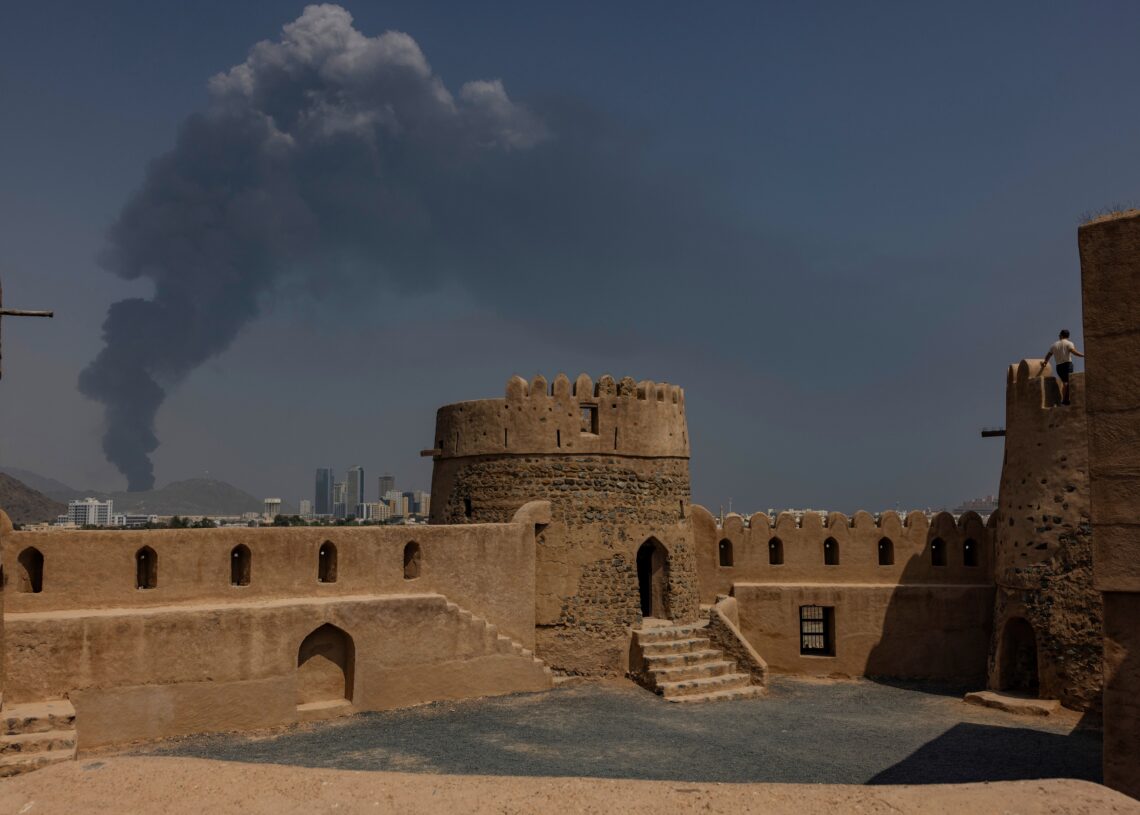
DUBAI — Black smoke rose above Dubai’s international airport Saturday morning after an Iranian drone struck near a terminal. That night, a boom reverberated across the Marina neighborhood as debris from another drone slammed into a high-rise tower. By Sunday morning, the shrill blare of missile alerts rang out over mostly empty beach clubs.
More than a week after the United States and Israel attacked Iran, killing its supreme leader, Persian Gulf nations continue to be targeted by waves of Iranian drones and missiles that show few signs of letting up. The unprecedented assault has shaken countries that transformed in recent decades from sparsely populated desert nations into globally renowned business and tourism centers, calling into doubt their reputations as havens of wealth and stability and forcing them to take sides in a war they publicly opposed.
No place embodies the Gulf’s success — and the threats to it — more than Dubai, a futuristic metropolis that is the most populous city in the UAE and where more than 90 percent of its roughly 4 million residents are foreigners.
Dubai “is a safe haven and a brand name and a role model,” said Abdulkhaleq Abdulla, a political science professor from the United Arab Emirates.
“It has built itself this image that people aspire to,” Abdulla said, sitting in a quieter-than-usual shopping mall on Sunday. “The damage to that image is already there. The question is how permanent that damage is.”
The transformation of Gulf countries such as the UAE, Saudi Arabia and Qatar was made possible in part by diplomatic hedging by their leaders, who remained friendly with Iran even as they formed partnerships with the West, including allowing U.S. military bases to be constructed on their territory.
The UAE, for example, signed President Donald Trump’s Abraham Accords normalizing relations with Israel, but it also has been a key hub for Iranian business.
That balancing act, analysts say, appears to have reached its limit. Over the past nine days, government statistics show that Iran has targeted the UAE with about twice as many drones and missile strikesas Israel. Dubai’s airport and some of its most iconic landmarks have been hit.
“Surprise is too nice a word — we were shocked,” Abdulla said. “Iran for generations was our neighbor. For 47 years under the Islamist regime, it was a threat. Now, it is our enemy.”
Publicly, Gulf leaders have projected confidence in their defense capabilities, noting that about 94 percent of attacks have been intercepted. The country for the past 10 years has used a Terminal High Altitude Area Defense (THAAD) system, developed by U.S.-based Lockheed Martin, and for even longer has used the Patriot missile defense system to defend against lower-altitude targets. Casualties have remained relatively low across the nation of 11 million, with four people killed and more than 100 wounded since Feb. 28. But the region remains on edge, with no end to the war in sight and the Gulf’s vulnerabilities, including its reliance on imported food and desalinated water, acute.
Some residents of Dubai fled in the early days. Those who remain say they are both confident in their government and unsure about the endgame.
“We may be shaken, but our foundation is solid,” said Cherif Sleiman, the chief revenue officer of Property Finder, a real estate company akin to Zillow in the United States. Debris from a drone had left a mark on Sleiman’s patio. “What has been built on a resilient foundation will surely sustain.”
Sleiman said he could not imagine the conflict continuing for more than week. “We are all in wait-and-see mode,” he said.
Iranian President Masoud Pezeshkian publicly apologized to Iran’s neighbors on Saturday morning, saying in a recorded video message that attacks would stop unless strikes on Iran originated from the Gulf.
But soon after, plumes of smoke rose above Dubai International Airport after an Iranian drone hit near a terminal — one of the most jarring scenes this weekend as the UAE was targeted with 229 drone attacks and 26 strikes by ballistic missiles, according to officials.
In Bahrain, the government said Sunday that Iran had hit a desalination plant, a move analysts warned could mark a dangerous turn in the war. And in Saudi Arabia, where waves of attacks continued to hit oil infrastructure, the U.S. Embassy told staff to depart — an indication that American officials think violence could escalate.
Analysts said the apparent contradiction between Pezeshkian’s remarks and the continued attacks reflected discord within Iran’s government, which will now be led by Mojtaba Khamenei — a son of the slain supreme leader Ali Khamenei.
A Gulf official, who spoke on the condition of anonymity because of the sensitivity of the military situation, said the country has the defense system it needs to continue to protect residents. But the official warned that “a fragmented decision-making environment could push the region into a wider confrontation that nobody can fully control.”
“The Gulf states have invested heavily in defensive capabilities and contingency planning, and those systems are performing their purpose, but air defense alone cannot stabilize a region if the political track collapses,” the official said.
So far, Gulf leaders have defended themselves but abstained from joining the fight against Iran. The UAE, Abdulla said, is relying on its “soft power” to try to pressure the regime behind the scenes, including using diplomatic channels and threats of sanctions.
“At any moment, Iran could hit a certain target that ends up being a tipping point for the Gulf to change its stance,” said Esfandyar Batmanghelidj, chief executive of the Bourse & Bazaar Foundation, an Iran-focused think tank. “But the longer this goes on, the more unforgettable its impact will become and the more fully that image of the Gulf will be pierced.”
Already in Dubai, a famously image-conscious city that has become a global hub for influencers, debates about the narrative, and who controls it, are raging.
The UAE prides itself on being responsive to citizens and offering premier services. But it is also famously repressive, punishing critics with jail and fines. In recent days, citizens were warned they could be arrested for taking or sharing photos of Iranian attacks or strike sites, which the government said could create “public panic” and harm national security.
In the wake of the initial strikes, a wave of international coverage described frantic escapes and sometimes made Dubai out to be a city under siege. Then, there was a seemingly coordinated backlash by influencers, who posted themselves dancing in parks and by pools, declaring — often with slow-motion images of the country’s leaders and dramatic music — that they were not scared because they felt protected.
Reality is more nuanced, if still surreal. In Dubai’s old city, working-class residents continue to go to work each day, though business is a fraction of what it was just the week before.
“Everything is perfect here — safe, secure,” said Ikram Ulhaq, 24, who is from Pakistan. “See,” Ulhaq said, looking toward the sky, “there’s another plane flying. They wouldn’t do that if it wasn’t safe.”
At Dubai’s iconic beach clubs, the partying over the weekend was a fraction of what it would usually have been, clubgoers said, but very much still going. “There are ups and downs, but overall, there’s a feeling of calmness and safety,” said Tiarna McCormack, an Australian business owner having drinks at a club on Sunday with her friends.
She laughed that people keep asking whether she is getting paid to say she feels safe. “I am not, I wish,” she said, adding that she genuinely feels confident in the country’s leaders. But she also said that she’s monitoring the news and is not opposed to leaving if the situation worsens.
The city has also become a refuge for many fleeing other wars, for whom the current crisis still feels small. On Saturday night, three Eastern European friends were having dinner when a flash of light and loud boom signaled that a high-rise building a few blocks away had been hit. The women — two from Russia and one from Latvia — looked up briefly then continued sipping their wine.
The next day, missile alerts were ringing out from cellphones on Kite Beach. Miroslav Melih, 33, the general manager of a mostly empty club, smiled and shouted “50 percent discount” as his employees laughed and continued their game of cornhole.
“This is the vibe killer these messages,” Melih said, adding that he grew up when the U.S. was bombing Serbia.
“War in Dubai doesn’t feel like war,” he said, adding that he did not wish harm to anyone but wondered if it might not be a bad thing for people here “to see just a bit of what the rest of the region has experienced for years.”
Heba Farouk Mahfouz in Cairo contributed to this report.
The post UAE, oasis for business and partying, faces war appeared first on Washington Post.