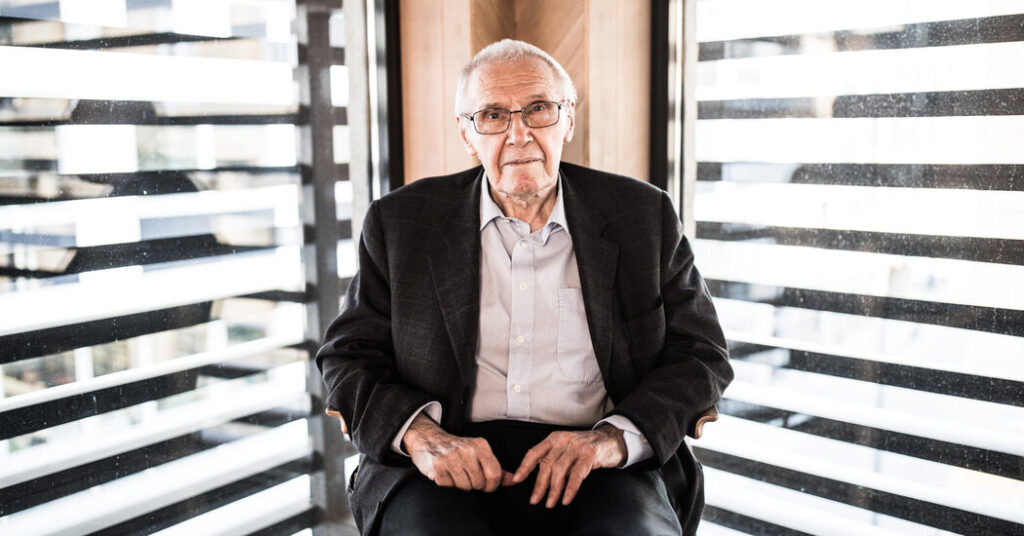
Deep into the night of György Kurtág’s 100th birthday, it was finally time for cake.
A small crowd was gathered on Feb. 19 for a toast in the lobby of Müpa Budapest, where a concert had just been given in his honor. Kurtág, a quiet titan among living composers, sat in a wheelchair and scanned the scene, flanked by two nurses in traditional outfits made from elaborate floral prints.
Gergely Fazekas, a musicologist and the evening’s master of ceremonies, picked up a microphone and said, “Raise your hand if you have been to a 100th birthday party.” A few scattered hands went up. Then he asked, “Who has had a 100th birthday party?”
No one there had. And virtually no composer has reached this age while still active, either, apart from the American avant-gardist Elliott Carter. Like Carter did, Kurtág is a centenarian with little interest in retirement. Persisting after the death of his wife, Márta, with whom he was inseparable in life and art, and holding out as his hearing fades, he teaches as meticulously as ever, and writes music with the searching mind of a composer who may never be satisfied with his body of work.
You could forgive Kurtág (his first name, György, is pronounced like “George”) for not wanting to make a speech. It had been a long day, and he has never been one for public remarks. He simply watched as a trombone player offered Kurtág’s music in lieu of “Happy Birthday” and caterers wheeled out a large sheet cake decorated with his piano score “Flowers We Are,” a floral sketch from Márta’s signature and a small “100” topper tucked in a corner.
As the party sprawled beyond the toast, with multiple buffets of Hungarian food and a line for slices of cake, Kurtág remained, softly holding court until, a little after midnight, when it was no longer such a special day, he left for bed.
KURTÁG’S BIOGRAPHY FOLLOWS the beats of the past century in Central Europe’s history. Born to a Jewish Hungarian family in the Banat region, which had been ceded to Romania in the Treaty of Versailles, he repeatedly experienced the upheaval of shifting borders and revolution. He composed on both sides of the Iron Curtain and achieved worldwide fame with the globalization of classical music. And he returned to Budapest in his twilight, revered in the country that had been a source of inspiration and pain all his life.
It was Schubert’s “Unfinished” Symphony, heard on the radio when Kurtág was 11 or 12, that made him want a life in music. He played piano, and had composed some small pieces, but now he wanted to write what he called a Jewish symphony with the title “Eternal Hope.” (In a series of interviews with the author Bálint András Varga, Kurtág once said that he identified as an atheist, “but I do not say it out loud, because if I look at Bach, I cannot be an atheist.”)
In 1946, having been spared the worst of the Holocaust, Kurtág moved to Budapest and took the entrance exam at the Franz Liszt Academy of Music, where he met György Ligeti, who would become a lifelong friend and a similarly celebrated Hungarian composer; Ligeti’s widow, Vera, was even with Kurtág throughout his birthday. School also introduced Kurtág to Márta Kinsker, whom he married in 1947.
The next decade was eventful: Their son, György Jr., was born, Kurtág completed his degree, the Hungarian Revolution brought Soviet tanks to the streets of Budapest, and he found an escape to Paris in the form of a fellowship. But, rattled and feeling stifled, he suffered an artistic crisis that ended only with the help of a psychologist. On the other side, he wrote music that, for the first time, he deemed worthy of an opus number: the String Quartet.
Another rebirth came in the early 1970s, again after a period of crisis, when Kurtág began to write pedagogical, even child-friendly miniatures for piano in the vein of Bartók’s classic “Mikrokosmos.” The series of pieces was called “Játékok,” or “Games,” and Kurtág later referred it as “something of a new Opus 1.”
“Suddenly, there is no system, there is no chromaticism, only a C in the middle of the keyboard,” he once told Varga, the author. The pianist Vikingur Olafsson, who recorded some of “Játékok” in his album “From Afar,” said at one of the recent events in Budapest that while he was working on the music, he watched his infant son in the garden, looking at the flowers and trees. “Meanwhile,” Olafsson recalled, “I was playing pieces that had a C-major scale, and I thought: He’s giving me this gift to discover the white keys on the piano in the same way that my son was discovering, with his 1-year-old eyes and fingers, the world.”
“Játékok” evolved into a kind of musical diary, an open-ended work in progress that has been published incrementally for the past half-century. The 11th volume was launched the afternoon after Kurtág’s birthday; the next is expected to be released by the end of the year.
In Kurtág’s early works, you can trace some degree of influence: of Bartók in the viola concerto he wrote at the Liszt Academy, of Webern in the String Quartet. But from “Játékok” onward his music sounds inimitably his own, characterized more by what it communicates than by how it’s crafted. After all, he has said that he composes from the same elements as Haydn; in his keyboard works, he has even abstracted classic devices like the Alberti bass, an accompaniment made of a broken chord that was popular in Haydn’s time.
For much of Kurtág’s life, he has been writing music that sounds late in style: preoccupied with death and memory, and marked by extreme economy. (His first opera, an adaptation of Samuel Beckett’s “Endgame” from 2018, for example, is “late” in every sense but could persuasively have been written at any point in his career.) His works are often short and spare, seeming to contain entire phrases within a silence or a single note; you can imagine holding a magnifying glass to the score and seeing a constellation inside each dot on the page. When he sets text, he chooses sources with a similar sensibility, like Hölderlin’s idiosyncratic poems or Lichtenberg’s fragmentary aphorisms.
Through the magic of Kurtág’s idiom, “Flowers We Are,” a recurring miniature introduced in the first volume of “Játékok,” makes an immense statement with just seven notes. The first sounds as if it’s asking a question that the next one answers, yet by the end, the response doesn’t feel definitive. “I look for a note, and perhaps I will eventually find it,” Kurtág has said of composing. “I may fail. Perhaps the piece is nothing more than an attempt to find it.”
The same could be said for the rest of his artistry. There is a lot of hesitation in Kurtág’s works (probably inspired, he has said, by stuttering being his “mother tongue” among the half-dozen languages he speaks). But there is also a refusal, despite the apocalyptic lateness of his sound, to accept finality.
That can make performing his music, especially in front of him, daunting. (Olafsson, whose “From Afar” was made before he met Kurtág, may represent the future of how his works are interpreted: informed and reverent, but not necessarily doctrinaire.) At an event around Kurtág’s birthday, the baritone Benjamin Appl, who has worked with the composer for the better part of the past decade and recorded the album “Lines of Life” with him, affectionately described the process as “a kind of nightmare.”
“With him, it’s always the journey, and the journey never stops,” Appl said. “You always question, you always reflect, you always doubt.”
The Monday before Kurtág’s birthday, Appl gave a recital at the Budapest Music Center, where Kurtág lives in a guest suite upstairs. They spent hours preparing over the weekend, even though Appl had performed and recorded the pieces before. And shortly before the concert, Kurtág wanted to hear the section of his “Hölderlin-Gesänge” that incorporates trombone and tuba.
Kurtág appeared uninterested in small talk, announcing that he was ready to listen, then stopping the musicians almost immediately. He sang the instruments’ lines, with an emphasis on articulation, then let them play again, before cutting them off repeatedly after the first measure until, unexpectedly, he said: “Good. Thank you very much.” Appl’s parting words were that he would try his best.
That night, Kurtág listened from the recital hall’s balcony, wearing a headset that helped him hear and watching with concentration. By the end, he had a list of criticisms to share.
MÁRTA KURTAG, who died in 2019, was no less exacting about her husband’s work: both how it was written and how it was performed. She was his first listener, and he called her “the projection of my superego.” They toured together, playing four-hand pieces from “Játékok” or Kurtág’s Bach arrangements, always sitting at an upright piano, a portrait of domestic musical intimacy.
Kurtág’s birthday concert at Müpa, Fazekas said from the stage, was dedicated as much to Márta as it was to him. She haunted the recent celebrations throughout Budapest, never more than in the premiere of a new documentary, “Kurtág Fragments.” The film contains archival footage of the couple, as well as a scene in which Kurtág tells Olafsson there is nothing like playing with your wife. At one point Kurtág says, as if Márta were in the room with him: “The sun went down, and I so badly wanted to show you. I was so lonely.”
It’s not that Kurtág is wanting for company. He has his family, receives visitors and teaches. But members of the public also maintain a respectful distance. When he attended events during his birthday week, including the preview for an installation at Sound Dome inside the House of Music Hungary, people refrained from approaching. It’s hard to imagine what you would even say to a man who disdains small talk.
The most moving tributes, appropriately for Kurtág, weren’t speeches but performances. Longtime collaborators, like the cellist Steven Isserlis and the pianist Pierre-Laurent Aimard, flew in for concerts. Olafsson took center stage on Kurtág’s birthday, joined by Halla Oddny Magnusdottir, his wife, for a suite of works played on an upright piano that György and Márta once shared at Carnegie Hall. The instrument’s sound was dull and soft, beckoning the audience to listen more closely; if you were hearing Kurtág’s music for the first time, you would immediately understand why each note matters so much.
With his usual dissatisfaction prompting rewrites under the wire, Kurtág wrote a new work for the festivities: “Die Stechardin,” a brief operatic monodrama. With a libretto by Christoph Hein, based on letters by Lichtenberg but clearly channeling Márta, it tells the story of a woman who eagerly waits for her beloved to join her in the afterlife.
The score opens with a sunny announcement and a plunging crash, as if committing to neither heaven nor hell but something containing the two. Maria Husmann’s soprano lines were often doubled among the players of Concerto Budapest, to fascinating timbral effect. As always with Kurtág’s vocal works, the text had the clarity of a dramatic recitation; and, as always, the music was too slippery to fully grasp.
In the final measures, the woman excitedly announces, “He is coming!” Kurtág inscribed a note at the end of the score: “For Márta. I am coming. I am coming to you.” It’s a gesture with a clear sentiment and, at the same time, as little resolution as anything in Kurtág’s music. He may be coming, but he is not yet there.
Joshua Barone is an editor for The Times covering classical music and dance. He also writes criticism about classical music and opera.
The post At 100, This Composer Is Still Searching for the Right Note appeared first on New York Times.