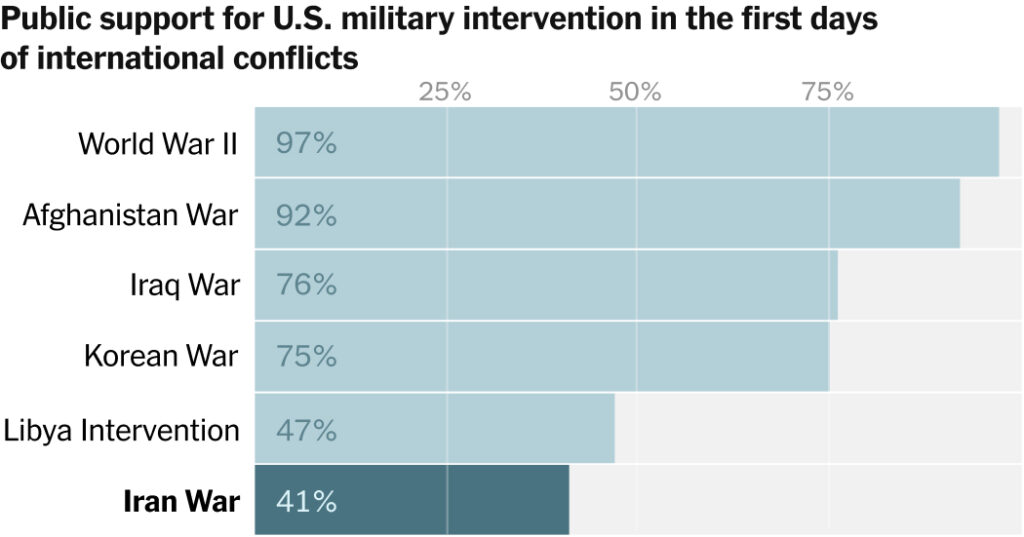
In the days after President Trump launched U.S. forces in an attack against Iran, support for the strikes is far lower than what it has been at the beginnings of previous foreign conflicts.
So far, polls have found that most Americans oppose the Iran attacks. Support ranges from 27 percent in a Reuters/Ipsos poll to 50 percent in a Fox News poll. The wide variation suggests that public opinion is still taking shape as more Americans learn details of the attacks and the aftermath.
But even the highest level of public support for this conflict falls far lower than that at the start of most other conflicts, including World War II, the Korean War and the Iraq War.
In the days after the United States was attacked at Pearl Harbor and subsequently declared war against Japan, 97 percent of the public supported the move, according to Gallup. And in the days after President George W. Bush put troops on the ground in Afghanistan, 92 percent of Americans were on board in a Gallup poll.
As unpopular as the Iraq War ultimately became, 76 percent of Americans approved of the decision to go to war in a poll taken the day after the conflict began.
A part of this difference in support, said Sarah Maxey, an associate professor of international relations at Loyola University of Chicago, is the way previous presidents have taken the time to sell wars to the public.
“Before the Iraq War in 2003, we had a whole year of why this mattered, why we exhausted other operations, why we needed this,” said Ms. Maxey, who studies public opinion around war and foreign conflicts. “We have not had many foreign conflicts without a clear communication strategy beforehand.”
But there are also larger forces at play.
At the beginning of wars, presidents typically experience what researchers call the “rally around the flag effect,” where support swells, even among those who otherwise disapprove of the president.
As polarization has grown over the last 30 years and Americans have drifted further apart politically, that effect has diminished.
“People from the opposing party of the president have been the source of most of the rally, but Democrats are not going to rally behind Trump,” said Matthew Baum, a professor at Harvard University who studies public opinion on foreign policy.
“For this president, to the extent that he has any rally from his base, he has a base who thinks they hired him to get him out of wars,” he added.
Support for wars typically wanes over time, as casualties increase and Americans start to feel the costs of war.
Near the start of the Vietnam War, a 60 percent majority of Americans did not see the war as a mistake. But as the number of casualties grew, so did the public’s doubts. By 1969, a majority of the public said the war was a mistake. That number continued to grow as the war went on. (There is no polling on public approval of the Vietnam War at the start of the conflict.)
Popular sentiment about the Iraq War plummeted soon after it began, with just 43 percent of Americans supportive of the war by the end. That drop in support, though, occurred across both parties.
But long gone are the days of a unified national front.
“To the extent that politics used to stop at the water’s edge, that’s no longer the case,” Mr. Baum said.
Sources: World War II: Gallup poll conducted Dec. 12-17, 1941; Korean War: NORC poll conducted July 1-31, 1950; Grenada: Gallup poll conducted Oct. 26-27, 1983; Panama: ABC poll conducted Dec. 20, 1989; Persian Gulf War: Los Angeles Times poll conducted Jan. 17-18, 1991; Kosovo: Princeton Survey Research Associates/Newsweek survey conducted April 1-2, 1999; Afghanistan War: Gallup poll conducted Oct. 11-14, 2001; Iraq War: Gallup poll conducted March 20, 2003; Libyan intervention: Gallup poll conducted March 21, 2011; Iran: CNN poll conducted Feb. 28-March 1, 2026.
Ruth Igielnik is a Times polling editor who conducts polls and analyzes and reports on the results.
The post Unlike in Past Conflicts, Most Americans Oppose Iran Attacks appeared first on New York Times.