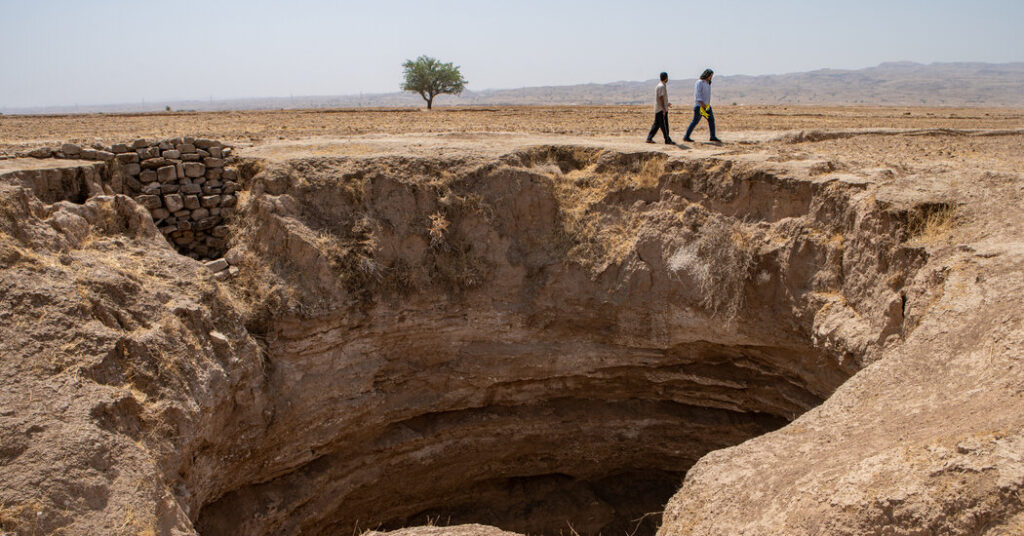
The war in Iran has exposed the country’s water woes, which had been pushed to the brink by climate change, excessive agricultural use and decades of mismanagement.
Iranian Foreign Minister Abbas Araghchi on Saturday accused the United States of bombing a desalination plant on Qeshm Island, affecting the water supply for 30 villages. The U.S. government has denied responsibility for the attack.
The incident — and Iran’s subsequent bombing of a desalination plant in Bahrain — has sparked fears that the U.S.-Israeli war with Iran could lead to broader assaults on critical water infrastructure in the Gulf, threatening supplies for millions.
But Iran was already facing a critical water shortage before the conflict.
“They’re still in a state of crisis,” said Eric Lob, an associate professor of politics and international relations at Florida International University. “There’s still water scarcity issues and power outages, and if anything, now the regime can blame conflict.”
Tehran, a city of 10 million people, has been gripped by years of drought. Late last year, the country’s average rainfall dropped to 45 percent below normal, and the dams and reservoirs that supplied the capital were operating at minimal capacity.
Iran’s meteorological organization said cities were on the brink of what it called “water day zero,” the point where supply systems simply stop functioning. Before the war started, the country’s president, Masoud Pezeshkian, called for relocating the capital and said dwindling water supplies and other ecological strains had “rendered the city uninhabitable.”
A torrential rain in December brought little relief because it landed on dry and degraded soil with little ability to absorb the rain, said Francesco Femia, co-founder of the Center for Climate and Security, a Washington research organization.
“For that reason and others related to water mismanagement, the rains also didn’t replenish Iran’s groundwater aquifers, leaving the country in a continued state of severe water stress,” Mr. Femia said.
Climate change has played a role. Drought cycles are becoming more frequent and severe, and last year marked one of the driest periods in the last 20 years for Iran. Extreme weather — like a 2023 heat wave that led to a two-day nationwide shutdown when temperatures reached 123 degrees Fahrenheit — has made water shortages worse. At the same time, snowmelt in the mountains that feeds rivers has been declining.
But the Iranian government also dangerously deepened the crisis with decades of mismanagement, experts said.
After the 1979 Islamic Revolution, Iran began drastically accelerating the construction of dams and reservoirs in a search for water self-sufficiency. But many were built in poor locations and rising heat has intensified water evaporation.
“The priority was power and profit, rather than what made sense from an ecological or water standpoint,” Mr. Lob said. Now many reservoirs stand nearly empty and have become what one critic called “monuments to failure.”
Iranian authorities have also quieted environmental activists and government officials who called for taking water issues more seriously. Instead of broader changes, officials implemented stopgap measures during shortages, like reducing water pressure and rationing water.
The country is also draining what remains of its underground water. A 2024 study of 1,700 water reserves in 40 countries found that 32 of the world’s 50 most over-pumped aquifers are in Iran.
Authorities have floated some longer-term solutions, like importing water from the Gulf of Oman. But the government has never made a serious effort to address the water crisis, instead focusing resources on bolstering military and nuclear capabilities and supporting terrorist proxies across the region.
The destruction of the Qeshm desalination plant may only have had a modest impact on the country’s water woes, said Michael S. Gremillion, director of the Global Water Security Center at the University of Alabama. But continued water scarcity in Iran, coupled with the economic devastation of war, could lead to food scarcity and cause residents to flee their homes.
“At least in the near future, the drought is not going to relieve itself any time soon,” Mr. Gremillion said, adding, “It’s going to cause a lot of issues.”
Lisa Friedman is a Times reporter who writes about how governments are addressing climate change and the effects of those policies on communities.
The post War Brings New Water Crises to an Already-Parched Iran appeared first on New York Times.