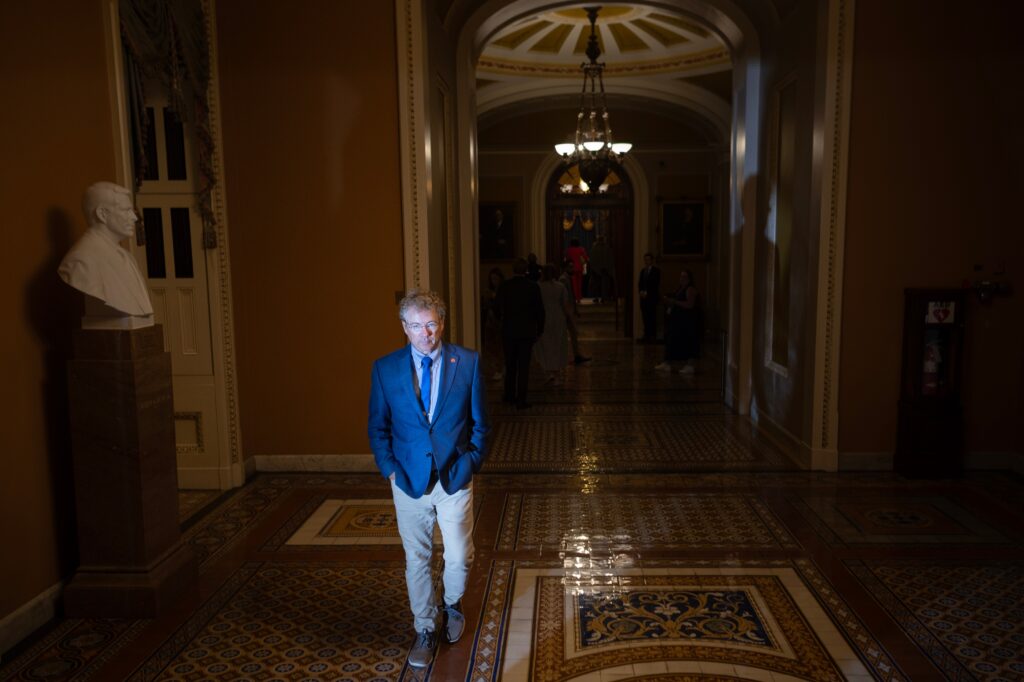
Early in March, senators gathered to take a vote meant to remind President Donald Trump of Congress’s power.
Just a few days before, the president had launched a war against Iran without seeking legislative approval. Two senators pushed forward a resolution that would have halted the fighting until Congress officially authorized military action — its prerogative under a 1973 law passed near the end of the Vietnam War.
On his way into the Senate chamber, Sen. Rand Paul, a Republican and libertarian from Kentucky, said founder James Madison once wrote that each branch of government’s ambition would counteract that of the others.
“But I think Madison never imagined or envisioned a Congress with no ambition,” Paul said. “This is a Congress without ambition. This is a Congress without really a belief structure in defending legislative prerogative. They just are a rubber stamp for whatever a president tells them to do.”
Paul walked onto the Senate floor and cast the lone GOP vote for the measure, which failed.
The vote was merely the latest capitulation of a GOP-controlled Congress that has subordinated itself to the executive branch headed by Trump. While lawmakers once jealously guarded their constitutionally endowed power over spending, trade and war — regularly checking the executive — Republicans in the 119th Congress have cast themselves as helpmeets to the president instead.
“I have no intention of getting in the way of President Trump and his administration,” House Speaker Mike Johnson (R-Louisiana) said in late January, when asked about his procedural maneuvering to prevent members from voting against the president’s tariffs. “He has used the tariff power that he has … very effectively.”
Weeks later, the Supreme Court disagreed, issuing an opinion that struck down most of Trump’s sweeping tariffs as an infringement on Congress.
“Yes, legislating can be hard and take time. And, yes, it can be tempting to bypass Congress when some pressing problem arises. But the deliberative nature of the legislative process was the whole point of its design,” Supreme Court Justice Neil M. Gorsuch, a Trump appointee, reminded everyone in his opinion.
Asked if he would work with Congress to enact new tariffs, Trump said “I don’t have to.” (He later imposed new tariffs using a different authority.)
Lawmakers of both parties have been ceding congressional power to the executive long before Trump was elected, especially on matters of war and trade. Congress has not officially declared war since World War II, and has passed laws delegating its trade power to the president in some circumstances.
A number of political factors — such as the growing role of big-money donations, even in local races, the organizational power of party activists and the excoriating exposures of social media — often discourage legislators from separating themselves from their parties.
But Trump’s second presidency has marked a major advance in the expansion of executive power at the expense of the legislative branch — an acceleration the president has not been shy about pursuing. That has raised concerns for some politicians — especially those who have left office — about maintaining the balance of powers seen as central to American democracy.
“I learned ninth-grade civics: You’ve got three equal branches of government,” said Fred Upton, the Republican from Michigan who chaired the House Energy Committee until 2017 and left Congress in 2023. “But right now, the Congress is not one of them. It abdicated everything to the White House.”
Trump routinely dismisses the idea that Congress might exist as an obstacle to his will. When a reporter asked him last year how he planned to rename the Defense Department as the Department of War, given it takes an act of Congress to do so, the president brushed off the concern.
“We’re just going to do it. I’m sure Congress will go along,” he said.
A mountain of executive orders, a trickle of legislation
Over the past year, Congress has allowed the executive branch to refuse to spend or delay funds that legislators appropriated, overhaul agencies without consulting it and issue executive orders on matters that previously would have been approached only via legislation. Scandal-tainted presidential nominees who might have failed to win approval in past administrations have largely muscled their way through tense confirmations, as Trump let Republicans know he would take any “no” votes as betrayals that could lead to primary challenges for rogue senators.
No Congress has given up its power quite like this one, but its ability to do so stems from the behavior of past Congresses.Lawmakers began legislating away their tariff authority starting in the 1930s. They have frequently refused to hold votes authorizing wars in recent decades, including when the Obama administration asked them to authorize military action against the Islamic State.
Vanishing bipartisanship also has made passing bills difficult, tempting members of Congress to lean on their presidents to accomplish their goals.
“Members of Congress in both parties have been willing to give up their institutional power to the executive branch because it is hard to legislate in Congress,” said Molly Reynolds, the vice president and director of governance studies at the center-left Brookings Institution. “And the partisanship and polarization makes it hard for parties to get the things it wants to get done, done.”
This has created an opening for a president eager to expand his influence.
Trump issued 225 executive ordersduring his first year back in office, several times more than the 55 he signed in the first year of his first term and far above the 77 President Joe Biden signed in 2021. Some of Trump’s first executive orders in his second term were directives to effectively eliminate federal agencies authorized by Congress.
As Trump busied himself with enacting his agenda, Congress did little. The legislature passed and enacted just 68 public laws in 2025, many of them repeals of Biden-era policies. During the same time in Trump’s first term, Congress passed and enacted 96 laws.
Many Republicans have excused Trump’s incursion into their territory, arguing Congress has become too dysfunctional to tackle GOP-priorities such as lowering the ever-expanding national debt. (The debt has continued to climb under Trump, reaching more than $38.8 trillion, according to the Treasury Department.) They’ve defended giving the president wide latitude to set both his and their agendas. Johnson — who emerged as a weakened speaker in a closely held House after a bitter internal battle — said after Trump was sworn in that part of Congress’s role was to look through Trump’s executive orders and decide which ones should be passed into law.
One of the first bills the House passed in 2026 did just that: It codified Trump’s executive order allowing shower heads to have higher water-flow rates.
“If you want a nozzle that drizzles on your head, then go get one of those,” said its author, Rep. Russell Fry (R-South Carolina). “That should be your choice as a consumer.”
Another lawmaker, Rep. Jeff Van Drew (R-New Jersey), a close ally of the president, boasted last year about his role in persuading Trump to sign not legislation, but an executive order, pausing wind energy.
“We wrote that first part,” he said of the order in an interview with the conservative Newsmax network. “Proud to be a part of it.”
Even this Congress’s signature achievement — the massive tax-and-immigration legislation called the One Big Beautiful Bill, which became law in July — involved an unusual level of involvement from the president, who served as something of an unofficial whip, pressing House members to support it. He handed out free merchandise to fence-sitting members, fielded their phone calls and promised executive actions to get their votes.
“You know, it was supposed to be in three, four, five, six, or seven different bills,” Trump said at the signing ceremony for the sweeping law in July. “I said, ‘Let’s do it in … one big beautiful bill.’”
And Congress did.
A state of emergency
Constitutionally, there is a way a president can sidestep Congress, and gain additional powers: when there is a national emergency.
The idea is that sometimes — such as in the case of a devastating attack or natural disaster — there’s no time for deliberation, and the executive must act decisively on behalf of the American people. In 2001, George W. Bush declared a national emergency in the wake of the 9/11 attacks, and Jimmy Carter declared one in 1979 due to the Iranian hostage crisis, allowing him to freeze Iranian government assets held in the United States.
Trump has made liberal use of his power to declare an emergency, declaring 11 overall — including emergencies around fentanyl, energy and trade deficits to reshape global trade policy and implement other policies. Barack Obama declared one national emergency in his first year of office (for the swine flu), and Joe Biden declared four.
But Republicans, aware of Trump’s unique political popularity with their party’s base despite his broad national unpopularity, have indulged him, even as he uses the power to levy tariffs many of them dislike.
Paul, a fiscal hawk who rode into Congress on the tea party wave about 15 years ago, is a rare exception. He’s given impassioned speeches against Trump’s emergency declarations. He’s worked with Democrats multiple times, once to try to cancel the fentanyl trafficking emergency Trump declared to impose tariffs against Canada, and again, to try to terminate the trade deficit emergency Trump cited to levy global tariffs.
Only a handful of Republicans have joined him in that effort, however, and Trump has blasted him on social media as a disloyal person with “crazy” ideas.
“I think this is too much power,” Paul said of the emergency powers. He supports legislation to make presidential emergency declarations expire after 30 days if Congress doesn’t affirmatively vote to extend them.
“The problem is, we probably had a dozen Republicans interested in the issue when there was a Democrat president. … But now [that] there’s a Republican president, they’ve sort of melted into the ether,” Paul said in an interview late last year. “I can’t find them.”
Some signs of pushback
As Trump’s poll numbers have slipped and Republicans now fear a potential drubbing in this year’s midterm elections, the president has faced some new pushback from Capitol Hill.
Republican lawmakers with oversight over spending were hesitant to speak out when the U.S. DOGE Service, led by Elon Musk, aggressively advanced on their power of the purse last year, shuttering and reorganizing entire agencies without consulting the committees that oversee them — and ignoring numerous inquiries from lawmakers about where congressionally allocated funding was going.
Now, those same lawmakers have written some guardrails into the spending bills that recently became law, attempting to claw some power back from the administration to prevent it from dictating how money will be spent.
In November, facing pressure from their base, House Republicans voted overwhelmingly to release government files concerning disgraced financier Jeffrey Epstein, despite Trump’s initially fierce resistance to that move.
Republicans have also shown an increased willingness to speak out when they are ignored by the Trump administration.
“I’m often struggling to get briefings, clear information or meaningful cooperation from the administration or the State Department,” said Sen. John Curtis (R-Utah) to Secretary of State Marco Rubio at a January Senate hearing he attended. The secretary pledged to get the department to cooperate better with him in the future.
And complaints from Republican senators helped lead to the ouster of Homeland Security Secretary Kristi L. Noem, who performed poorly under bipartisan scrutiny in congressional hearings this month.
More pushback could arise in coming weeks. Johnson’s maneuver to prevent Republicans in the House from bringing up resolutions to roll back Trump’s tariffs expired at the end of January. Weeks later, the House held a vote on canceling the national emergency underpinning Trump’s tariffs on Canada. Six Republicans voted for the measure, which passed. And with Trump threatening more foreign intervention — against Cuba and other countries — Congress could again confront the White House via the War Powers Act, which requires U.S. forces to withdraw within 60 days unless Congress authorizes military action.
Sen. Tim Kaine (D-Virginia), who sponsored the war powers resolution and others on tariffs, said he believed some of his colleagues are beginning to want to do oversight again — however slowly.
“It is a muscle that is weakened through lack of use, and I think it is getting stronger,” Kaine said.
It remains to be seen how much that muscle will actually be used, however, and some lawmakers fear the chamber’s norms could be permanently eroded.
“Right now you’re seeing the Republican Congress be more deferential to our Republican president,” said Sen. Lisa Murkowski (R-Alaska), an appropriator and moderate. “And we’re forgetting that we have a role in this process.”
Clara Ence Morse and Theodoric Meyer contributed to this report.
The post In Trump’s Washington, Congress matters less than ever appeared first on Washington Post.