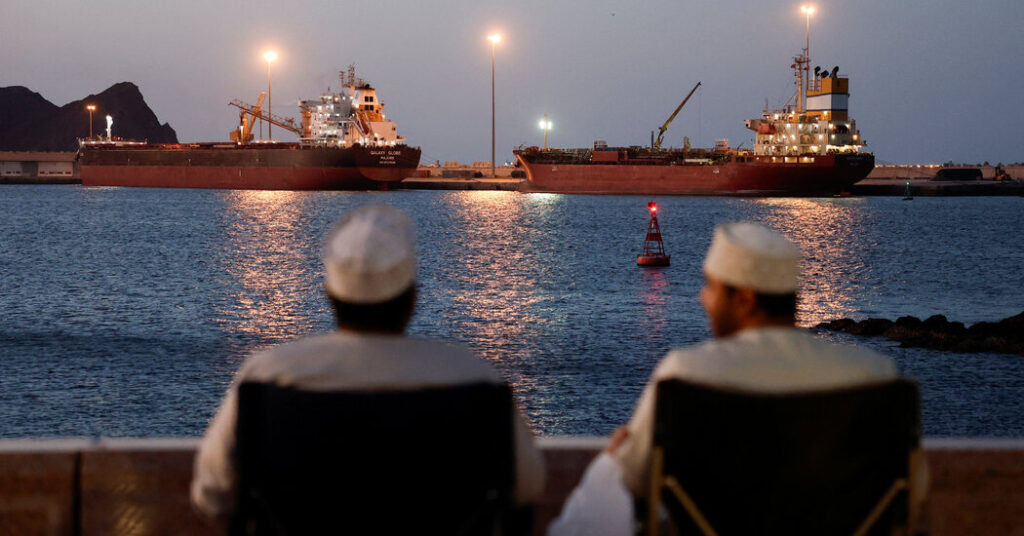
President Trump said on Monday the war in Iran would go on for at least another week and, facing pressure from a surge in energy prices, he suggested that the United States could begin accompanying oil tankers through the Strait of Hormuz to help keep oil flowing from the Middle East.
“We’ve already won in many ways, but we haven’t won enough,” he told a gathering of Republican lawmakers in Florida. “We go forward more determined than ever to achieve ultimate victory that will end this long-running danger once and for all.”
Asked later at a news conference if the war with Iran would be over this week, Mr. Trump said, “No.” He added, “Soon, very soon.”
With oil prices having risen above $100 a barrel on Monday before falling back, Mr. Trump issued a warning to Iran. He said that if Iran were to attack ships under U.S. protection transiting the Strait of Hormuz — a potential choke point in the global energy trade — American forces would respond aggressively.
“We will hit them so hard that it will not be possible for them or anybody else helping them to ever recover that section of the world,” Mr. Trump said, meeting with reporters.
During his news conference in Doral, Fla., Mr. Trump said the American air campaign had accomplished many of its missions in Iran, and he claimed it had decimated the country’s military capabilities. But he said more work had to be done before he would end the war.
The varying tone of his comments during the day appeared intended to balance between signaling to nervous oil markets and investors that the war was nearing an end while suggesting at the same time that the assault by forces from the United States and Israel would go on until Iran had no capacity or will to pursue a nuclear weapon.
“If it starts up again, they’ll be hit even harder,” he said.
Mr. Trump argued that he has already achieved almost all the campaign’s military goals, including badly damaging Iran’s air defense systems, its missile production capacity and its navy. Yet he backed up Defense Secretary Pete Hegseth in saying this was just the beginning.
“It’s the beginning of building a new country,’’ Mr. Trump said, claiming that Iran had no navy and no air force.
“They have no antiaircraft equipment,” he said. “It’s all been blown up.”
But repeatedly, the president made clear the oil markets were on his mind, ahead of midterm elections in which his party could be punished if prices stay high. He said he would waive “certain oil related sanctions to reduce prices,” and said the American military would protect oil shipments.
“The Strait of Hormuz is going to remain safe,” Mr. Trump said. “We’re putting an end to all of this threat once and for all, and the result will be lower oil prices, oil and gas prices for American families.”
Gas prices are expected to be a key issue in the midterm elections. Already, Democrats are pointing to how Mr. Trump’s policies, from tariffs to the war in Iran, are making life less affordable for many Americans.
The war is unpopular with most Americans, according to opinion polls, and in the 10th day of the conflict it is unclear how long the fighting might go on.
Mr. Trump said he knew the American and Israel attacks on Iran would result in spiking prices, but said he believed that development would be temporary.
“They’ve gone up probably less than I thought they’d go up,” he said of gas prices.
During the remarks, Mr. Trump also addressed the killing of 175 civilians at an Iranian school. With evidence suggesting the students were killed by an American missile, Mr. Trump has tried to cast blame on Iran, suggesting it launched the weapon. After repeating that assertion, he qualified that stance on Monday, saying the missile could have been fired by Iran or another country but that he would defer to the findings of an investigation by the Pentagon.
“Whatever the report shows, I’m willing to live with that report,” he said.
The president did not directly answer a question on whether he would seek to kill Iran’s new supreme leader, Mojtaba Khamenei, the son of Ayatollah Ali Khamenei, who was killed by an Israeli missile strike at the beginning of the war.
“I was disappointed because we think it’s going to lead to just more of the same problem for the country, so I was disappointed to see their choice,” he said of the appointment of Mojtaba Khamenei.
Luke Broadwater covers the White House for The Times.
The post Trump Seeks to Calm Energy Markets but Says War Will Go On for Now appeared first on New York Times.