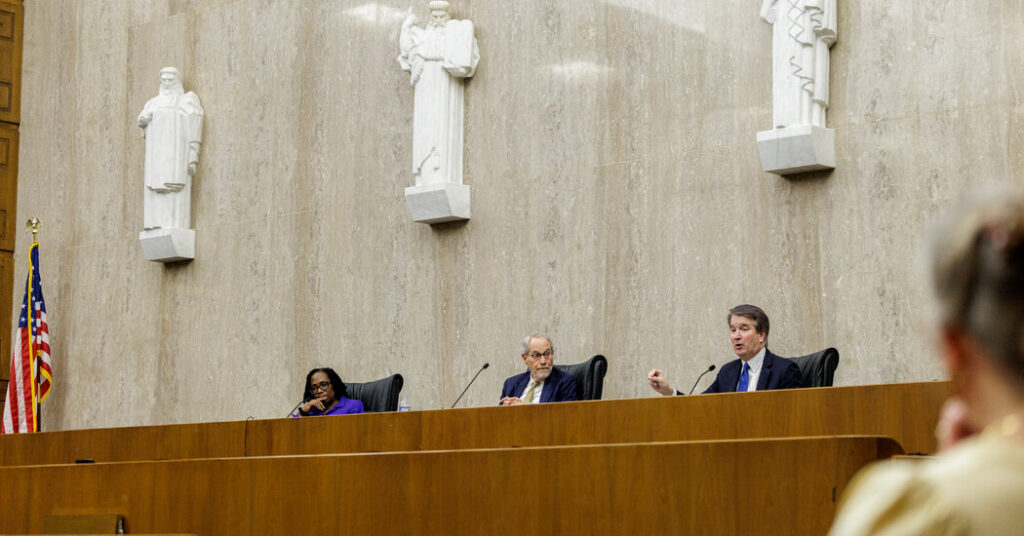
Two Supreme Court justices publicly sparred on Monday evening over how the court is handling a barrage of emergency requests to clear the way for Trump administration policies.
The polite but forceful back-and-forth between Justices Ketanji Brown Jackson, one of the court’s three liberals, and Brett M. Kavanaugh, who is part of the court’s conservative supermajority, gave a rare glimpse into the justices’ sharply differing viewpoints about how to navigate repeated emergency requests by the Trump administration to greenlight its policies.
Supreme Court justices deliver only occasional public remarks and appear together even more rarely, particularly across the ideological divide.
The notable example of two justices debating one other in front of a crowd came during an annual lecture series at a federal courthouse in Washington, D.C., and in front of a courtroom packed with spectators, including prominent federal judges who have handled cases involving Trump administration policies.
Since President Trump began his second term, the administration has filed a flood of emergency applications with the justices, asking them to clear the way for a wide range of policies, including immigration, federal funding and firing of independent agency leaders.
The court’s conservative supermajority has shown a willingness to allow many of these policies to take effect, often agreeing that the Trump administration can move ahead, even as lower courts consider whether its actions are legal.
On the court’s traditional, or “merits” docket, the justices choose which cases to accept. They then receive extensive written briefs and hear oral arguments. Before ruling, they engage in lengthy deliberations and often take months to come to a decision. Published opinions include vote counts of the justices and lay out the majority’s reasoning.
The emergency docket, on the other hand, which is known by critics as the “shadow docket,” involves an entirely different process. There, cases are typically decided without oral argument or full briefing sometimes weeks or only days after the court has received the applications. Decisions often include little or no reasoning, and no vote count.
Justice Kavanaugh told those gathered that he thought the justices were being asked more frequently to weigh in on presidential actions because gridlock in Congress has led presidents to do more through executive orders, which have then been challenged in court. It is an argument he has made previously from the bench and in public appearances.
He added that such emergency requests are “not a new phenomenon” and had been on the rise during the Biden administration as well. He pointed to an emergency request by the Biden administration to keep in place access to a widely available abortion drug, mifepristone, as a lower court heard a challenge to the drug’s approval.
Justice Jackson, however, pushed back and suggested the court’s actions under Mr. Trump represented a departure.
Previously, she argued, the court had used emergency orders largely to maintain the status quo. Yet in the Trump administration, she said the court was signing off on new policies. In the mifepristone example, she said, the drug had already been in use for decades, and the Biden administration wanted to maintain access, not seek a new policy or change.
By agreeing to take on such emergency applications, she said the justices had signaled a willingness to hear the cases before they had worked their way through the lower courts, creating “a warped” kind of proceeding and “a real unfortunate problem.”
“I think it is not serving the court or our country well at this point,” Justice Jackson said, to applause from many in the audience.
Justice Kavanaugh appeared to share Justice Jackson’s frustration with the emergency docket’s speed. And he said he too worries that emergency cases could involve short-circuiting the deliberations in lower courts.
“None of us enjoys this,” he said.
But, he added, he believed the court had little choice. The justices, he said, are required to “grant or deny” any application they receive.
Abbie VanSickle covers the United States Supreme Court for The Times. She is a lawyer and has an extensive background in investigative reporting.
The post Two Supreme Court Justices Debate Handling of Trump Emergency Cases appeared first on New York Times.