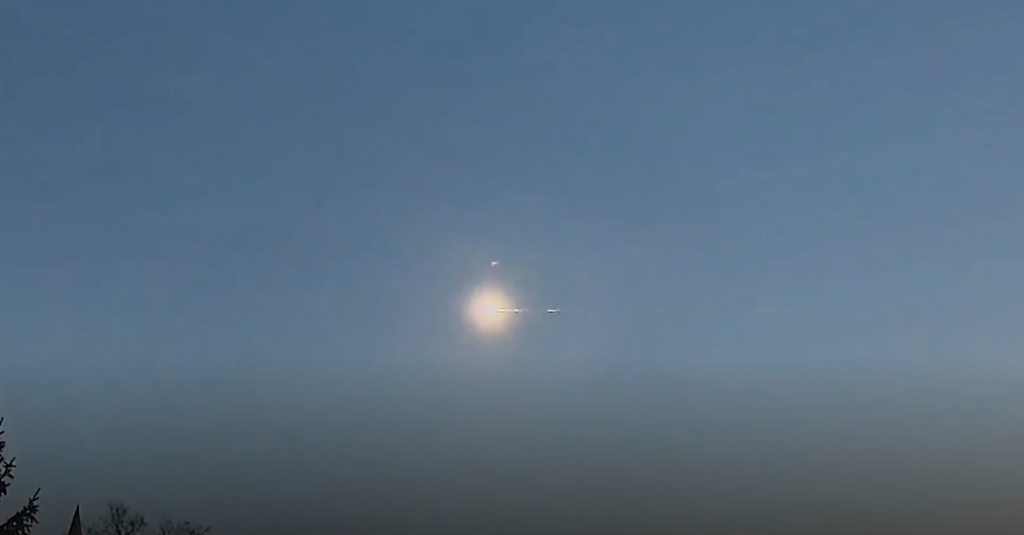
This past weekend, people in Koblenz, Germany, might have found themselves asking an unusual question: Is my house insured against meteorite damage?
Around 6:55 p.m. local time on Sunday, an extremely bright fireball burned through the twilight skies of northwestern Europe. Thousands of people in Belgium, France, Luxembourg, the Netherlands and Germany had no difficulty spotting the incandescent object as it moved rapidly toward the northeast.
The fireball was recorded in several places by AllSky7 — a network of 24-hour skygazing cameras established in 2018, operated by private citizens and designed to spot falling meteors. This allowed astronomers to quickly work out the trajectory of the object and ascertain where any of its fragments might have crash-landed.
That task was made much easier when news organizations reported that several buildings in the western German state of Rhineland-Palatinate had been damaged by mysterious debris that fell from the heavens. The roof of one house, in the town of Koblenz, appears to have been punctured by at least one larger meteorite — a shard that fell into the (fortunately unoccupied) bedroom below.
No deaths or injuries have been reported. So, aside from some unexpected home renovations, this fireball event is “really fantastic,” said Juan Luis Cano, an aerospace engineer with the European Space Agency’s Near-Earth Object Coordination Center.
Finding meteorites — which contain clues about the solar system’s chaotic past and puzzling present — normally takes days or weeks, with hunters needing to comb through acres of grassy fields, forests or deserts at a glacial pace. “Given that some of them landed on a roof of a house, they were easier to spot,” Mr. Cano said.
Sunday’s fireball was first spotted at an altitude of 53 miles. As it screamed through the sky, several quick, strobe-like flashes were seen. Each flash corresponded to an outburst on the meteoroid itself.
“There are easily ten to a hundred meteorites in every one of those bursts,” said Mike Hankey, an amateur astronomer at the American Meteor Society and the creator of the AllSky7 network. “You’re looking at a lot of meteorites.”
That the fireball, which lasted for six seconds, happened at a time of widespread conflict in and around the Middle East didn’t go unnoticed. Some speculated online that the fireball might be an Iranian missile, although Iranian rockets do not have the range to strike Germany.
Astronomers are still crunching the numbers, but based on the brightness and duration of the fireball, the object was probably three to 10 feet long. Space rocks of similar size “fall to Earth every couple of weeks,” Mr. Cano said.
Such meteors mostly fall over vast oceans, or large and sparsely populated parts of the planet. But, as with this latest example, they sometimes provide firework displays to millions of people, like a cometary fragment that exploded over Spain and Portugal in May 2024. Coincidentally, another fireball was also seen this Sunday in the skies above the northeastern United States and Canada.
A fireball’s meteorites are usually difficult to find, but trajectory calculations based on camera networks like AllSky7 are a huge help. Such was the case in January 2024, when a rare type of asteroid sprayed meteorites over an area near Berlin.
Asteroids plunging through the atmosphere are initially moving at speeds of around 38,000 miles per hour. Any small pieces that break off rapidly decelerate, meaning they tend to land at speeds of up to 450 miles per hour — far slower, but still capable of inflicting structural damage.
In 2019, a meteorite smashed through the tin roof of a doghouse. (Don’t worry: The resident, a German shepherd named Roky, was unharmed.) In 2021, one left a dent (and a pile of extraterrestrial soot) in a driveway in England. And last June, a cherry-tomato-sized space rock burst through the roof of a house in Atlanta.
The newly aerated house in Koblenz is the latest building to fall victim to one of these rocky vandals from beyond.
Although several of the fireball’s fragments have been found, a quest is now on to find hundreds more. Mr. Hankey said that meteorite hunters are excitedly commenting beneath social media posts “posting their tickets to Germany with aspirations of finding these meteorites.”
The post Meteorite Crashes Through Roof in Germany After Fiery Light Show appeared first on New York Times.