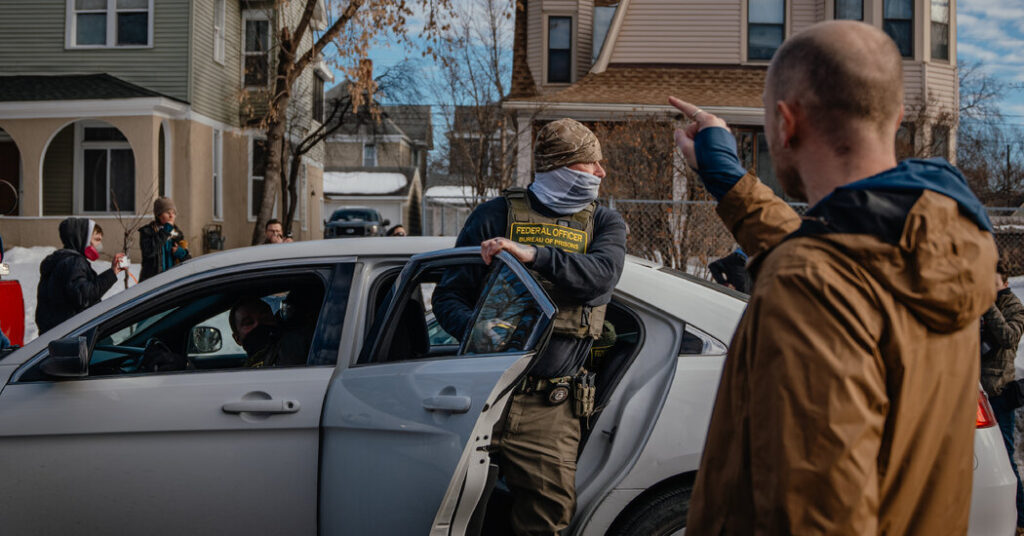
Columbus, Ohio, was sure it would be next. As thousands of federal immigration agents were overwhelming Minneapolis, officials, activists and residents across Columbus prepared for the sprawling immigration crackdown many thought was imminent, particularly given the city’s sizable Somali population.
In Philadelphia, nerves were on edge for weeks. Some worried local officials grumbled that the district attorney’s brazen pledge to arrest federal agents all but guaranteed that U.S. Immigration and Customs Enforcement would show up in force.
And in Maryland, rumors of a major ICE crackdown have been swirling. Local and state officials have been scrambling to verify or disprove the rumors, checking for fluctuations in hotel occupancy rates and keeping an eye on federal transactions, including ICE’s purchase of an enormous warehouse in the western part of the state and efforts to lease more office space around Baltimore and Washington.
These efforts have continued even as the prospects seemed to dim for a big, confrontational operation like the one that engulfed Minneapolis over several weeks in December and January.
After two U.S. citizens were killed by immigration agents during the Minneapolis operation, the Department of Homeland Security demoted the Border Patrol commander who had been leading the charge, Gregory Bovino. The president’s border czar, Tom Homan, stepped in and said that the operation would be winding down and that tactics would be changing nationwide. And on Thursday, Kristi Noem, the D.H.S. secretary who had called the dead Americans domestic terrorists, was fired after two contentious appearances this week on Capitol Hill.
But the drama at D.H.S. has hardly reassured people in places that are home to many immigrants.
“We’re all in a state of guessing, taking context clues of what’s happening around us, and then not wanting to be caught off guard,” said Krystal Oriadha, the chair of the Prince George’s County Council in the Maryland suburbs of Washington. “Because once it starts, it’s going to be too late to really coordinate, organize, get involved — you know, be prepared.”
Activists are still setting up food delivery networks for people who do not want to leave their homes, and lawmakers are considering legislation for every possible scenario. A proposal in a package of bills in the Philadelphia City Council would seek to bar ICE agents from wearing masks or using unmarked vehicles; an executive order issued this week by the mayor of Baltimore authorizes city government lawyers to provide pro bono representation to residents involved in immigration cases; a bill in the Montgomery County, Md., council would make it easier for families to recover a vehicle left behind after an ICE arrest. State leaders in Pennsylvania and Maryland are mounting efforts to block the opening of new ICE detention centers.
The activity by community groups as well as the pushback by local officials is not sudden or new. Since the early days of the second Trump administration, hundreds of people in these jurisdictions have been arrested; Columbus was the site of an ICE surge over a week in mid-December. But the urgency has intensified in recent weeks, as the operation in Minnesota seemed to expand the risks .
Catalina Rodriguez-Lima, the director of the Mayor’s Office of Immigrant Affairs in Baltimore, said that city officials had been planning for months on how to respond to a range of scenarios.
If there were a surge of hundreds of officers coming in from other states, similar to what happened in Minnesota, she said, that would call for a different response from what appears for now to be a more likely scenario: ICE deploying additional personnel more incrementally as thousands more agents are hired nationwide. But planning for the effects of any big immigration crackdown is complicated by the whirlwind of rumors and the lack of communication from federal authorities.
“We are continuing to prepare for all possibilities,” Brandon M. Scott, the mayor of Baltimore, said in announcing his immigration-related executive order, “because, as I often say, with this administration, uncertainty is the only certainty.”
The difficult balance for activists and local officials is how to encourage immigrant communities to prepare without triggering unnecessary alarm. Ms. Rodriguez-Lima’s office sent out a release in February warning about the “spread of misinformation” regarding ICE activities, cautioning that unverified rumors “unnecessarily heighten fear, confusion and division.”
Some activists have insisted that this mix of anxiety and mistrust is an intended part of the federal government’s opaque, unpredictable approach to immigration enforcement.
“That’s the whole thing, to just keep everybody confused and wondering and panicked,” said Dorothy Hassan, the leader of a nonprofit organization in Columbus that helps immigrants and refugees. But, she said, finding the right balance between vigilance and fear is not easy when everyone is in the dark.
“We know something is going to happen,” she said. “But we just don’t know what.”
Campbell Robertson reports for The Times on Delaware, the District of Columbia, Kentucky, Maryland, Ohio, Pennsylvania, Virginia and West Virginia.
The post With Lots of Rumors and Little Information, Other Cities Prepare for ICE appeared first on New York Times.