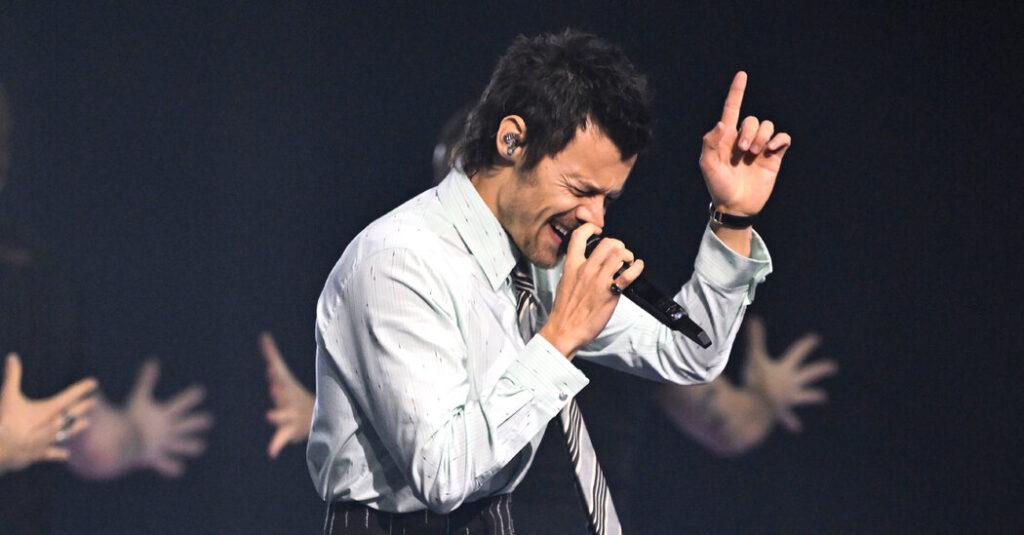
As the youngest member of One Direction — the world-conquering, now-defunct British boy band that he joined at 16 — Harry Styles, now 31, has been famous for nearly half of his life. But Styles’s initial fame sprang less from any particular aesthetic or innovation than from the fact that he always looked and carried himself like a superstar: His androgynous good looks, impish charm and too-good-to-be-true surname made his eventual solo career feel like an inevitability even before anyone knew what his music might sound like.
Styles’s identity as a solo artist did not arrive fully formed, but has been something that he discovered, experimented with and constantly refined while already in the public eye. Following his career has sometimes felt like watching a time-lapse video of the once-empty shelves of someone’s record collection gradually begin to fill in. Used copies of ’70s rock LPs were added around the time of his 2017 self-titled debut. Breezy ’80s pop and forlorn singer-songwriter folk inspired its superior follow-up, “Fine Line.”
As a discerning man of taste must in his late 20s, Styles acquired some more obscure and sophisticated records when he was making his Grammy-winning third album, “Harry’s House,” its title a nod to the Japanese musician Haruomi Hosono’s 1973 solo debut, “Hosono House.” Buoyed by the bouncy smash “As It Was,” “Harry’s House” catapulted Styles farther into the stratosphere, earning him a banner in Madison Square Garden’s rafters for selling out 15 consecutive shows (he’ll return later this year for 30 more performances) and a Grammy for album of the year. Such success also earned Styles an extended hiatus from the spotlight, which he spent, in part, relaxing in Rome and reveling in the dance clubs of Berlin.
“Kiss All the Time. Disco, Occasionally.,” his intermittently delightful if sometimes obtuse fourth album, suggests that he also added some LCD Soundsystem and Radiohead LPs to his shelves in the time off. You can hear it in the nervy, bass-forward electro-pop of “Are You Listening Yet?” (“You keep forgetting your mantra,” Styles chides himself, in the middle of a half-rapped tough-love speech into the mirror), and in the glitchy pulse of its lead single “Aperture,” a muted but ultimately cathartic invitation to embrace whatever “lets the light in.” The slick “Dance No More,” a pleasantly hammy slab of lite-funk that sounds like a Bruno Mars 7-inch released on DFA Records, seeks a place “where there’s no difference in between the tears and the sweat.”
Perhaps unsurprisingly for an album inspired by dancing past dawn at Berghain, the lyrics on “Kiss All the Time” sometimes resemble the seemingly life-altering epiphanies one has during a psychedelic trip, only to be revealed as airy truisms in the cold, sober light of day: “We belong together,” Styles sings at the ecstatic climax of “Aperture,” as an accompanying gospel choir underlines this sentiment as though it’s the meaning of life. “It finally appears, it’s only love.” Who can argue with that?
Even as it lurches in the direction of ecstatic release, though, a gentle melancholy wafts throughout “Kiss All the Time.” Ballads like the lush, orchestra-assisted “Coming Up Roses” or the less successful, acoustic guitar-driven “Paint by Numbers” consider relationships that didn’t work out. The midtempo, synth-squiggled “The Waiting Game” identifies a pattern of romantic self-sabotage: “You found someone to put your arms around, playing the waiting game / But it all adds up to nothing.” Even one of the album’s loveliest moments, the dreamy second single “American Girls,” has an undercurrent of loneliness: “My friends are in love with American girls,” Styles sings of his happily married pals, admiring their contentment from a distance.
On a sonically cohesive album that indulges in nostalgia for the early aughts, “American Girls” is the most 2026-sounding track, and a rare moment when Styles seems like he’s in conversation with his contemporaries. (Do you generally appreciate the 1975’s music but wish its impertinent frontman, Matty Healy, would stop offending? Have I got a song for you.)
With its hazy romanticism and drifting pop-rock piano chords, “American Girls” imagines a more mature take on the 20-year-old pop-rock phenomenon Sombr, perhaps the most direct Styles inheritor to emerge during his recent absence. (There’s also Benson Boone, the back-flipping showman who seems to have raided Styles’s closet, if not his record collection.) To paraphrase one of Styles’s inspirations, the LCD Soundsystem frontman James Murphy, might Styles be worried about losing his edge to the kids coming up from behind? This finely crafted pop song suggests not quite yet.
“American Girls” is simple, direct and legible in its lyricism. That is not always the case on “Kiss All the Time.” “It’s like you’re taking up arms, but the message is wet,” Styles intones on “Are You Listening Yet?,” a mixed metaphor that unfortunately describes some of the album’s writing. Styles can conjure vivid images, but they feel oddly untethered from the songs they find themselves in. Who are the “kids with water guns” who randomly appear in “Paint by Numbers”? Why is there “a baby sleeping upon a candy bar”? (That’s a metaphor for the awe Styles witnessed when the subject of his tepid closer, “Carla’s Song,” heard “Bridge Over Troubled Water” for the first time.)
On the whole, Styles’s attempts at introspection amount to a murky self-portrait that obscures as much as it reveals. “Season 2 Weight Loss” is a striking title with an adventurous arrangement by Styles’s longtime producer Kid Harpoon that makes the most of his wall of modular synths, but it ultimately promises something deeper and more incisive than it delivers.
The surface, though, is usually where Styles’s music sparkles, and there’s plenty of gleam throughout this LP. The chirping, densely layered synth-pop of “Taste Back” is a sonic sugar rush, while the irresistible “Ready, Steady, Go!” makes the most of its gummy bass line and exuberant chorus. With its winking, onomatopoeic title, “Pop” is a heady kaleidoscope of suggestive phrases and sounds that aren’t very interested in making sense — this song just wants to pop. Maybe those straining too hard to find the substance in Styles’s music should keep in mind the joys of his surname.
Harry Styles “Kiss All the Time. Disco, Occasionally.” (Columbia)
Lindsay Zoladz is a pop music critic for The Times and writes the music newsletter The Amplifier.
The post Harry Styles Dances Himself Clean appeared first on New York Times.