Fuel prices could soar, and stay elevated for months. That could make groceries and other shipped goods more expensive. And consumers and businesses, stung by the rising costs, could choose to spend less, constraining economic growth.
In the eyes of economists, that is the increasingly real and dire picture from the U.S.-led war with Iran, now in its second week. It may be a conflict of President Trump’s making, but it is becoming the world’s latest economic headache, one that has sent foreign leaders scrambling for ways to contain the possible fallout.
At the heart of the panic is a surge in the price of oil, which at one point rose above $100 per barrel on Monday. Because energy is central to the functioning of the global economy, the turbulence has sparked fears about a prolonged conflict that could inflict some of its steepest financial costs on Americans.
World leaders convened an emergency meeting of the Group of 7 countries, where finance ministers considered, yet decided against, tapping their national stores of oil to increase available supply. The gathering came as Mr. Trump continued to assert that the war he started with Iran would be short, rendering it unnecessary for the U.S. government to mount a major economic response.
Mr. Trump has dismissed even the suggestion that the U.S. economy might be harmed by his strikes on Iran and resulting disruptions to global shipping. He has also described the surge in gasoline prices as a “very small price to pay” for national security, despite the fact that he has long viewed the gas pump as a gauge of the nation’s trajectory.
The impact seemed anything but small for Americans. The average price of a gallon of gasoline reached nearly $3.48 nationally on Monday, according to AAA, a 16 percent increase from a week earlier. The surge in energy costs spooked financial markets, leading the S&P 500 and other major stock indexes to drop.
In many ways, the fallout has been similar to the global panic that greeted the start of Mr. Trump’s trade war nearly a year ago. Then, too, economists warned about looming upheaval, while world leaders panicked over the consequences for their economies. Some of the dire predictions came to pass, jilting consumers and businesses in ways still being felt today.
Yet Mr. Trump remained undeterred. With Iran, Mr. Trump he has once again forged ahead in spite of warnings that a long military engagement could inflict lasting damage, perhaps even touching off a global recession.
“This is a very concerning shock to consumers, which have been a driving force in the economy,” said Tim Mahedy, chief economist at Access/Macro, a research firm, who formerly worked at the Federal Reserve Bank of San Francisco.
He noted that consumer spending, which drives roughly 70 percent of U.S. economic growth, was the only sector that expanded throughout most of last year. Now, with Americans having run through their savings, Mr. Mahedy said the energy shock is “really hitting at a bad time.”
“I am very concerned this could tip us into a recession if it persists,” he said.
Exactly how the war will ripple across the global economy may mostly depend on one factor — its duration. That’s because the conflict has obstructed shipping in the Persian Gulf, which has snarled most of the world’s oil and gas. The longer the slowdown, the worse the toll will be, though the administration has signaled it believes shipments could restart soon.
“We’re not too long, I think, before you will see more regular resumption of ship traffic through the Strait of Hormuz,” said Chris Wright, the energy secretary, in an interview Sunday on CNN’s “State of the Union.”
If U.S. strikes on Iran conclude in a few weeks, most economists believe that the rise in gas prices and other disruptions may prove short-lived. But that doesn’t mean that the war will be painless, especially for Americans who are already suffering a real pinch at the pump.
“If $100-per-barrel oil is sustained, you’re going to see the impact most directly in less consumer spending,” said Bernard Yaros, the lead U.S. economist at Oxford Economics. He added that low-income consumers would shoulder the heaviest burden because energy accounts for so much of their monthly spending.
If hostilities continue for many months, however, the damage to the global economy could be more pronounced. Oil could stay above $100 per gallon in a worst-case scenario, carrying severe repercussions that would make goods more expensive and slow global growth, said Gregory Daco, the chief economist at EY-Parthenon.
A protracted conflict could cause inflation globally to rise about two percentage points faster than it would have otherwise, he estimated. In the United States, that means inflation could top 4 percent this year. The surge in prices would coincide with a slowdown that could tip off a recession and depress total U.S. output. The nation’s gross domestic product, a measure of that output, would grow by only 1.6 percent in 2026, compared to the 2.4 percent originally projected, Mr. Daco found.
These new risks have surfaced at a vexing moment for the U.S. economy, which is still growing at a moment when prices are high and the labor market is showing new signs of weakness. The competing forces are the result of factors including the meteoric rise of artificial intelligence and Mr. Trump’s policies, including his steep tariffs and mass deportations.
“This administration is a sequence of supply shocks,” said Mr. Mahedy. “This is coming on top of two other very significant supply shocks, tariffs and immigration policy.”
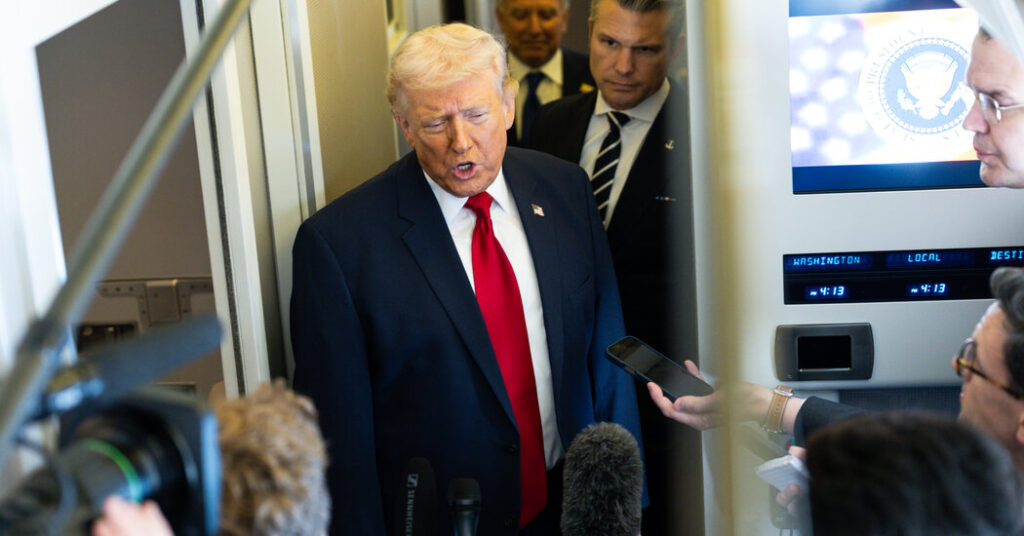
Despite those warnings, the Trump administration has remained bullish about the pace of the war with Iran. Asked this weekend if he was concerned about the rise in gas prices, Mr. Trump told reporters: “No. This is a short excursion into something that should’ve been done for 47 years. No president had the guts to do it.”
But Mr. Trump has also not ruled out sending troops into the country, which would mark a dramatic escalation in the fighting. With an ever-shifting definition for what might render the operation a success, the president has taken some steps to insulate Americans from economic fallout.
Last week, the U.S. government said it would offer limited protection and insurance for tankers crossing the Persian Gulf. The Treasury Department began taking steps that could allow for sanctioned Russian oil to be sold to other countries, including India.
Lifting those sanctions, which were strengthened recently in response to Russia’s invasion of Ukraine, marked a dramatic turnabout for Mr. Trump, who had previously threatened withering tariffs against countries that purchased Russian energy. It was also an effort to bolster the oil supply, even as the president’s top aides insisted that they would not tap U.S. reserves to ease strains on the market.
“From my early briefings about what was going to happen, and how it was going to affect the economy, it’s going way faster, it’s been way more successful, than I expected just listening to the briefings,” said Kevin Hassett, the director of the White House National Economic Council, during an appearance on CNBC last week.
“I think that, the bottom line is, there’s some disruption right now,” he said, “but at the White House we’ve got our eyes on the horizon.”
Tony Romm is a reporter covering economic policy and the Trump administration for The Times, based in Washington.
The post Trump’s War Becomes World’s Latest Economic Hazard appeared first on New York Times.