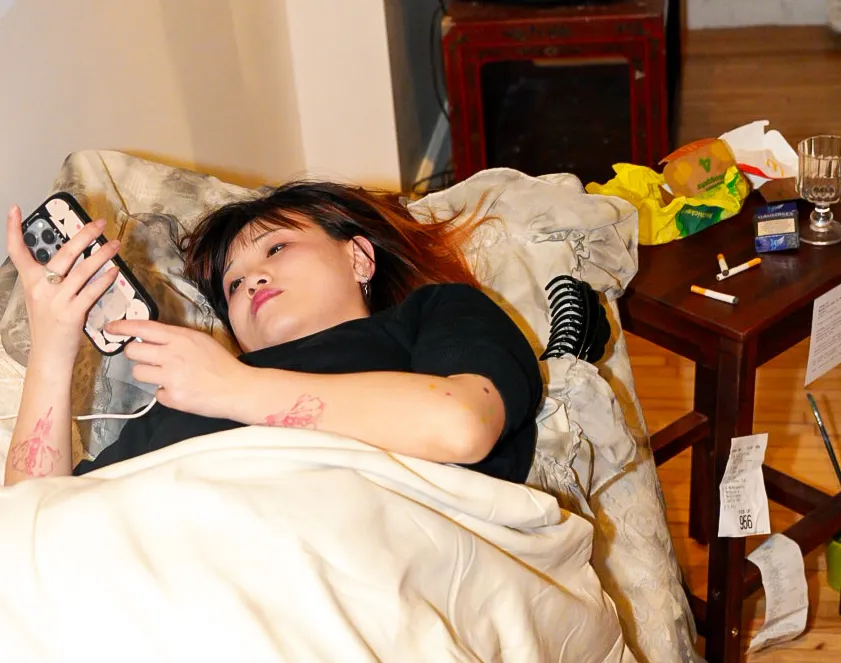
A week ago last Friday, in a liminally lit speakeasy gallery off Fifth Avenue, I stood among a crowd of dazed art kids to watch a woman lie in bed, doomscrolling on her phone. Her expression was blank, fixed on her screen, as if aloof to her own spectacle. She, the artist Alison Long, was performing “bed rotting,” a viral term describing the act of staying on one’s mattress for extended, indeterminate periods of time.
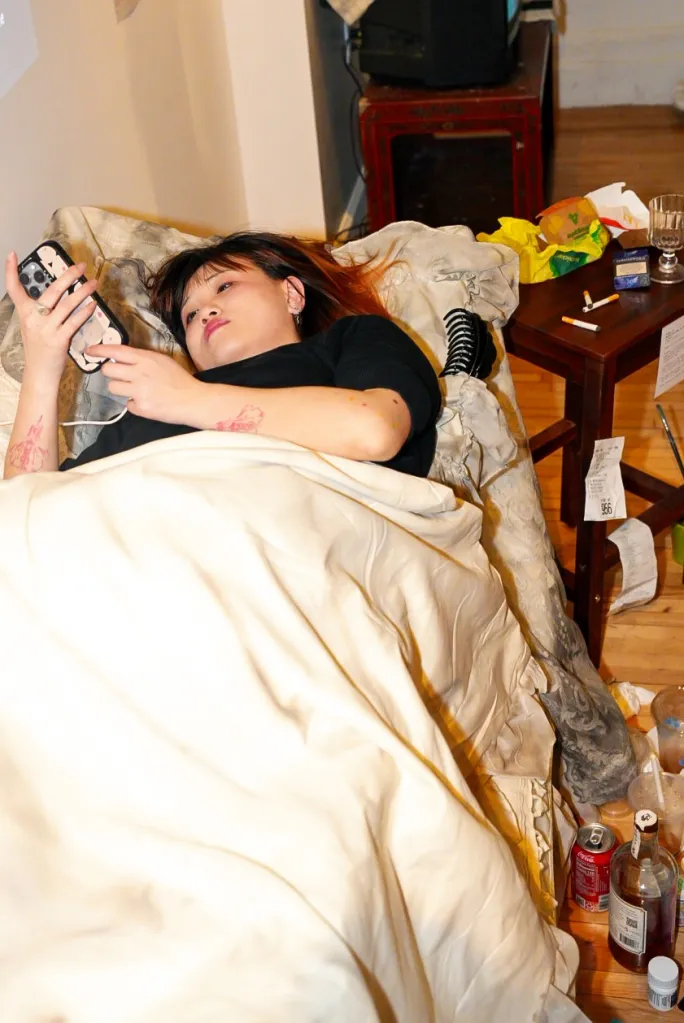
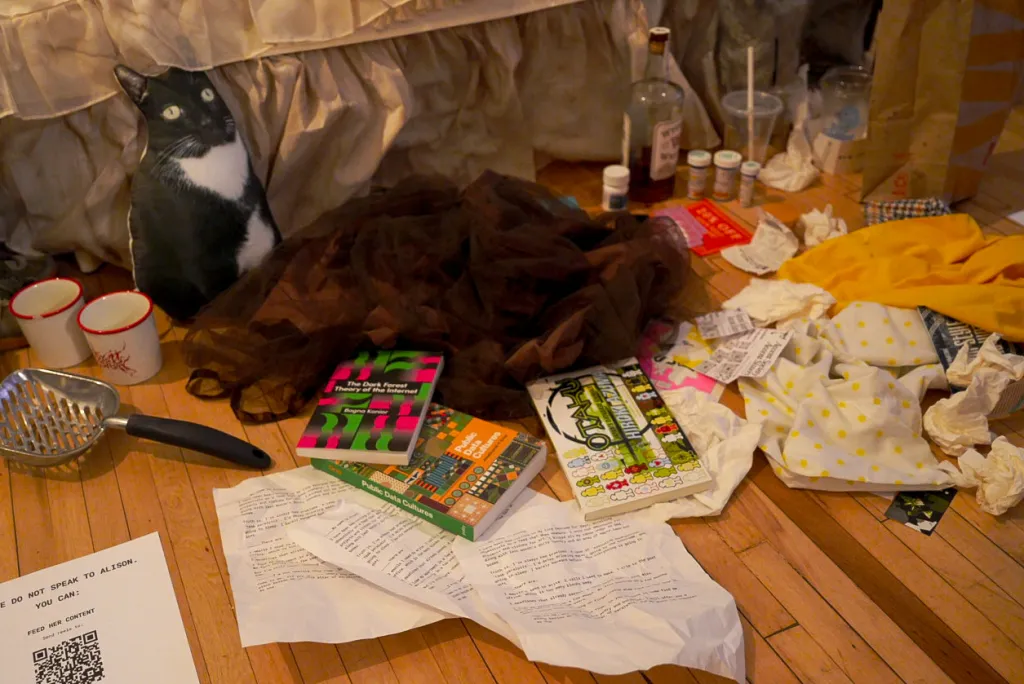
Before her on the floor was a mess of textbooks, expired to-do lists, scattered pages, crumpled napkins, paper bags, pill bottles, a liquor handle, and even a stuffed cat—all makeshift refuse of rot. For the next week, her workplace, Accent Sisters, a queer and feminist Chinese bookstore in Chelsea, was to serve as her “crusty dysfunctional bedroom,” and all were welcome to join her “at the altar of paralysis,” to “rot together as one.” The audience could honor Long’s exhibition of exhaustion by DMing her Instagram reels and ordering her takeout food; small offerings to bless her effort. While I wasn’t planning on buying her McDonald’s, I was interested in joining her congregation and communing with her.
“Hey Alison,” I messaged. “I’m Nick. I’d like to speak with you about your performance.”
“hiiii,” she replied, and then sent me an image of a cat. “Talk to Ahzel, uWu.”
Ahzel, her co-curator, was a cheerful, bespectacled man. After I introduced myself, he impressed upon me the thesis of the show: that currently, the dimensions of our world—the analog and the digital—are colliding and collapsing. It’s all becoming one surface, especially since quarantine, and the AI explosion is increasing and accelerating our exposure to cultural and political content in a way that’s causing a backlash against “big data.” Bed rotting, he surmises, is a representation of our new reshaped interfacing in this changing paradigm.
Invested, I then questioned him on their choice of example; did he think they might, in any way, be glamorizing paralysis? Valorizing social or mental decay? In Ottessa Moshfegh’s acclaimed My Year of Rest and Relaxation, the unnamed narrator aims to recover from tragic events by sleeping the year away. She consumes a massive cocktail of both real and invented prescription drugs, and effectively engages in a form of proto-bed rotting, albeit one much more isolating, given the story takes place in a pre-social media world. At times, the book has been accused of aestheticizing mental illness, and highly subject to misinterpretations that fetishize female depression as a trendy accessory. Did he think their project was any possibility of the same? “I think it’s just reflective of the world right now,” he shrugged, and then directed me to look at the other installations, additional relics left by other artists.
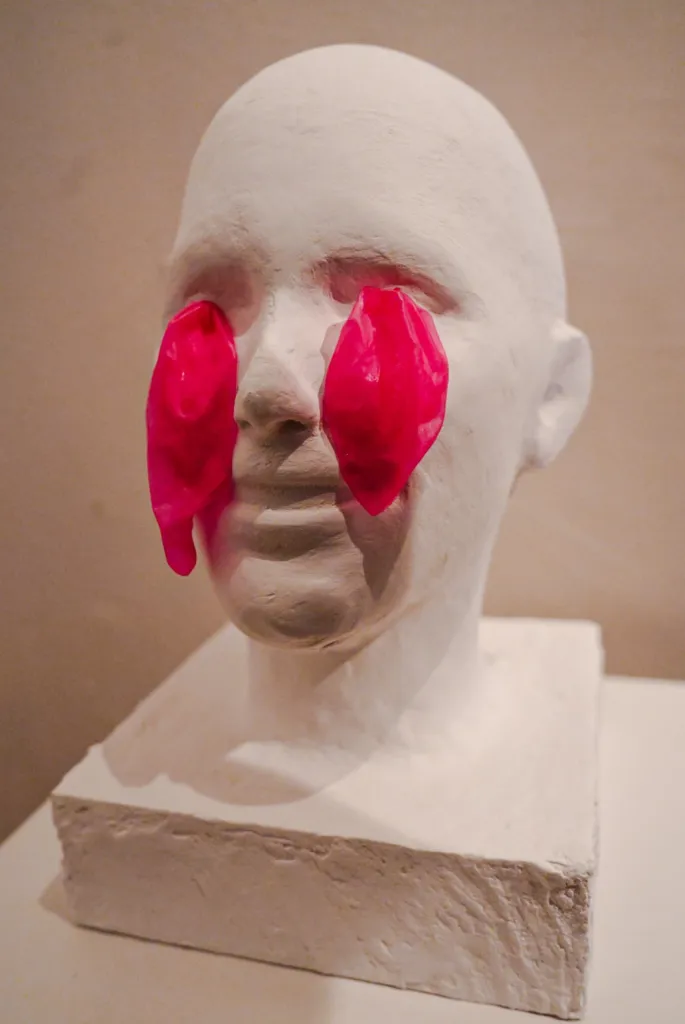
Adorning the walls around Long’s bed were a series of allegedly rot-adjacent pieces. Most notably a visceral red watercolor of two naked women, a sculpture of a white head crying pink blood, an old TV stuck in static, and a newspaper polemic about maintenance. I found the last the most intriguing. “Maintenance is rot, and rot is an unaffordable form of maintenance,” its label read. I wasn’t sure what to make of the credo, remembering how Proust, recently dubbed a “booksmaxxing jester” by the streamer Clavicular, wrote much of In Search of Lost Time recumbent in bed. Maintenance seemed affordable enough for him, I thought.
On one of the papers near the bed was an admission from Alison documenting the various crises of her life and her inability to confront them. She despairs that she’s losing her apartment in a few weeks, that her visa’s expiring in a few months, and that she’s turning 30 in a few years, yet remains immobile, chewing on her fingernails wide-eyed in the dark. After reading it, I felt a pang of dread, and re-engaged with her, our conversation flashing onto the wall from the projector for spectators to watch.
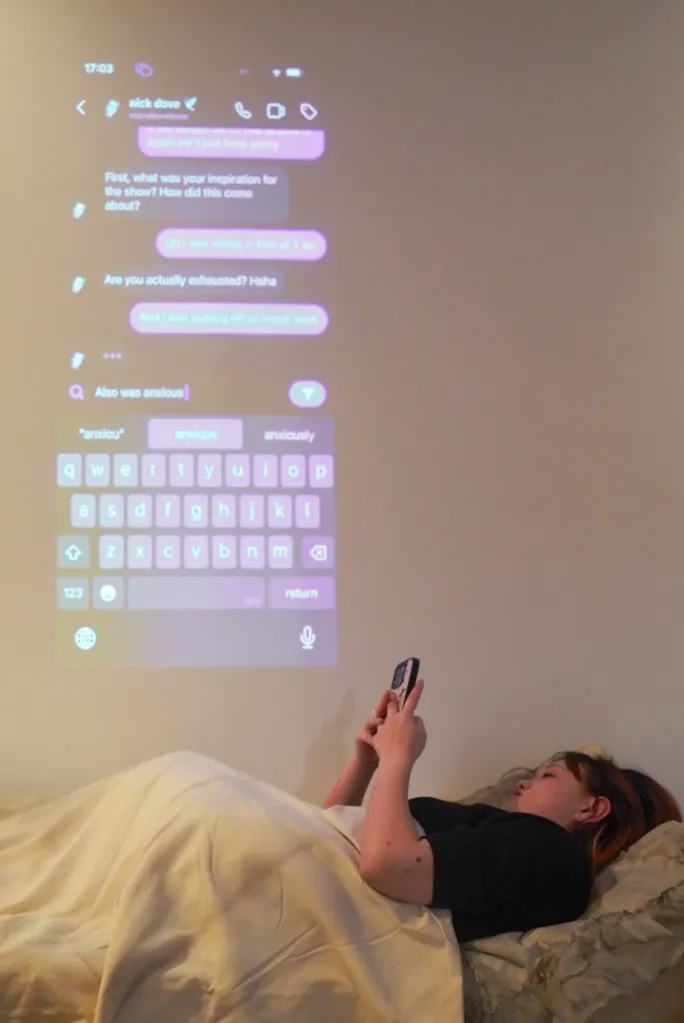
DOVE: What was your inspiration for the show? How did this come about? Are you actually exhausted?
LONG: Oh, I was sitting in bed at 3AM, and I was putting off so much work. I also was anxious about submitting to open calls, and not doing enough as an artist, but scrolling on Reels nonetheless.
Relatable. Did you have any knowledge about the history of similar performances? Like Tilda Swinton’s week-long sleeping in a glass box at the MoMA, or John Lennon and Yoko Ono’s anti-Vietnam war “bed-ins?”
I’ve heard about both performances, but didn’t really look at them as references.
Do you see bed rotting more as self-care or self-harm?
Just second nature. I fall into a bed rotting cycle a few times a month. I don’t really choose to do it, sadly. And I do feel really guilty looking at the trash and unkept room and to-do list.
Is the messy bedroom meant to convey something beyond the bed rotting?
It’s the essence of what my actual bedroom looks like sometimes. As a very dysfunctional person.
Why do you consider yourself dysfunctional?
I think mostly just comparing myself to some common standards. Such as doing my laundry regularly. Or, you know, replying to emails on an acceptable timeline. In college, I consistently turned in essays two weeks after their deadlines.
So do you think most people follow those standards? Because I see the appeal of your show as resting in how relatable your behavior is.
Indeed. I think everyone can relate on some level. My friend said [my behavior] actually helped her with stress.
Interesting. So your struggles were therapeutic for her. How does that make you feel?
I was on a journey of self-acceptance at that time, so it was mostly okay. But there was also a bit of “I want to convince her to let loose” so I’m not alone in my failure. A part of this anxiety to perform comes from comparing yourself to others, of course. In Chinese netizen language we have this word [for it] called 内卷, “neijuan,” [to curl inward, translated to “involution”].
Do you think there’s a different attitude towards bed rotting in China, versus the U.S.?
I think China’s homogeneous structure makes it very easy to compare things. But in China, we’re not that worried about appearing to be perfect on the mental health front.
Interesting.
Achievements.
Achievements, but not appearances?
Hmm, yes. In my experience, Americans value putting up a perfect home life as a virtue [more].
How do you think the concept of bed rotting differs between men and women?
I’ve had pressure [not to] do this, because it’s especially bad for girls to be disgusting and lazy. But because of nerd culture and otaku culture, it’s not an opinion I see often among [people my age]. But my mother is also a bed rotter so I don’t give myself the pressure.
So is mine. Though she’d kill me for saying it.
Very beautifully feminine?
At least stereotypically. Do you think the bedroom is female-coded? Because I’ve realized I never hear about men bed rotting. Their laziness is always relegated outside to the couch. “Couch potatoes.”
I think people tend to contribute things close to everyday life, and intimate things, to the women’s sphere. Or maybe it’s because you have to sit up to play video games. For naps and books you can stay horizontal.
One last question: How do you characterize this performance? More hopeful, or nihilistic?
It’s a snapshot of how I go about my life. I let myself break down. We’re thinking about stocking this book, Donna Haraway’s Staying with Trouble, [at Ancient Sisters]. About the environment and the Anthropocene, et cetera.
Have you read Ottessa Moshfegh’s My Year of Rest and Relaxation?
I’ve been recommended that by many people.
Great, I’ll let you rot for now.
Thank you.
I didn’t stick around after our interview. The place was starting to fill up, making it hard to move about, and I’d had enough stasis for the night. Seeing I was leaving, Tori, a friend of mine who’d also attended the show, accompanied me and offered her thoughts on it.
“It’s curious,” she said. “She avoided all of her responsibilities, even to the point of risking deportation, to put together a week in which she is expressly ‘allowed’ to bed rot. That doesn’t sound like executive dysfunction to me. It’s more like artistic misdirection.”
“So,” I laughed. “You think it was ‘performative’ performance art?”
“Maybe!”
I considered her point, wondering if Alison was exaggerating her disempowerment, but determined I’d no way of knowing. One’s demands or desires are not always accomplished in logical order. The ability to pursue them can seem like a game of whack-a-mole, arriving by circumstance and accomplished by chance. I’ve found evidence for that in my own life.
We then walked to Kazuza, a hookah lounge in the East Village, to meet other friends, and smoked and drank until the early dawn, enjoying that the DJ was spinning Y2K oldies. When I awoke in my apartment the next day, I was hungover, and felt like my body was decomposing.
Knowing a cure, I decided to bed rot (lie on the couch) until I felt better. It took longer than I’d care to admit.
The post An Artist Spent a Whole Week ‘Bed Rotting’ in a Public NYC Gallery appeared first on VICE.