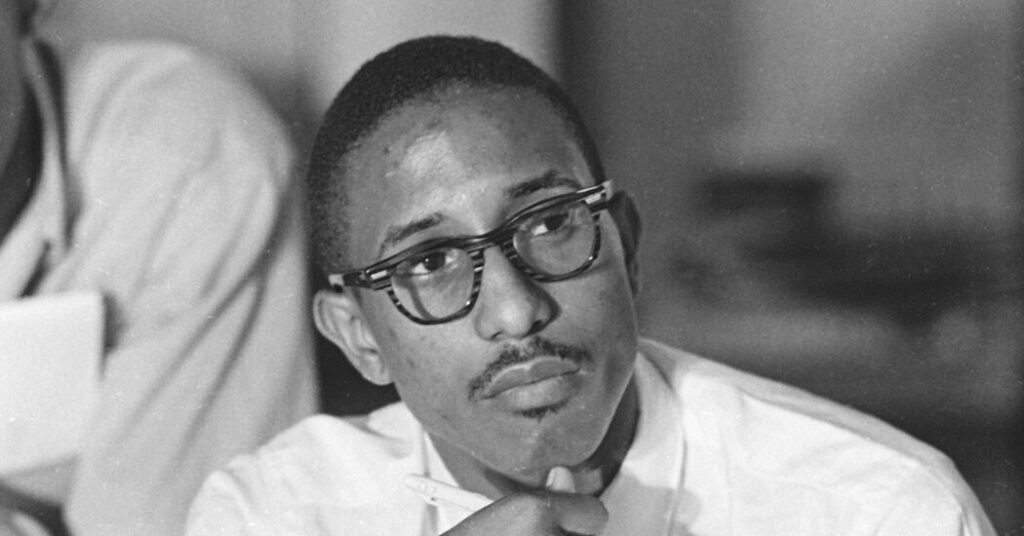
Bernard Lafayette Jr., a central figure in the civil rights movement of the 1960s who helped desegregate Nashville lunch counters; was imprisoned in Mississippi as part of the Freedom Rides; led early planning for the Selma-to-Montgomery march for voting rights in 1965; and coordinated the 1968 Poor People’s Campaign for the Rev. Dr. Martin Luther King Jr., died on Thursday at his home in Tuskegee, Ala. He was 85.
His son Bernard Lafayette III said the cause was a heart attack.
Dr. Lafayette played a key role in many of the events that defined the civil rights movement. Soft-spoken and bespectacled, he was known for his meticulous organizing skills and his commitment to nonviolence.
He was a 19-year-old seminary student in Nashville when, early in 1960, he and his roommate John Lewis joined Diane Nash, James Bevel and others to start a sit-in campaign that led to the desegregation of the city’s downtown commercial district.
In April of that year, Mr. Lafayette and other members of what came to be known as the Nashville Student Movement traveled to Shaw University, a historically Black institution in Raleigh, N.C. There, they joined activists from across the South in forming the Student Nonviolent Coordinating Committee, which quickly became one of the leading civil rights organizations of the era.
They returned to Nashville to focus on desegregation efforts, but Dr. Lafayette soon found himself pulled further south.
In 1961, a group of Freedom Riders — who were challenging the lack of enforcement of a Supreme Court ruling that deemed segregated interstate travel illegal — was assaulted by white mobs in Anniston and Birmingham, Ala., forcing the riders to cancel their mission, which intended to reach New Orleans.
Members of the Nashville movement decided to travel to Alabama to continue the trip. When they arrived in Montgomery, the state capital, they were immediately attacked by another white mob.
“We didn’t run; we didn’t fight back,” Dr. Lafayette wrote in his memoir, “In Peace and Freedom: My Journey in Selma” (2013), written with Kathryn Lee Johnson. “We got back up when slammed to the ground, and looked our attackers directly in the eyes, fighting violence with nonviolence.”
The riders traveled on to Jackson, Miss., where Dr. Lafayette was arrested. He joined more than 300 civil rights activists in the notorious Mississippi State Penitentiary, better known as Parchman Farm, where he was held for over a month.
Undaunted, Dr. Lafayette decided to commit himself to the movement full time and left college. (He later returned and finished, and went on to receive a doctorate.)
In 1962, he became the director of the Student Nonviolent Coordinating Committee’s Alabama Voter Registration Project. In early 1963, he and his wife, Colia Liddell Lafayette, who was also a prominent civil rights advocate, moved to Selma — a city that even other committee members felt was too dangerous for organizers.
The Lafayettes’ organizing, based in homes and church basements, laid the groundwork for the 1965 march from Selma to Montgomery, a 54-mile procession that helped pressure Congress to pass the Voting Rights Act.
By then, Dr. Lafayette had been arrested 10 times in four Southern states. He had been beaten by white civilians and the police, and faced constant threats to his life.
On the night of June 12, 1963, a gun-wielding white assailant attacked him outside his home in Selma. (It was the same night that Medgar Evers, another civil rights activist, was shot and killed outside his home in Jackson.)
Dr. Lafayette was saved by a neighbor who came to his aid with a rifle. A standoff ensued and Dr. Lafayette, drawing on his nonviolence training, talked both men into lowering their guns. The next morning, he went to work in his bloodied shirt to show everyone, Black and white, that he was unafraid.
He worked with fellow organizers in Selma as they planned the huge march to Montgomery in support of federal protection of voting rights. At the same time, he and Mrs. Lafayette were hired by the nonprofit American Friends Service Committee to organize working-class Black residents in Chicago.
The Lafayettes were still up north on March 7, 1965, when Dr. Lafayette’s friend Mr. Lewis made his first attempt to lead the Selma-Montgomery march, only to be assaulted by the police in what became known as Bloody Sunday.
The Lafayettes quickly rallied a busload of activists and headed to Alabama, arriving in time to join the next attempt to complete the march, which succeeded.
Dr. Lafayette returned to Chicago, where he became a key figure in Dr. King’s Northern campaign to organize Black residents around issues like public health, tenants’ rights and job discrimination.
He became a close lieutenant to Dr. King, who in 1967 tasked Dr. Lafayette with organizing the Poor People’s Campaign. The following year, the campaign brought thousands of poor people of all races to Washington for a weekslong encampment on the National Mall.
Dr. Lafayette was with Dr. King in Memphis during the garbage-worker strike that began in February 1968. On the morning of April 4, he visited Dr. King at the Lorraine Motel to review a news release; Dr. King was murdered at the motel that evening.
Bernard Lafayette Jr. was born on July 29, 1940, in Tampa, Fla., where his father worked in a cigar factory and his mother, Verdell (Foster) Lafayette, managed the home.
Although he attended an integrated public elementary school, he also witnessed the raw violence of Jim Crow racism early on.
When he was 7, he and his maternal grandmother, Rozelia Forrester, known as Ma Foster, tried to board a trolley in downtown Tampa.
The trolleys were segregated, and Black people had to pay at the front, then get off and re-enter through a back door. After they had paid the fare and as they were reboarding, the trolley driver pulled away, and his grandmother was thrown to the ground.
After Dr. King’s assassination, Dr. Lafayette returned to Nashville to complete his undergraduate studies at American Baptist Theological Seminary. After receiving his degree and becoming an ordained minister in 1969, he received a master’s and doctorate in education, both from Harvard.
Dr. Lafayette’s first marriage ended in divorce. He married Kate Bulls in 1969. She survives him, along with his son from his first marriage; seven grandchildren; six great-grandchildren; his sisters Rozelia Kennedy, Brenda Austin, Geraldine Coverson and Victoria Davis; and his brother, Michael Lafayette. Another son, James, predeceased him.
After receiving his doctorate, Dr. Lafayette spent much of his career in education, including serving as president of his seminary, which had become the American Baptist College, from 1993 to 1999.
He continued to lecture and run seminars on nonviolence, using the skills he had learned alongside Dr. King.
“The last thing he said to me is that we needed to figure out a way to institutionalize and internationalize nonviolence,” Dr. Lafayette told The Gannett News Service in 2013. “I had to figure out how I was going to fulfill Martin Luther King’s last request.”
Clay Risen is a Times reporter on the Obituaries desk.
The post Bernard Lafayette Jr., 85, Dies; Civil Rights Leader Helped Plan Selma March appeared first on New York Times.