Melanskia is not your typical Amish woman. She boasts more than 300,000 followers on Instagram and warns them about the perils of store-bought foods. She touts the benefits of removing “industrial waste” from the liver with a drink mix her followers can buy on Amazon.
With her modest white hair-covering and wire-rim spectacles, Melanskia is earnest, charming and quite convincing. She is also not real.
She is one of a handful of synthetic influencers created with artificial intelligence who are promoting an untested dietary supplement, called Modern Antidote, which sells for just under $50 a jar. There is no disclosure on her account that everything about her is A.I.-generated.
Behind Melanskia is a genuine human being, Josemaria Silvestrini, who is part of a growing vanguard of entrepreneurs taking advantage of rapid advances in A.I. to promote their brands using people who don’t actually exist.
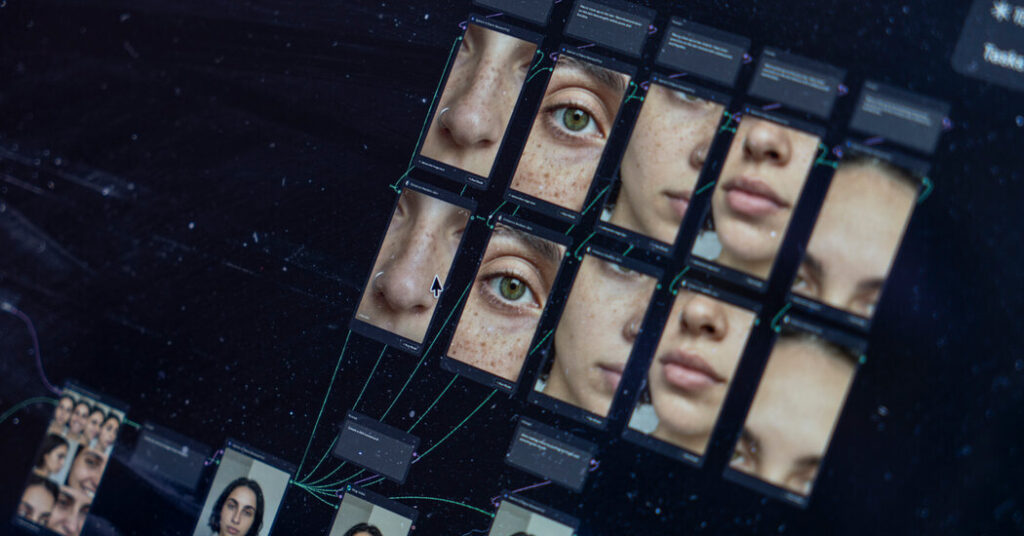
It is, in many respects, a marketer’s dream. Now, virtually anyone can produce highly realistic videos featuring ersatz personalities carefully calibrated to appeal to any target audience — and do it for a fraction of the cost of a flesh-and-blood pitchman.
“A.I. is a game changer,” said Mr. Silvestrini, 28, who is running the company from Shanghai while he completes a master’s program. “Every piece of the business is being A.I.-ified.”
But the technological leap is also raising alarm about consumers being duped by deepfakes. A February study in the British Journal of Psychology found that people overestimated their ability to recognize A.I.-generated faces, leaving them vulnerable to “fraud and deception.” That risk is intensifying as the technology improves.
While A.I. once had obvious giveaways, like hands with extra fingers, the newest videos look confoundingly authentic — and often, viewers are not told otherwise. In videos, Melanskia visits what appears to be a fully stocked Costco store, milks cows and bakes bread. Her wrinkles look realistic; shadows fall where they should.
“I thought Amish weren’t allowed to use electricity,” one confused Instagram user commented.
Timothy Caulfield, research director at the Health Law Institute at the University of Alberta, said that the use of A.I. has grown in the wellness space, a crowded but lucrative market where consumers rely on perceptions of authenticity and identity to make buying decisions. One Instagram account with 125,000 followers, run by a self-described “hustler” in Miami, features an A.I.-generated Buddhist monk with an English accent who says he lives in Tibet promoting fiber supplements and soursop bitters. That content, too, is not labeled as being A.I.-generated.
With A.I., Mr. Caulfield said, brands can experiment inexpensively with a huge variety of avatars until one works.
“It’s so tremendously efficient,” he said. “You can curate an image that perfectly fits the vibe you’re trying to produce.”
Multiple states have passed laws requiring disclosure of A.I. content, including one in California that requires A.I. companies to watermark it and another that demands social media companies detect and label it. In December, Gov. Kathy Hochul of New York signed the nation’s first legislation explicitly requiring the disclosure of “synthetic performers” in advertisements.
Unlike other legislation, that law places a burden on the creators of deepfake content, not just social media and A.I. companies. But it doesn’t take effect until June, and it’s not yet clear whether a December executive order from President Trump proposing a regulatory framework for the technology would pre-empt it and other state-level regulations.
Mr. Silvestrini said he was “aware” of the New York regulation and was working with his legal team to ensure his brand would be compliant with the law when it goes into effect.
At a time when people are increasingly uneasy about the technology’s ubiquity, Mr. Silvestrini has proved unusually open about his use of synthetic avatars.
Another brand, Rosabella, has used a wide array of A.I. avatars on TikTok to promote its moringa supplement. Some of the videos were tagged by the platform as A.I.-generated. But other videos probably generated by A.I., like one featuring an older woman promoting moringa’s “age reversing secrets,” are not labeled, nor are posts in Spanish featuring naturopaths and nutritionists who have different faces but share the same voice lauding the benefits of moringa for gut health.
Last month, the Food and Drug Administration and Centers for Disease Control and Prevention issued recall notices for Rosabella’s moringa powder capsules after a drug-resistant salmonella outbreak that led to multiple hospitalizations was linked to the product. Ambrosia Brands, the parent company of Rosabella, did not respond to requests for comment.
“Early adopters of A.I. have realized that there really is a lot of money to be made in different ways,” said Cameron Wilson, who runs The Diigitals, one of a handful of modeling agencies representing only virtual talent. “The problem is that most of them seem to be deceptive ways.”
For Mr. Silvestrini, the appeal of A.I. avatars was the opportunity to inject new ideas into marketing his brand. Rather than make the videos himself, he relies on more than three dozen independent creators to coax people to buy his product using what appear to be personal accounts.
In exchange for a retainer, commissions on sales and the chance to win incentive bonuses for view and sales goals, the creators are given relatively free rein to dream up their own ideas for selling the powder.
In addition to Melanskia, other synthetic avatars selling the supplement include a few, almost identical-looking muscular middle-aged men who post similar videos to Instagram and Facebook, and accounts on TikTok, Facebook and Instagram featuring a wholesome farmer with a bushy white beard who goes by the moniker Farmer Honest.
Still, Mr. Silvestrini said that the account promoting his supplement with the highest conversion rate, or number of sales per view, features an actual human being: a bearded former bodybuilder in Canada.
A chemistry major at Williams College, Mr. Silvestrini said he developed a recipe centered around sulforaphane, an antioxidant found in broccoli and kale, and hired a lab in California to help manufacture it at scale.
Mr. Silvestrini used A.I. to design the supplement’s logo, packaging and website, saving him tens of thousands of dollars and months of development time compared with his first entrepreneurial endeavor, a wellness drink.
As soon as he can afford to, he said, he plans to conduct a clinical study of his product to see if it has any effect on microplastics in the body, as he claims. “I want to put my money where my mouth is,” he said.
In reviews on Amazon, some Modern Antidote customers said the supplement helped them feel better, with one claiming it gave them a “clearer mind.” But others raised concerns about the way it was marketed; one labeled it an “AI SCAM” and another worried that the Farmer Honest account was fear-mongering to generate sales.
“We take it seriously and are always thinking about how to evolve as norms develop around this,” Mr. Silvestrini said of consumers who react negatively to A.I. avatars.
So far, Mr. Silvestrini has sold about 1,000 jars of his powder, he said, and he thinks consumers will eventually stop worrying about A.I.
“Peoples’ unease about it will, I think, fade more and more away,” he said. “Very soon it’s going to just become so commonplace that it’s just more content.”
Ken Bensinger covers media and politics for The Times.
The post An Amish Avatar and an A.I. Monk Are Pitching Supplements on Social Media appeared first on New York Times.