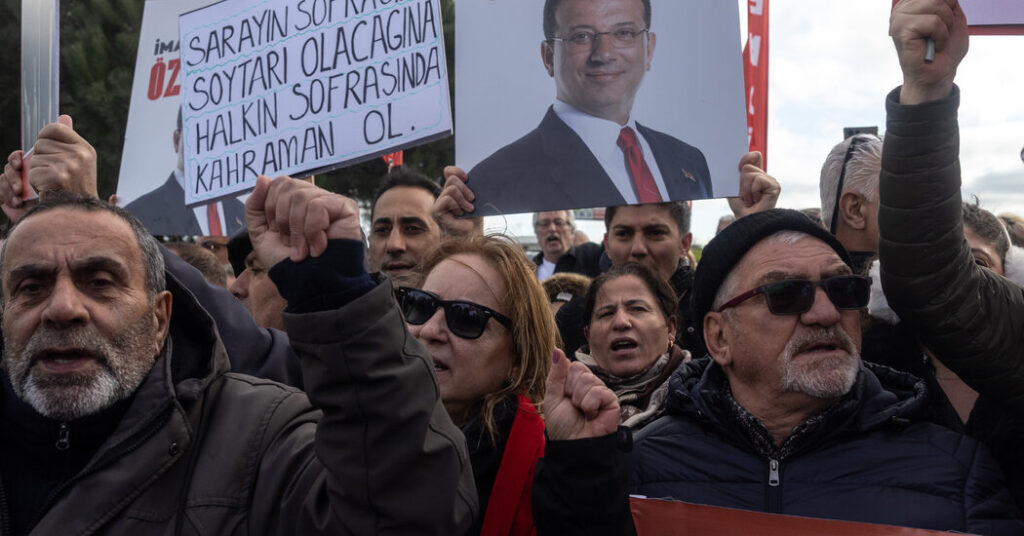
The top political rival of President Recep Tayyip Erdogan of Turkey clashed with the head judge of a mass trial for him and hundreds of other defendants on corruption charges, just minutes after the first hearing began on Monday.
“Judge, I want to speak,” the politician, Ekrem Imamoglu, the former mayor of Istanbul, told the three-judge panel hearing the case.
The head judge threatened to remove him from the court if he kept speaking out of turn, and Mr. Imamoglu criticized the trial before returning to his seat in the dock.
The outcome of the trial could have wide-ranging effects on Turkey’s political scene, potentially eliminating the opposition’s best hope of defeating Mr. Erdogan in Turkey’s next presidential election before the race even begins.
Prosecutors have accused Mr. Imamoglu of leading a vast criminal operation inside Istanbul’s city hall in order to enrich himself and fund his political ambitions.
Mr. Imamoglu has denied all wrongdoing, and rights groups, experts on Turkey and his supporters have called the trial politically motivated to block him from challenging Mr. Erdogan.
The government insists that the courts are independent of political pressure.
Mr. Imamoglu, 54, won an upset victory against a candidate backed by Mr. Erdogan to become mayor of Istanbul, Turkey’s economic capital, in 2019. He won a new term in 2024 and made clear his intention to challenge Mr. Erdogan, Turkey’s predominant politician for more than two decades, for the presidency.
Last March, just days before Turkey’s main opposition party designated him its presidential candidate, he was arrested at his home as part of a broad investigation into suspected corruption in his municipal administration.
In the trial, which opened in a large courtroom in the town of Silivri, west of Istanbul, he and 401 co-defendants face charges that include corruption, bribery, bid-rigging and extortion.
The trial opened in a large courtroom packed with defense lawyers, opposition party members, journalists and relatives of the defendants, some of whom are still detained.
Supporters clapped, cheered and waved as the defendants were led into the dock. Applause filled the hall when Mr. Imamoglu entered, wearing a suit and tie, and turned to wave.
In written responses to questions sent by The New York Times before the trial began, Mr. Imamoglu wrote from jail that he did not expect a fair trial.
“I am not being judged fairly in front of an independent and unbiased judiciary,” he wrote.
His lawyers would address the legal accusations, he wrote, but he would speak during his testimony to the people of Turkey.
“I will defend the will of the nation, democracy, the republic and the future of the country,” he wrote.
Mr. Imamoglu addressed the judges on Monday after the head judge announced that he would be among the last defendant to testify because he was accused of being the leader of the suspected criminal conspiracy.
As Mr. Imamoglu spoke, the head judge told the clerks to mute Mr. Imamoglu’s microphone. Mr. Imamoglu continued to speak for several minutes before returning to his seat among his co-defendants.
The hearing proceeded and a defense lawyer complained to the judges that a list of defendants and the order in which they were to testify had not been shared with the defense but claimed they had been leaked to a pro-government newspaper.
Supporters of the defendants yelled for the judge to respond. He did not but called a recess so order could be restored.
The hearing resumed later, with defense lawyers criticizing the proceedings as unlawful and the judges as biased. The judges said little.
The trial poses dilemmas for Mr. Erdogan’s opponents, who must decide how much to engage with the government’s accusations and how much to cast doubt on the legal process itself.
Seated in the audience, Ozgur Ozel, the head of Mr. Imamoglu’s party, the Republican People’s Party, accused the prosecutor of acting on orders from Mr. Erdogan and said he did not expect the judges to handle the case fairly.
“The whole world should know that this is a formality,” he said. “They have already made their verdict,” he added.
Turkey’s next presidential election is scheduled for 2028, when Mr. Erdogan’s term ends and a constitutional term limit would prevent him from running again. But if he can amend the Constitution or if Parliament calls an early election, he could run again. Most experts expect that he will.
Seated in the courtroom, Songul Karaoglu covered her mouth and wept when her husband, Mustafa Karaoglu, entered to take his place in the dock.
Mr. Karaoglu, a media relations official in the Istanbul municipality, stands accused of bid-rigging and has been detained for 294 days, Ms. Karaoglu said.
“This is all so heavy on us,” she said. “I have never been apart from my husband, even for a day.”
Ben Hubbard is the Istanbul bureau chief, covering Turkey and the surrounding region.
The post Trial of Erdogan’s Top Rival Begins in Turkey appeared first on New York Times.